Gold prices consolidated around $4,150 ahead of the US non-farm payroll data release, awaiting a directional move.
2026-10-02 10:06:17
On Friday during Asian trading hours, spot gold rose and then fell back, trading around $4,150 per ounce , after hitting a high of $4,180 during the day. The immediate catalyst for this rebound was the decline in US Treasury yields: the 10-year US Treasury yield, a global benchmark for borrowing costs and asset pricing, fell back to around 5.24% after hitting a multi-year high of 5.34% during the session ; the 30-year US Treasury yield also retreated from its 24-year high . The easing of long-term interest rates provided a respite for gold, a previously pressured non-interest-bearing asset.  Market analysts point out that the safe-haven logic supporting gold prices remains intact: the geopolitical uncertainty stemming from the stalled US-Iran ceasefire negotiations continues to provide safe-haven buying for gold ; however, high oil prices remain a sword of Damocles hanging over inflation. If rising energy costs further increase price pressures, it will strengthen the Federal Reserve's rationale for maintaining tightening, thus suppressing gold prices again. With these mixed factors, the upside potential for gold prices may be constrained in the short term by the dual constraints of interest rates and inflation expectations. On the data front, the market is awaiting the US September jobs report to be released Friday evening. Economists expect non-farm payrolls to increase by approximately 90,000 in September, a significant drop from the robust 162,000 in August; the unemployment rate is expected to remain unchanged at 4.1% . Previously released ADP private sector employment data showed an increase of 90,000 in September, exceeding expectations and providing forward-looking evidence of the resilience of the labor market, but also increasing uncertainty regarding the actual non-farm payroll reading. For gold, the direction of employment data is crucial—as one precious metals trading director stated, any factor that could increase the probability of a Fed rate hike will dampen sentiment in the gold market ; a significant rise in energy prices or an escalation of tensions in the Middle East would have a similar effect. The pricing of interest rate paths is also changing rapidly. According to the CME FedWatch Tool, the market is betting on a 24.9% probability of a 25 basis point rate hike in October , and a combined probability of a 25 or 50 basis point hike by December, totaling 79.4% . Previously, the slowdown in US core PCE inflation in August had significantly reduced bets on an October rate hike, but the continued high yields and persistent inflation concerns mean that the expectation of "high interest rates lasting longer" has not truly disappeared, and the cost pressure of holding gold remains. Institutional reviews of previous market movements also confirm this logic. According to analysts, spot gold surged to $4,219 per ounce in the previous trading session before falling 0.6% to $4,157 , with high real yields continuing to suppress gold prices. On the macro level, the US August PCE price index rose 0.3% month-on-month, in line with expectations, while the year-on-year growth rate fell from 3.7% to 3.4% . Although revisions to statistical methods improved the data's appearance, they did not substantially change the underlying direction of inflation. In other words, the true extent of cooling inflation still needs more data to confirm. From a global perspective, gold is currently in a "race between safe-haven demand and tightening expectations": buying driven by geopolitical risks and selling pressure from rising yields and a strong dollar continue to tug at the price, resulting in wide fluctuations rather than a one-sided trend. For the global market, gold price movements have also become an important barometer for observing inflation expectations and real interest rates. Market sentiment remains cautious overall, with investors focusing on three key areas: tonight's US September non-farm payroll data and wage performance, whether US Treasury yields can maintain their downward trend, and whether new variables emerge in the US-Iran situation —these three factors will collectively determine the direction of gold prices around $4180. From a technical perspective, on the daily chart, gold prices are still trading below the 100-day moving average and the 20-day Bollinger Band , indicating that the short-term bearish bias has not yet reversed. Prices are trading close to the lower half of the Bollinger Bands, and the 14-day RSI is in the neutral-to-weak zone at 40.83 , reflecting insufficient market momentum; any attempt at a rebound is still constrained by the cluster of moving averages above. On the resistance side, the 100-day moving average at $4285 is the first resistance level, followed by the 20-day Bollinger Band at $4300 , with stronger resistance near the upper Bollinger Band at $4470 . On the support side, the lower Bollinger Band at $4130 is immediate support; a sustained break below this level would strengthen the bearish structure and open up further downside potential. From a 4-hour chart perspective, gold is currently in a technical rebound structure after a short-term oversold condition, with the price center gradually rising from the lows. However, the rebound momentum is still accumulating and has not yet been confirmed to accelerate. If gold prices can effectively stabilize in the current area and challenge the cluster of moving averages, there is a chance for a recovery towards the $4,300 level. Conversely, if the rebound is resisted near the 100-day moving average and indicators show signs of decline, it may retest the $4,130 support level. The watershed between a breakout and a pullback will depend on the market's repricing of interest rate paths after the non-farm payroll data is released—only if gold prices close above the dense moving averages on the daily chart can the current downward pressure be substantially alleviated.
 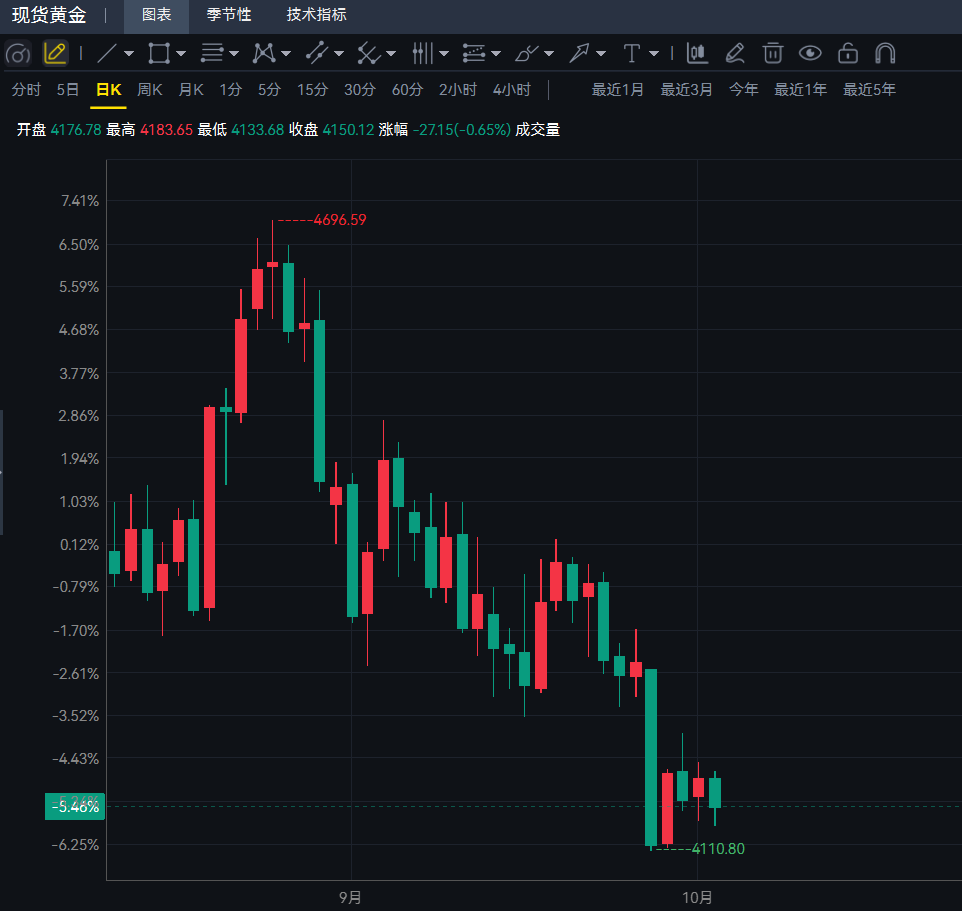 Editor's Summary : Overall, gold is currently in a tug-of-war between "falling yields providing short-term support and tightening expectations suppressing the central level": the pullback in US Treasury yields from multi-year highs has fueled this rebound, but oil-driven inflation risks and a 79.4% probability of a December rate hike limit the upside potential for gold. Looking ahead, tonight's non-farm payroll report is the most important watershed in the near term: if the employment data is significantly weaker, the probability of an October rate hike will be further reduced, and gold prices may break through the resistance of dense moving averages and recover towards $4300 or even higher; conversely, if employment remains resilient and yields rise again, gold prices will likely fall back to the $4130 area to seek support. On the risk side, the recurring geopolitical situation and the unexpected rise in oil prices are the main upward disturbances, while the high level of real yields is the core factor suppressing the rebound.
Market analysts point out that the safe-haven logic supporting gold prices remains intact: the geopolitical uncertainty stemming from the stalled US-Iran ceasefire negotiations continues to provide safe-haven buying for gold ; however, high oil prices remain a sword of Damocles hanging over inflation. If rising energy costs further increase price pressures, it will strengthen the Federal Reserve's rationale for maintaining tightening, thus suppressing gold prices again. With these mixed factors, the upside potential for gold prices may be constrained in the short term by the dual constraints of interest rates and inflation expectations. On the data front, the market is awaiting the US September jobs report to be released Friday evening. Economists expect non-farm payrolls to increase by approximately 90,000 in September, a significant drop from the robust 162,000 in August; the unemployment rate is expected to remain unchanged at 4.1% . Previously released ADP private sector employment data showed an increase of 90,000 in September, exceeding expectations and providing forward-looking evidence of the resilience of the labor market, but also increasing uncertainty regarding the actual non-farm payroll reading. For gold, the direction of employment data is crucial—as one precious metals trading director stated, any factor that could increase the probability of a Fed rate hike will dampen sentiment in the gold market ; a significant rise in energy prices or an escalation of tensions in the Middle East would have a similar effect. The pricing of interest rate paths is also changing rapidly. According to the CME FedWatch Tool, the market is betting on a 24.9% probability of a 25 basis point rate hike in October , and a combined probability of a 25 or 50 basis point hike by December, totaling 79.4% . Previously, the slowdown in US core PCE inflation in August had significantly reduced bets on an October rate hike, but the continued high yields and persistent inflation concerns mean that the expectation of "high interest rates lasting longer" has not truly disappeared, and the cost pressure of holding gold remains. Institutional reviews of previous market movements also confirm this logic. According to analysts, spot gold surged to $4,219 per ounce in the previous trading session before falling 0.6% to $4,157 , with high real yields continuing to suppress gold prices. On the macro level, the US August PCE price index rose 0.3% month-on-month, in line with expectations, while the year-on-year growth rate fell from 3.7% to 3.4% . Although revisions to statistical methods improved the data's appearance, they did not substantially change the underlying direction of inflation. In other words, the true extent of cooling inflation still needs more data to confirm. From a global perspective, gold is currently in a "race between safe-haven demand and tightening expectations": buying driven by geopolitical risks and selling pressure from rising yields and a strong dollar continue to tug at the price, resulting in wide fluctuations rather than a one-sided trend. For the global market, gold price movements have also become an important barometer for observing inflation expectations and real interest rates. Market sentiment remains cautious overall, with investors focusing on three key areas: tonight's US September non-farm payroll data and wage performance, whether US Treasury yields can maintain their downward trend, and whether new variables emerge in the US-Iran situation —these three factors will collectively determine the direction of gold prices around $4180. From a technical perspective, on the daily chart, gold prices are still trading below the 100-day moving average and the 20-day Bollinger Band , indicating that the short-term bearish bias has not yet reversed. Prices are trading close to the lower half of the Bollinger Bands, and the 14-day RSI is in the neutral-to-weak zone at 40.83 , reflecting insufficient market momentum; any attempt at a rebound is still constrained by the cluster of moving averages above. On the resistance side, the 100-day moving average at $4285 is the first resistance level, followed by the 20-day Bollinger Band at $4300 , with stronger resistance near the upper Bollinger Band at $4470 . On the support side, the lower Bollinger Band at $4130 is immediate support; a sustained break below this level would strengthen the bearish structure and open up further downside potential. From a 4-hour chart perspective, gold is currently in a technical rebound structure after a short-term oversold condition, with the price center gradually rising from the lows. However, the rebound momentum is still accumulating and has not yet been confirmed to accelerate. If gold prices can effectively stabilize in the current area and challenge the cluster of moving averages, there is a chance for a recovery towards the $4,300 level. Conversely, if the rebound is resisted near the 100-day moving average and indicators show signs of decline, it may retest the $4,130 support level. The watershed between a breakout and a pullback will depend on the market's repricing of interest rate paths after the non-farm payroll data is released—only if gold prices close above the dense moving averages on the daily chart can the current downward pressure be substantially alleviated. Editor's Summary : Overall, gold is currently in a tug-of-war between "falling yields providing short-term support and tightening expectations suppressing the central level": the pullback in US Treasury yields from multi-year highs has fueled this rebound, but oil-driven inflation risks and a 79.4% probability of a December rate hike limit the upside potential for gold. Looking ahead, tonight's non-farm payroll report is the most important watershed in the near term: if the employment data is significantly weaker, the probability of an October rate hike will be further reduced, and gold prices may break through the resistance of dense moving averages and recover towards $4300 or even higher; conversely, if employment remains resilient and yields rise again, gold prices will likely fall back to the $4130 area to seek support. On the risk side, the recurring geopolitical situation and the unexpected rise in oil prices are the main upward disturbances, while the high level of real yields is the core factor suppressing the rebound.- Risk Warning and Disclaimer
- The market involves risk, and trading may not be suitable for all investors. This article is for reference only and does not constitute personal investment advice, nor does it take into account certain users’ specific investment objectives, financial situation, or other needs. Any investment decisions made based on this information are at your own risk.