Oil prices fluctuated and declined amid the ongoing battle to retake the Bab el-Mandeb Strait and mixed supply optimism and concerns.
2026-10-05 17:12:18
On Monday (October 5), international oil prices rebounded after hitting a low during the Asian and European sessions. The Houthi rebels faced a strong counterattack from local government forces, and Kpler shipping data showed a significant recovery in oil flow through the Strait of Hormuz. However, the CEO of Saudi Aramco warned that a supply gap of 200 barrels per day would still exist. The previous trading day saw a sharp rebound after the UK Maritime Trade Organization (UKMTO) reported that an oil tanker was hit by an unidentified projectile while sailing outwards through the Strait of Hormuz. Meanwhile, Iranian Islamic Revolutionary Guard Corps General Naghdi stated that the economic encirclement imposed by the enemy would be ineffective and that if the opponent did not choose to back down, they would face a heavy blow from Iranian armed forces. The Strait of Hormuz handles a large volume of global crude oil exports. The tanker attack, coupled with Iran's tough rhetoric, instantly amplified market concerns about disruptions to Middle Eastern crude oil exports, directly driving the price rebound. However, after the price rebound, International Energy Agency Executive Director Birol stated that the agency would consult with member countries to finalize the allocation plan for oil reserves. Currently, IEA member countries have ample reserves, and can release additional reserves should market supply shortages occur, thereby offsetting oil supply disruptions caused by geopolitical events. It is worth noting that the IEA's statement regarding reserve releases came after oil prices surged due to geopolitical conflicts, serving to calm market panic. 
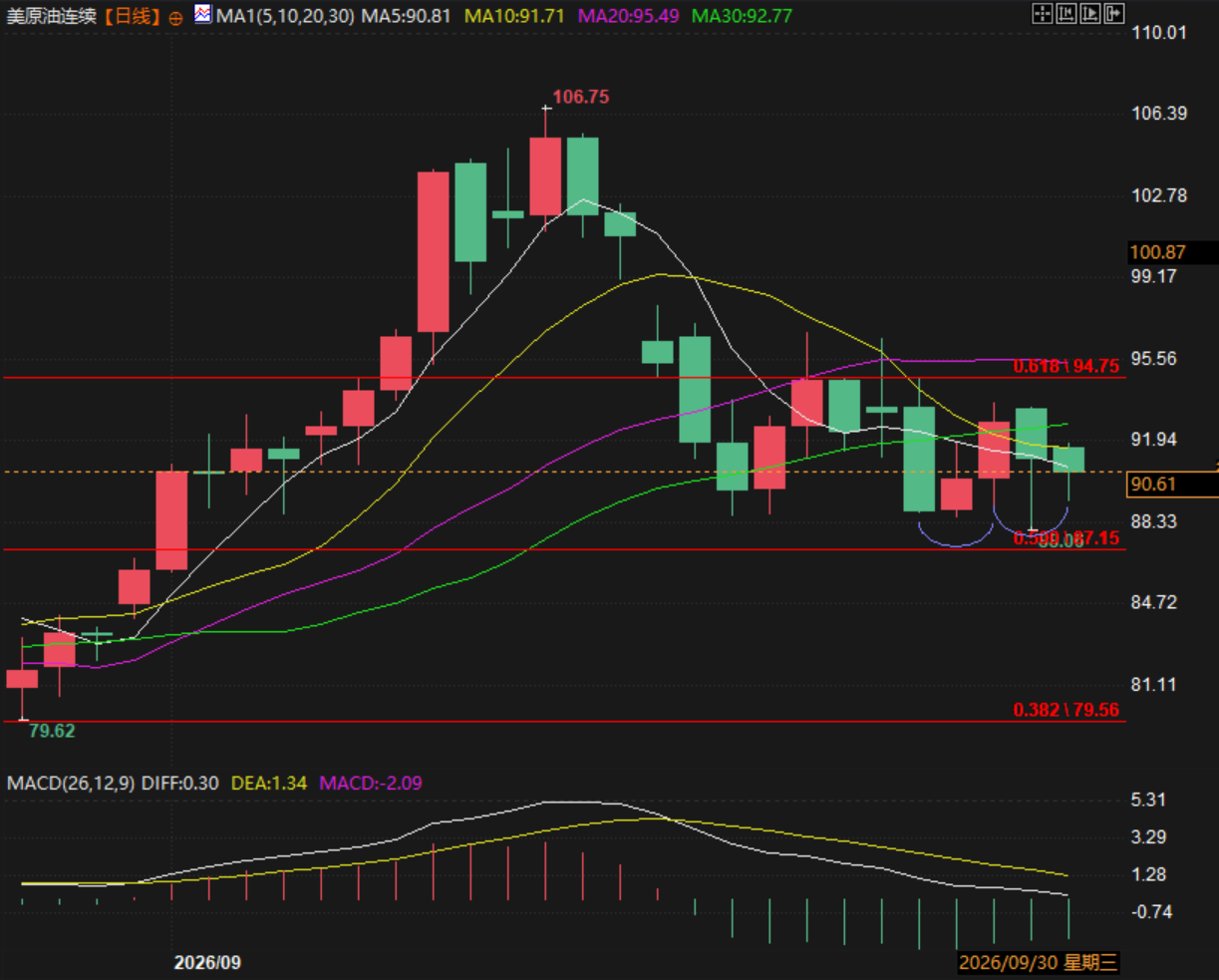 (WTI crude oil futures main contract daily chart, source: EasyTrade) At 16:57 Beijing time, WTI crude oil futures main contract was trading at $90.61 per barrel.
Kpler shipping data: Crude oil flow in the Straits is recovering; oil prices were under pressure in early trading but remained firm at high levels.
A report from shipping data analytics firm Kpler shows that crude oil outflows from the Strait of Hormuz have returned to pre-war levels. Influenced by this news, international crude oil prices declined in early trading, while Brent crude remained above $100. Both commodities actually rose compared to Friday's closing price, indicating that some traders are awaiting concrete evidence of improved shipping conditions. Kpler's preliminary data shows that daily crude oil traffic in the Strait of Hormuz ranged from 19.5 million to 22.5 million barrels between September 27th and 29th, approximately double that of a month ago. Despite ongoing attacks on Saudi energy infrastructure and tankers in the strait, crude oil transport has recovered. Previously, Kpler had disclosed that strait shipping traffic remained below the 10-day moving average, raising concerns about supply among energy market participants. Even with the tanker attacks, some market participants believed the actual impact on oil prices was limited. The data also shows that LNG flow in the Strait of Hormuz has returned to pre-war levels; Qatar Energy is currently still under force majeure for exports, and although it is purchasing LNG spot to fulfill long-term contracts, it will be difficult for the country to restore LNG exports to pre-war levels with only emergency purchases.The war in Yemen has escalated dramatically, with Houthi rebels capturing a key transportation hub.
Geopolitical risks in the Middle East continue to escalate, with the Yemeni civil war reigniting after a four-year ceasefire. The Iranian-backed Houthi rebels captured the town of Turba on Sunday. This town, strategically located on the main road connecting Taiz province's capital to the port of Aden, has long been a key stronghold for pro-Saudi government forces defending Taiz. Prior to this, the Houthis had already seized several villages surrounding Taiz, gradually completing the encirclement of Yemen's third-largest city. The Washington-based think tank, the Institute for War Studies, analyzes that the fall of Turba will severely limit the pro-government forces' ability to reinforce and supply the front lines, while also cutting off some government troop withdrawal routes, further shifting the initiative on the battlefield towards the Houthis.The Red Sea shipping choke point is exposed, impacting the global crude oil trade landscape.
The current conflict was sparked in July when the Houthis accused Saudi Arabia of airstrikes on Sana'a airport. They subsequently launched missile and drone attacks on Saudi Arabia and Yemeni government forces, and announced a blockade of Saudi shipping routes in the Red Sea, attacking several related vessels. In September, the Houthis launched a large-scale offensive along the Red Sea coast, capturing the strategic port of Muha and several Red Sea islands, and gaining control of the Bab el-Mandeb Strait on the Yemeni side. The Bab el-Mandeb Strait handles approximately 12% of global international trade and is a crucial maritime route for Middle Eastern crude oil exports to Europe. If the route is blocked, oil tankers must round the Cape of Good Hope in Africa, increasing transport time, insurance, and logistics costs, directly impacting crude oil spot and futures prices.Saudi Arabia and the Yemeni government have launched a strong counterattack, and the conflict is unlikely to de-escalate in the short term.
In response to the Houthi offensive, the internationally recognized Yemeni transitional government announced the launch of a large-scale military operation. Rashad Alimi, chairman of the Presidential Leadership Council, addressed the nation in a televised address, stating the goal was to retake Houthi-controlled territory and appealing for international assistance. Saudi military spokesman Major General Malki pledged full operational support to the Yemeni government forces until the Houthi threat was eliminated, while emphasizing Saudi Arabia's right to take all necessary measures to counter ongoing missile and drone attacks.Saudi Aramco warns of supply gap
In a statement, the CEO of Saudi Aramco stated that physical crude oil spot prices sometimes trade at a premium of $20-50 per barrel to the Brent benchmark, and the company relies heavily on ship-to-ship transshipment operations. He estimated that global demand would need at least 2 million barrels per day over the next 18 months to replenish current crude oil inventories. The company can guarantee supply agreements with customers in Asia and Europe, and will initiate asset repairs even if the fires at facilities are not fully extinguished; currently, it can meet all customer needs. Simultaneously, it is advancing the engineering design of its fourth and fifth export routes, studying new crude oil export channels, and establishing more overseas storage facilities to cope with short-term supply shocks. He emphasized that Saudi Aramco has never used its strategic petroleum reserves.The humanitarian costs are severe, and the oil market continues to closely monitor two major variables.
UN data shows that the new round of conflict has resulted in over 800 deaths, more than 3,600 injuries, and over 145,000 people displaced within Yemen, with over 3,000 fleeing across the sea to Djibouti. The fighting has severely damaged the local healthcare system, with many hospitals damaged. Currently, the crude oil trading market is focused on two key variables: first, whether the Strait of Hormuz and the Bab el-Mandeb Strait in the Red Sea can maintain normal navigation, with particular attention focused on the Yemeni government's actions regarding the Bab el-Mandeb Strait; disruption of this route would directly increase crude oil trade premiums; second, the pace of the IEA's strategic reserve release. Reserve releases can only provide short-term market reassurance and cannot eliminate long-term geopolitical uncertainties in the Middle East. Subsequent crude oil prices will continue to fluctuate based on the safety of Middle Eastern shipping lanes, the progress of the Yemeni conflict, and the implementation of the IEA reserve plan. Technically, the WTI crude oil futures main contract is still fluctuating around 95-87, with moving averages in a bearish alignment, indicating an overall downward bias. (WTI crude oil futures main contract daily chart, source: EasyTrade) At 16:57 Beijing time, WTI crude oil futures main contract was trading at $90.61 per barrel.
- Risk Warning and Disclaimer
- The market involves risk, and trading may not be suitable for all investors. This article is for reference only and does not constitute personal investment advice, nor does it take into account certain users’ specific investment objectives, financial situation, or other needs. Any investment decisions made based on this information are at your own risk.