













Australian consumer confidence index collapses: When will the cost of living nightmare end?
2026-10-06 08:54:17
In October 2026, Australia's consumer confidence index suffered another major blow. According to the latest consumer confidence report, the index plummeted 4.7% to 80.4 in October from 84.4 in September, one of the worst readings since the monthly survey began in the 1970s. Even more alarming was the precipitous drop within the survey week. Before the Reserve Bank of Australia (RBA) announced its interest rate hike, 60% of respondents had a confidence index of 86.9, a slight increase from September; however, after the announcement, the remaining 40% of respondents saw their confidence index plummet to 67.2—a figure only seen during the worst of the economic recession in the early 1990s. This nearly 20% drop before and after the rate hike marks the largest single-day decline since daily tracking began in 2019. 
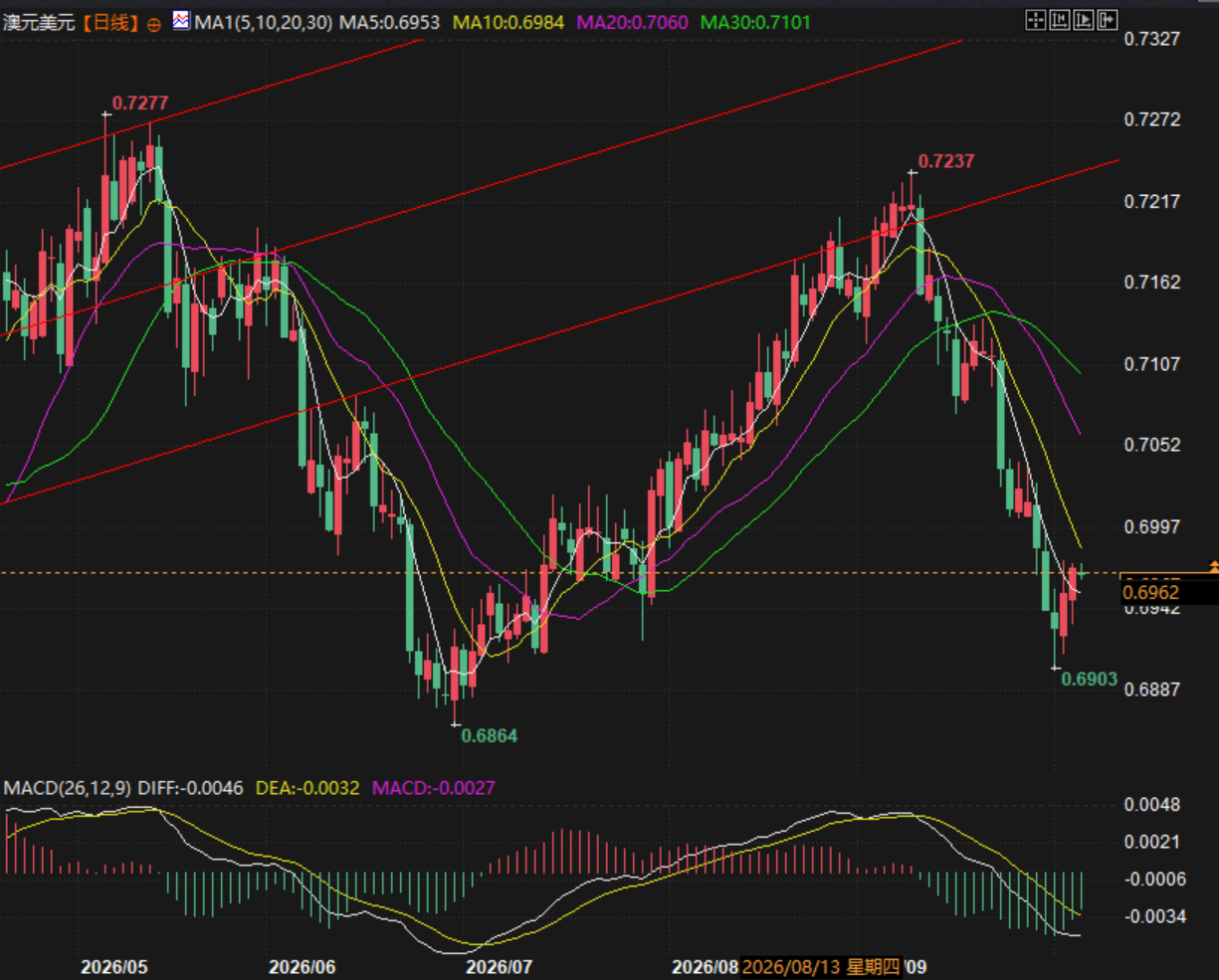 (AUD/USD daily chart, source: FX678) At 8:52 Beijing time, the AUD/USD is currently trading at 0.6967/68.
Triple pressures: oil prices, interest rates, and a housing market downturn.
The report states that Australian consumers are trapped in a "nightmare of living costs with no end in sight." The current consumer confidence index is among the worst 40 readings on record, and has already been reached three times in 2026 (April, June, and October), plus eight times between 2022 and 2023, marking the worst period of sustained low confidence in Australia since the catastrophic recession of the early 1990s. Oil prices are soaring: the national average petrol price has once again surpassed AU$2.30 (RMB 10.8) per liter, approaching the April peak and rising nearly 25% since the beginning of the year. Interest rates are climbing: the RBA's latest rate hike pushed the cash rate to 4.6%, the highest level since 2011. Standard variable mortgage rates are about to break 9%, the first time since the 2008 global financial crisis. The housing market is under pressure: the Consumer Financial Assessment Index plummeted 8% to 66.9, matching the extreme low of April. More than 80% of consumers expect mortgage rates to rise further in the coming year, and this figure is close to 90% among mortgage borrowers, with more than 40% expecting rates to rise sharply.Pessimism spreads across the board
The report shows that among the 106 consumer subgroups tracked, 102 groups had more pessimists than optimists, with nearly two-thirds of these groups having a pessimist rate more than 20% higher. All five sub-indices are in the pessimistic range, well below long-term averages: Household financial situation year-on-year assessment: down 8% to 66.9; Household financial expectations for the next 12 months: down 6.4% to 88.4; Economic expectations for the next 12 months: down 1.6% to 78.3; Economic expectations for the next 5 years: down 0.4% to 85.5, close to the low point during Melbourne's second lockdown in August 2020; Willingness to purchase big-ticket items: down 7.1% to 83, a full 40 points below the long-term average of 123. Australian Economic Outlook: Slowing growth, persistent inflationary pressures, and weakening economic growth momentum . The Australian economy is facing serious challenges. The RBA's consecutive interest rate hikes have pushed the cash rate to a 13-year high of 4.6%, while standard variable mortgage rates are about to break through 9%, which will continue to suppress household consumption. Consumer confidence remains at historically low levels, meaning that private consumption, which accounts for about 60% of GDP, will struggle to provide growth momentum. Australia's GDP growth is projected to slow further to around 1.5% from about 2% in 2025 to early 2027 in the second half of 2026. Inflationary pressures remain high . Oil prices have risen nearly 25% since the beginning of the year, and this cost is being passed on to a wider range of goods and services. The upside inflation risks previously warned by the RBA are becoming a reality. The report notes that unemployment concerns are particularly pronounced among consumers working in cyclical and fuel-cost-exposed sectors such as construction, hospitality, food service, and transportation. Core inflation is expected to remain above the RBA's target range of 2%-3% until the end of 2026, meaning the likelihood of a near-term interest rate cut is extremely low. The labor market is facing a turning point . The unemployment expectations index rose 1.9% to 142.1, above the long-term average of 129. While the current unemployment rate remains historically low, consumer concerns about the employment outlook are slowly rising. With increasing cost pressures on businesses and weakening consumer demand, the labor market may see a significant easing in early 2027, with the unemployment rate expected to gradually climb from the current 3.9% to around 4.5%. Housing Market and Mortgage Risks Over 80% of consumers expect mortgage rates to continue rising over the next year, with this figure approaching 90% among mortgage borrowers. The RBA's next monetary policy meeting will be held on November 2-3, and Westpac believes further rate hikes are likely. If interest rates continue to rise, Australian household debt burdens will increase further, raising mortgage default risks and potentially impacting the banking system and the housing market. The RBA faces a dilemma: on the one hand, inflationary pressures have not fully subsided, and on the other hand, economic momentum has clearly weakened. The RBA is expected to maintain a tight stance until the end of 2026, but if economic data deteriorates further, it may shift to a wait-and-see approach or even moderate easing in the first half of 2027. Regarding fiscal policy, the government may need to strike a balance between controlling spending and providing cost-of-living relief.Global Economic Outlook and Australian Dollar Exchange Rate Forecast
The US economy is expanding robustly with a potential growth rate of approximately 2%, while AI-related investments are growing at a rate exceeding 20% annually, becoming a core driver of structural growth. US real GDP growth is projected at 2.3% in 2026 and 2.2% in 2027. The European economy is benefiting from a simultaneous recovery in consumption, manufacturing, and trade activity, and its growth rate is expected to gradually converge with that of the US. Leading indicators such as Japan's manufacturing survey and machinery orders continue to improve. In emerging markets, global trade remains resilient, and investment in technology and manufacturing supply chains continues to grow, resulting in relatively robust economic performance. The main uncertainty lies in the most significant change in the current global market: the sharp rise in interest rates. Global 10-year and 30-year government bond yields have risen to levels unseen for many years or even decades, a result of rising oil prices, unsustainable fiscal policies, and expectations of AI-driven growth. This high-yield environment is expected to persist and is unlikely to reverse in the short term.Australian dollar under pressure: Narrowing interest rate differentials and weakening risk appetite
The Australian dollar is facing multiple downward pressures. Firstly, while the RBA's continued interest rate hikes provide short-term support, signals of collapsing consumer confidence and slowing economic momentum are weakening market confidence in Australian assets. Secondly, as a major commodity exporter, Australia's currency is highly sensitive to global risk appetite. The collapse in consumer confidence, reflecting weak domestic demand, coupled with the suppression of commodity demand in a high-interest-rate environment, will weaken Australia's terms of trade. If prices of major export commodities such as iron ore and coal decline, the Australian dollar will lose significant fundamental support. Furthermore, rising global risk aversion is also putting pressure on the Australian dollar. If Australian economic data continues to deteriorate, the market may interpret it as a leading indicator of a global economic slowdown, further suppressing risk appetite, driving funds to safe-haven assets such as the US dollar, and exacerbating the downward pressure on the Australian dollar. Overall, global economic growth is projected at 2.5% in 2026 and 2.6% in 2027. The collapse in Australian consumer confidence not only reflects the deep-seated difficulties of the domestic economy but also sends a warning signal to the world—when cost-of-living pressures reach a critical point, consumption-driven economies will face severe challenges. For the Australian dollar, the diminishing interest rate advantage, the downside risk to commodity prices, and the rising global risk aversion will put it under triple pressure, and the Australian dollar exchange rate may continue its weak and volatile pattern. (AUD/USD daily chart, source: FX678) At 8:52 Beijing time, the AUD/USD is currently trading at 0.6967/68.- Risk Warning and Disclaimer
- The market involves risk, and trading may not be suitable for all investors. This article is for reference only and does not constitute personal investment advice, nor does it take into account certain users’ specific investment objectives, financial situation, or other needs. Any investment decisions made based on this information are at your own risk.

