The 10-year US Treasury yield hit a 24-year high, putting downward pressure on gold prices. Strategists say the long-term value preservation logic of gold remains unshaken.
2026-10-06 09:38:17
On October 1st, the yield on 10-year US Treasury bonds climbed to 5.358%, a 24-year high. As cash and fixed-income products offer substantial returns, rising bond yields pose direct competition to gold. However, market strategists believe that persistent inflation continues to erode the purchasing power of fiat currencies, and the underlying logic for allocating to gold remains valid.
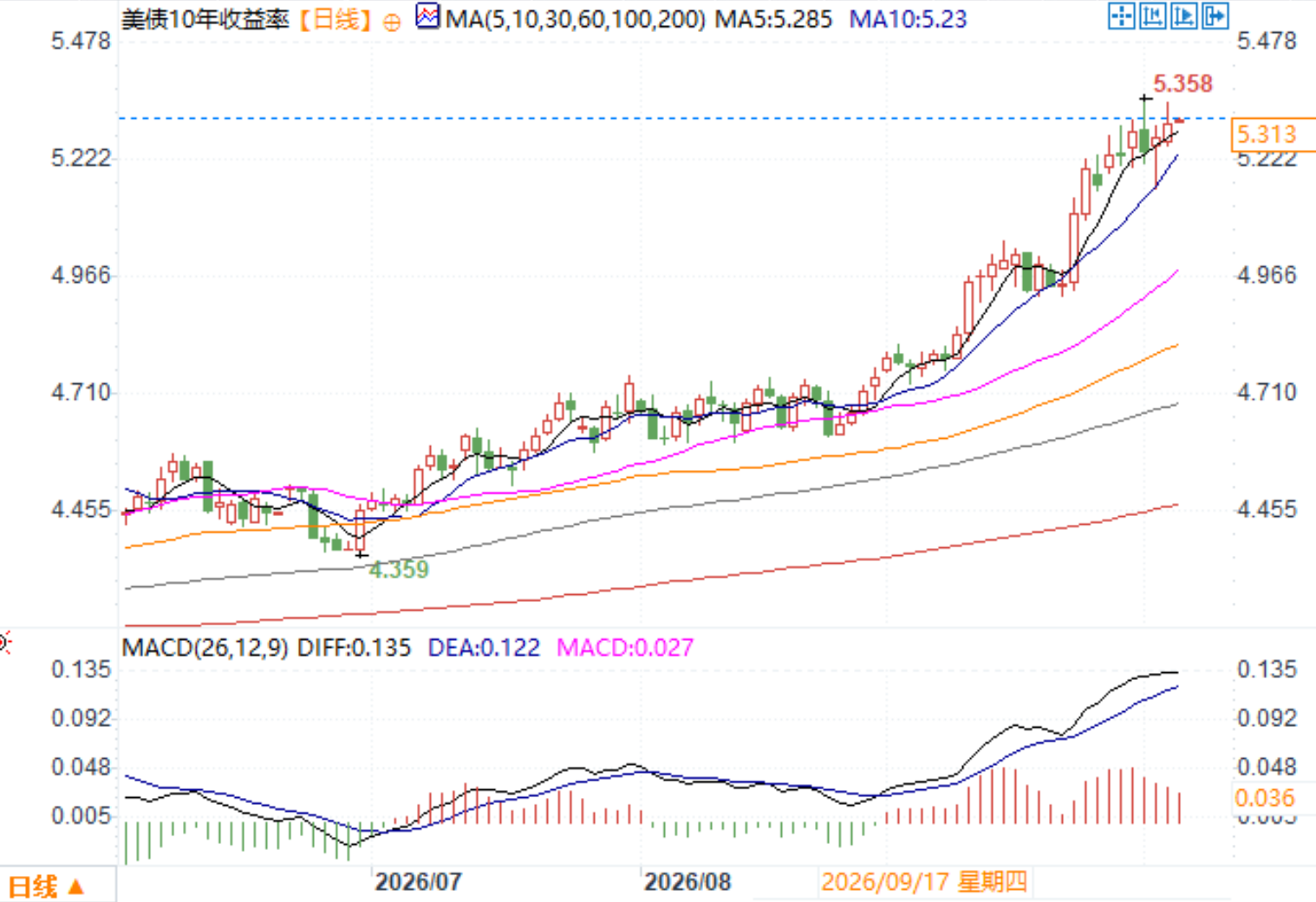 10-year US Treasury yield daily chart. Source: EasyTrade. At 9:34 AM Beijing time on October 6th, the 10-year US Treasury yield was 5.313%.
High-yield assets divert funds, putting short-term pressure on gold prices.
Michael Khouw, chief strategist at YieldMax, said that high interest rates will suppress gold in the short term, as investors can rely on their principal for stable returns, thus reducing gold's appeal. He said, "It's not surprising that gold prices are under pressure. When interest rates rise to a sufficient level, investors may not carefully calculate the real yield, but this will ultimately have a negative impact on physical assets." Khouw stated that investors don't need to precisely calculate returns after deducting inflation to appreciate the allure of high-yield assets. Money market accounts and other highly liquid products offer yields of around 5%, which is extremely attractive to investors with cash flow needs. He said, "Once interest rates have real value, they create a substitution effect, regardless of whether investors carefully calculate the returns."Inflation will persist in the long term, but gold's fundamental role as a store of value remains unchanged.
In his view, competition from fixed-income products will not erase the fundamental reasons why investors allocate gold. Investors buy precious metals because they understand that the purchasing power of fiat currencies will shrink in the long term, and inflation is equivalent to imposing an implicit tax on savings, thus creating market demand for physical assets that can preserve value. He said, "Investors buy gold because they understand that the US dollar and various fiat currencies are not stores of value, and their purchasing power will continue to be diluted. They vaguely perceive that their actual purchasing power is constantly being lost and hope to use physical assets to build a hedging tool." Hu also mentioned that the current rise in interest rates is actually correcting the market imbalance caused by the previous policy lag. Inflation had already shown persistence many years ago, but policymakers once characterized the price increase as a temporary phenomenon. The current price environment has undergone a structural change, and the inflation center will be higher than the market previously expected. He said, "Five years ago, there was sufficient evidence to prove that inflation was real, but four years ago, the authorities still insisted that inflation was only a temporary phenomenon. The new inflation environment is unlikely to fall below 2%, and will most likely remain above 3%. The market has begun to price in this reality, and gold prices have therefore fallen, but the underlying core issues have not changed."The root cause is fiscal issues; gold remains a high-quality diversified asset.
While high US Treasury yields reflect market concerns about inflation, Hu believes that behind the high Treasury rates lies a deeper fiscal problem. Monetary policy is more of a passive response to inflationary pressures; the root of the problem lies in government spending and fiscal policy. Only a significant improvement in the US fiscal situation will change the outlook for inflation and interest rates; without fiscal adjustments, inflationary pressures will be difficult to dissipate. He also pointed out that the recent gold price correction and return to normal volatility will lead long-term investors to refocus on the gold market. Gold has never been a highly volatile speculative asset; its stable price movement helps to ensure a steady flow of long-term funds back into the precious metals sector. YieldMax's investment portfolio continues to allocate to precious metals and mining stocks, using them as important asset diversification tools. He said, " Gold has been and will continue to be a high-quality, low-correlation asset for long-term value preservation; I see no signs of this attribute weakening. "Conclusion
In summary, the substitution effect of high US Treasury yields in the short term is suppressing gold prices, with funds flowing into high-yield fixed-income products. However, structural inflation and the ongoing US fiscal concerns continue to weaken the purchasing power of fiat currencies. The long-term value of gold in hedging against depreciation and diversifying portfolio risk remains fundamentally unchanged, and short-term adjustments may actually attract long-term investment. 10-year US Treasury yield daily chart. Source: EasyTrade. At 9:34 AM Beijing time on October 6th, the 10-year US Treasury yield was 5.313%.
- Risk Warning and Disclaimer
- The market involves risk, and trading may not be suitable for all investors. This article is for reference only and does not constitute personal investment advice, nor does it take into account certain users’ specific investment objectives, financial situation, or other needs. Any investment decisions made based on this information are at your own risk.