Gold rebounded after hitting a new low, but yields continue to dominate trading logic.
2026-10-06 19:56:18
Gold prices broke below last week's low in early trading on Tuesday (October 6), but the bears failed to capitalize on the breakout to extend the decline. Buying pressure immediately emerged. The current daily chart suggests gold may be forming a closing price reversal bottom pattern, but the overall trend remains downward. This round of gold's rebound was entirely driven by the bond market. Long-term US Treasury yields and the US dollar both retreated from Monday's highs, providing the only positive support for the bulls at present.  Spot gold was trading at $4,172.58, up $31.96, or 0.77%. A slight decline in yields triggered this rebound in gold . Monday was extremely unfavorable for gold bulls. After the market digested Friday's non-farm payroll report, bond bears regained momentum, pushing the 10-year US Treasury yield up to 5.349% and the 30-year yield to 5.703%, the highest level since 2002. On Tuesday, yields saw limited correction: the 10-year yield fell 3.4 basis points to 5.273%; the 30-year yield fell 3.1 basis points to 5.630%, and gold followed the yield decline, rebounding from its lows. However, the two long-term yield levels remain high, far from relieving downward pressure on gold prices. Meanwhile, the 2-year US Treasury yield fluctuated slightly, remaining around 4.81%, still significantly lower than last week's high of 4.96%. Weak non-farm payroll data eased short-term interest rate market sentiment, but long-term bonds continued to face selling pressure. There was no clear buying interest in long-term US Treasuries. Gold rebounds whenever yields fall slightly; for this rebound to move beyond simple short covering, long-term yields must continue to decline. Services sector inflation is giving bond shorts the upper hand . I focused on the prices paid component of the ISM Services PMI released on Monday, and here's the problem: this component rose 1.4 points to 74, with its 12-month average reaching its highest level since March 2023. The September services PMI composite reading fell to 54.9, in line with market expectations and lower than August, but traders ignored this composite data. Domestic demand continues to squeeze the supply chain, and corporate input costs remain high. The weak non-farm payroll data last Friday, but services sector inflation did not cool down, leading to a continuation of the bond sell-off after the non-farm payroll data release. The market will now focus on the Fed meeting minutes on Wednesday. Traders are hoping to glean insights into the extent of Federal Reserve officials' concerns about long-term Treasury yields and whether a September rate hike has gained widespread support within the committee. December is the key window for gold to watch out for regarding Fed policy . Following last Friday's non-farm payrolls data, market sentiment in October has clearly eased. According to the FedWatch Tool, the probability of the Fed maintaining interest rates unchanged at the October 28th meeting is 78.4%, while the probability of a 25 basis point rate hike is only 21.6%. However, the logic for December is completely different. Market pricing indicates an 86.2% probability of at least one rate hike by the December 9th meeting; a 68.4% probability of rates rising to the 4.00%-4.25% range, and a 17.8% probability of further increases to the 4.25%-4.50% range. Gold needs to simultaneously digest the policy expectations from both the October and December meetings; unless inflation data shows a significant cooling, the risk of a December rate hike will continue to suppress gold prices. The US dollar's consolidation is only temporary and has not provided any substantial benefit to gold. The US dollar index surged to 102.535 on Monday and fluctuated around 102 in early Tuesday trading. It slightly retreated to 102.044 during Tuesday's session, but the price remained firmly above its 50-day and 200-day moving averages. Neither the interest rate market nor the currency market provided strong support for gold. The dollar's rise has stopped, but there are no technical signals indicating an imminent decline. Middle East geopolitical developments have also failed to trigger safe-haven buying in gold. The Saudi-backed Yemeni government claimed to have recaptured coastal areas near the Bab el-Mandeb Strait, driving the Houthi rebels out of large swathes of territory seized last month. However, this geopolitical news had limited impact and could not overcome the interest rate-driven trading logic. Spot Gold Technical Analysis
 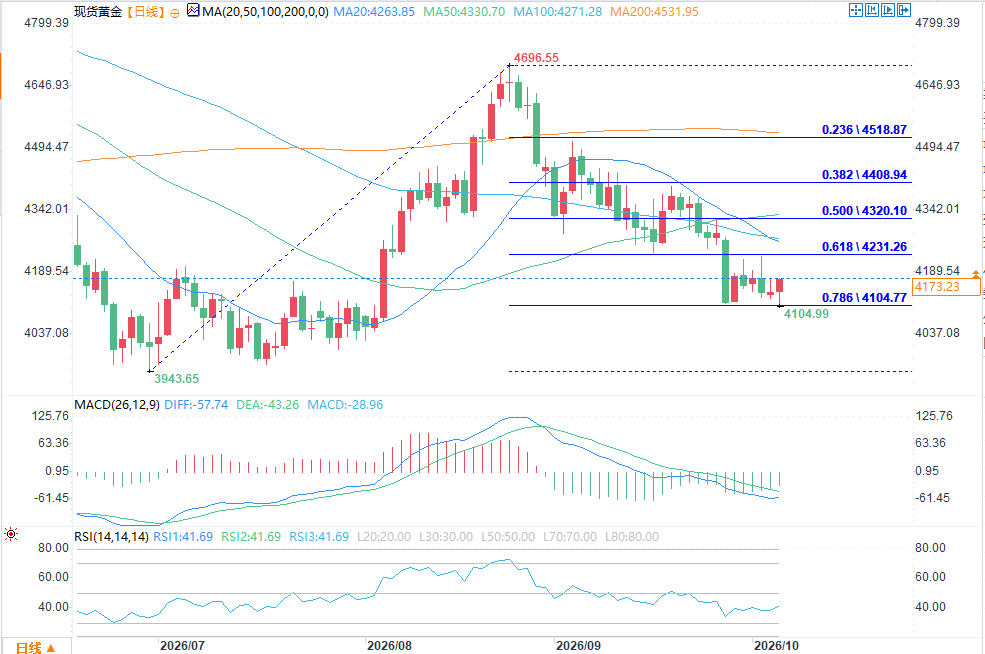 (Spot Gold Daily Chart Source: FX678) Spot gold rose slightly in early trading on Tuesday after falling below last week's low of $4110.87. The daily chart shows a downward trend, but the early morning reversal suggests the possibility of a closing price reversal bottom. Even if this pattern is confirmed, it won't directly reverse the overall trend, but it could trigger a 2-3 day counter-trend rebound. A valid break above $4399.67 is needed for the main trend to turn upward; a break below $4103.52 would further confirm the continuation of the downtrend. Near-term resistance is at the 61.8% Fibonacci retracement level of $4230.51. A sustained hold above this level could lead to a further rebound towards the 50% Fibonacci retracement level of $4319.61, followed by resistance at the 50-day moving average of $4330.43. Potential downside targets are historically significant lows: $3996.06, $3959.80, and $3942.10. Key points to watch for in the future: Even with weak non-farm payroll data, the bond market continues to sell off long-term US Treasuries. Wednesday's Fed meeting minutes will reflect this market environment. Service sector prices are still rising, and the market is still pricing in a possible December rate hike, leaving bond bulls with little reason to enter the market. Until the long-term yield structure changes, gold prices will continue to be driven by yields. After breaking below $4110.87 in the early morning, gold has the potential to form a closing price reversal bottom, but the bond market ultimately has the pricing power. Early Tuesday morning buying provided support at $4103.52, and gold has not yet tested the $4230.51 resistance level. The daily chart pattern is bearish, and the current price is below the 50-day moving average, indicating a continued downward bias. A closing price reversal bottom formation only changes short-term upward momentum and will not reverse the overall trend.
Spot gold was trading at $4,172.58, up $31.96, or 0.77%. A slight decline in yields triggered this rebound in gold . Monday was extremely unfavorable for gold bulls. After the market digested Friday's non-farm payroll report, bond bears regained momentum, pushing the 10-year US Treasury yield up to 5.349% and the 30-year yield to 5.703%, the highest level since 2002. On Tuesday, yields saw limited correction: the 10-year yield fell 3.4 basis points to 5.273%; the 30-year yield fell 3.1 basis points to 5.630%, and gold followed the yield decline, rebounding from its lows. However, the two long-term yield levels remain high, far from relieving downward pressure on gold prices. Meanwhile, the 2-year US Treasury yield fluctuated slightly, remaining around 4.81%, still significantly lower than last week's high of 4.96%. Weak non-farm payroll data eased short-term interest rate market sentiment, but long-term bonds continued to face selling pressure. There was no clear buying interest in long-term US Treasuries. Gold rebounds whenever yields fall slightly; for this rebound to move beyond simple short covering, long-term yields must continue to decline. Services sector inflation is giving bond shorts the upper hand . I focused on the prices paid component of the ISM Services PMI released on Monday, and here's the problem: this component rose 1.4 points to 74, with its 12-month average reaching its highest level since March 2023. The September services PMI composite reading fell to 54.9, in line with market expectations and lower than August, but traders ignored this composite data. Domestic demand continues to squeeze the supply chain, and corporate input costs remain high. The weak non-farm payroll data last Friday, but services sector inflation did not cool down, leading to a continuation of the bond sell-off after the non-farm payroll data release. The market will now focus on the Fed meeting minutes on Wednesday. Traders are hoping to glean insights into the extent of Federal Reserve officials' concerns about long-term Treasury yields and whether a September rate hike has gained widespread support within the committee. December is the key window for gold to watch out for regarding Fed policy . Following last Friday's non-farm payrolls data, market sentiment in October has clearly eased. According to the FedWatch Tool, the probability of the Fed maintaining interest rates unchanged at the October 28th meeting is 78.4%, while the probability of a 25 basis point rate hike is only 21.6%. However, the logic for December is completely different. Market pricing indicates an 86.2% probability of at least one rate hike by the December 9th meeting; a 68.4% probability of rates rising to the 4.00%-4.25% range, and a 17.8% probability of further increases to the 4.25%-4.50% range. Gold needs to simultaneously digest the policy expectations from both the October and December meetings; unless inflation data shows a significant cooling, the risk of a December rate hike will continue to suppress gold prices. The US dollar's consolidation is only temporary and has not provided any substantial benefit to gold. The US dollar index surged to 102.535 on Monday and fluctuated around 102 in early Tuesday trading. It slightly retreated to 102.044 during Tuesday's session, but the price remained firmly above its 50-day and 200-day moving averages. Neither the interest rate market nor the currency market provided strong support for gold. The dollar's rise has stopped, but there are no technical signals indicating an imminent decline. Middle East geopolitical developments have also failed to trigger safe-haven buying in gold. The Saudi-backed Yemeni government claimed to have recaptured coastal areas near the Bab el-Mandeb Strait, driving the Houthi rebels out of large swathes of territory seized last month. However, this geopolitical news had limited impact and could not overcome the interest rate-driven trading logic. Spot Gold Technical Analysis (Spot Gold Daily Chart Source: FX678) Spot gold rose slightly in early trading on Tuesday after falling below last week's low of $4110.87. The daily chart shows a downward trend, but the early morning reversal suggests the possibility of a closing price reversal bottom. Even if this pattern is confirmed, it won't directly reverse the overall trend, but it could trigger a 2-3 day counter-trend rebound. A valid break above $4399.67 is needed for the main trend to turn upward; a break below $4103.52 would further confirm the continuation of the downtrend. Near-term resistance is at the 61.8% Fibonacci retracement level of $4230.51. A sustained hold above this level could lead to a further rebound towards the 50% Fibonacci retracement level of $4319.61, followed by resistance at the 50-day moving average of $4330.43. Potential downside targets are historically significant lows: $3996.06, $3959.80, and $3942.10. Key points to watch for in the future: Even with weak non-farm payroll data, the bond market continues to sell off long-term US Treasuries. Wednesday's Fed meeting minutes will reflect this market environment. Service sector prices are still rising, and the market is still pricing in a possible December rate hike, leaving bond bulls with little reason to enter the market. Until the long-term yield structure changes, gold prices will continue to be driven by yields. After breaking below $4110.87 in the early morning, gold has the potential to form a closing price reversal bottom, but the bond market ultimately has the pricing power. Early Tuesday morning buying provided support at $4103.52, and gold has not yet tested the $4230.51 resistance level. The daily chart pattern is bearish, and the current price is below the 50-day moving average, indicating a continued downward bias. A closing price reversal bottom formation only changes short-term upward momentum and will not reverse the overall trend.
- Risk Warning and Disclaimer
- The market involves risk, and trading may not be suitable for all investors. This article is for reference only and does not constitute personal investment advice, nor does it take into account certain users’ specific investment objectives, financial situation, or other needs. Any investment decisions made based on this information are at your own risk.