The US dollar remains strong, and spot silver is nearing the lower edge of its trading range; a breakout should be anticipated.
2026-10-07 14:08:19
Spot silver opened sharply higher in Asian trading on Wednesday, but failed to hold onto its gains, falling back to around $60.60 per ounce throughout the session, a drop of about 1.3% on the day , compared to a close near $61.07 in the previous trading day. The direct driver suppressing silver prices came from the energy sector: international oil prices rebounded due to renewed supply risks in the Middle East— the UK's Maritime Trade Operations Office has reported nine tanker attacks in the Strait of Hormuz this month. Meanwhile, a storm forming in the Gulf of Mexico is expected to become the first Atlantic hurricane of 2026 within two days , with its path passing through offshore production areas accounting for about 15% of US crude oil production and about 5% of natural gas production. Energy companies such as Chevron have begun evacuating non-essential personnel from their platforms. Every rise in oil prices reignites market concerns about sticky inflation, reinforcing expectations that interest rates will remain high for a longer period, which directly suppresses silver, which does not generate yield.  However, silver is not entirely without support. Last week's significantly weaker-than-expected US non-farm payroll data for September has cooled market expectations for a Fed rate hike in October— according to the CME FedWatch Tool, the probability of an October rate hike has fallen to about 20%, while the probability of maintaining the current rate is about 78% . This dovish signal is theoretically beneficial to precious metals; however, the resilience of the US dollar index, coupled with the fact that US Treasury yields remain at multi-year highs (the 10-year yield touched a 24-year high of around 5.35% intraday), makes it difficult for the marginal improvement in interest rate expectations to effectively translate into upward momentum for silver prices. The widening fiscal deficit and the concentrated bond issuance triggered by artificial intelligence investment are also continuously raising the floor of long-term yields. From a global perspective, silver is caught between two forces: "geopolitical safe-haven demand" and "interest rate suppression": continued disruptions to Middle Eastern energy supplies provide safe-haven buying for silver, while the inflation and tightening expectations triggered by the rebound in oil prices limit upside potential. Market sentiment was generally cautious, with investors reluctant to bet on a directional breakout ahead of the FOMC minutes release, resulting in a convergence in both trading volume and volatility. In the short term, silver prices will largely depend on the seesaw effect between oil prices and US Treasury yields: if the Gulf Coast storm causes a substantial production cut or the situation in the Middle East escalates again, the safe-haven logic may temporarily prevail; conversely, if yields continue to rise, silver prices will remain under pressure. According to the latest positioning tracking data from TD Securities, trend-following funds (CTAs) are only maintaining a small net short position in silver, equivalent to approximately -2% of their historical maximum , without any large-scale short bets. The institution considers approximately $60.71/ounce as a key downside trigger level ; a clear break below this level could trigger a chain reaction of systemic selling, while above it, they tend to maintain range-bound trading. This positioning structure suggests that the current adjustment in silver prices is more of a passive correction driven by interest rate logic, rather than a trend-driven sell-off initiated by active short selling. The FOMC meeting minutes released tonight will be a key short-term variable: how the minutes interpret the unexpected slowdown in September's non-farm payrolls and the extent of Fed officials' concerns about AI-driven inflation will directly affect the market's repricing of the October and year-end rate hike path. If the minutes are generally dovish, the dollar and US Treasury yields may both fall, and silver may get a breather; if the minutes emphasize inflation risks and maintain a hawkish tone, silver prices may retest the support around $60.71. Investors are focusing on three areas: the policy stance of the FOMC minutes, the actual impact of the Gulf of Mexico storm on energy production, and the next development of the Middle East situation (Strait of Hormuz and Red Sea). From a technical perspective, spot silver has been consolidating after rebounding from around $60.30 on the daily chart, with prices still trading below the 20-day moving average, indicating a bearish short-to-medium-term structure ; the 14-day Relative Strength Index (RSI) has rebounded from the oversold zone but has not yet reached the neutral level, indicating limited upward momentum. On the upside resistance side, the $61.80 to $62.20 area forms the first resistance zone , with the 200-period moving average on the 4-hour chart at around $64.30 providing stronger resistance. On the downside support side, $60.30 is the starting point of the recent rebound, and the psychological level of $60.00 is the second line of defense . A break below $60 could see silver prices further decline to the $59.40 to $59.00 area. Looking at the 4-hour chart, short-term momentum indicators have weakened again after recovering from lows. If today's closing price holds above $60.50, the range-bound trading pattern can be maintained; conversely, a decisive break below $60, the CTA trigger level, could accelerate the decline.
 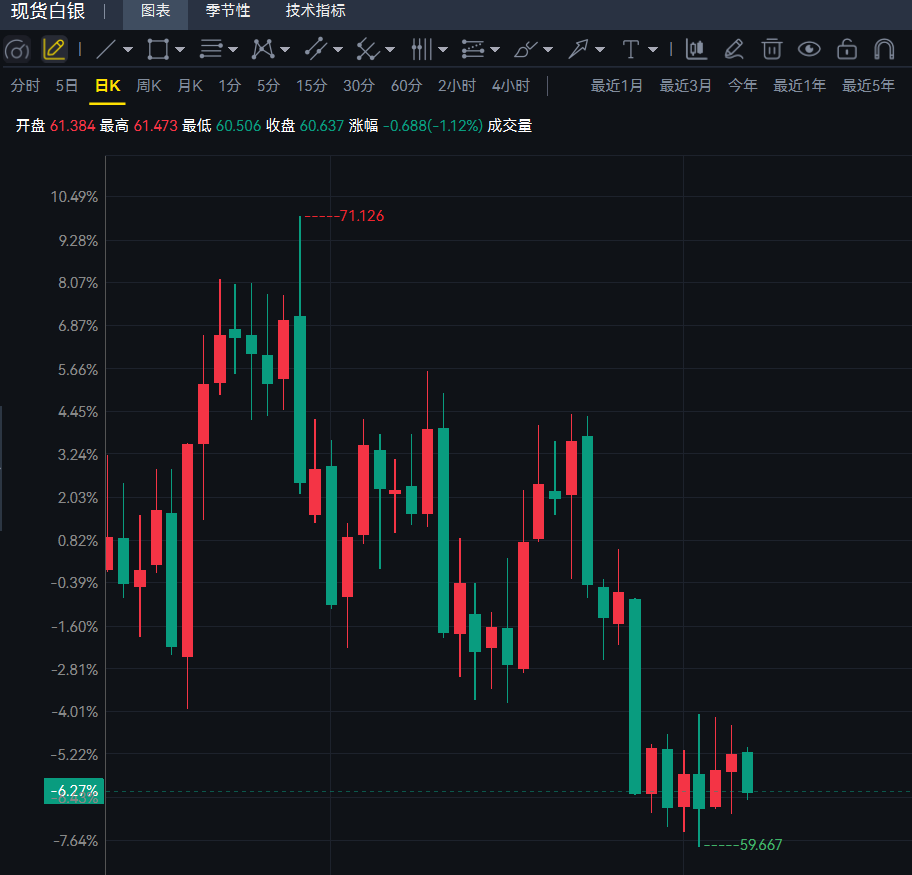 Editor's Summary: The core contradiction for silver currently lies in the tug-of-war between the "interest rate suppression" created by the combined effects of high oil prices and high yields, and geopolitical safe-haven demand. In the short term, the evolution of the Gulf of Mexico storm and the situation in the Middle East, as well as the statements in tonight's FOMC minutes, will determine the direction of silver prices' breakout within the $60.30 to $62.20 range. In the medium term, as long as the fundamental logic of sticky inflation and fiscal deficits pushing up long-term yields remains unchanged, silver's valuation ceiling will still be constrained. Two risks warrant attention: first, if oil prices surge rapidly due to storms or geopolitical events, the safe-haven and inflation logic may resonate to temporarily push up silver prices; second, if the FOMC minutes are unexpectedly hawkish and the probability of an October rate hike rises again, silver prices may fall below the $60 mark.
However, silver is not entirely without support. Last week's significantly weaker-than-expected US non-farm payroll data for September has cooled market expectations for a Fed rate hike in October— according to the CME FedWatch Tool, the probability of an October rate hike has fallen to about 20%, while the probability of maintaining the current rate is about 78% . This dovish signal is theoretically beneficial to precious metals; however, the resilience of the US dollar index, coupled with the fact that US Treasury yields remain at multi-year highs (the 10-year yield touched a 24-year high of around 5.35% intraday), makes it difficult for the marginal improvement in interest rate expectations to effectively translate into upward momentum for silver prices. The widening fiscal deficit and the concentrated bond issuance triggered by artificial intelligence investment are also continuously raising the floor of long-term yields. From a global perspective, silver is caught between two forces: "geopolitical safe-haven demand" and "interest rate suppression": continued disruptions to Middle Eastern energy supplies provide safe-haven buying for silver, while the inflation and tightening expectations triggered by the rebound in oil prices limit upside potential. Market sentiment was generally cautious, with investors reluctant to bet on a directional breakout ahead of the FOMC minutes release, resulting in a convergence in both trading volume and volatility. In the short term, silver prices will largely depend on the seesaw effect between oil prices and US Treasury yields: if the Gulf Coast storm causes a substantial production cut or the situation in the Middle East escalates again, the safe-haven logic may temporarily prevail; conversely, if yields continue to rise, silver prices will remain under pressure. According to the latest positioning tracking data from TD Securities, trend-following funds (CTAs) are only maintaining a small net short position in silver, equivalent to approximately -2% of their historical maximum , without any large-scale short bets. The institution considers approximately $60.71/ounce as a key downside trigger level ; a clear break below this level could trigger a chain reaction of systemic selling, while above it, they tend to maintain range-bound trading. This positioning structure suggests that the current adjustment in silver prices is more of a passive correction driven by interest rate logic, rather than a trend-driven sell-off initiated by active short selling. The FOMC meeting minutes released tonight will be a key short-term variable: how the minutes interpret the unexpected slowdown in September's non-farm payrolls and the extent of Fed officials' concerns about AI-driven inflation will directly affect the market's repricing of the October and year-end rate hike path. If the minutes are generally dovish, the dollar and US Treasury yields may both fall, and silver may get a breather; if the minutes emphasize inflation risks and maintain a hawkish tone, silver prices may retest the support around $60.71. Investors are focusing on three areas: the policy stance of the FOMC minutes, the actual impact of the Gulf of Mexico storm on energy production, and the next development of the Middle East situation (Strait of Hormuz and Red Sea). From a technical perspective, spot silver has been consolidating after rebounding from around $60.30 on the daily chart, with prices still trading below the 20-day moving average, indicating a bearish short-to-medium-term structure ; the 14-day Relative Strength Index (RSI) has rebounded from the oversold zone but has not yet reached the neutral level, indicating limited upward momentum. On the upside resistance side, the $61.80 to $62.20 area forms the first resistance zone , with the 200-period moving average on the 4-hour chart at around $64.30 providing stronger resistance. On the downside support side, $60.30 is the starting point of the recent rebound, and the psychological level of $60.00 is the second line of defense . A break below $60 could see silver prices further decline to the $59.40 to $59.00 area. Looking at the 4-hour chart, short-term momentum indicators have weakened again after recovering from lows. If today's closing price holds above $60.50, the range-bound trading pattern can be maintained; conversely, a decisive break below $60, the CTA trigger level, could accelerate the decline. Editor's Summary: The core contradiction for silver currently lies in the tug-of-war between the "interest rate suppression" created by the combined effects of high oil prices and high yields, and geopolitical safe-haven demand. In the short term, the evolution of the Gulf of Mexico storm and the situation in the Middle East, as well as the statements in tonight's FOMC minutes, will determine the direction of silver prices' breakout within the $60.30 to $62.20 range. In the medium term, as long as the fundamental logic of sticky inflation and fiscal deficits pushing up long-term yields remains unchanged, silver's valuation ceiling will still be constrained. Two risks warrant attention: first, if oil prices surge rapidly due to storms or geopolitical events, the safe-haven and inflation logic may resonate to temporarily push up silver prices; second, if the FOMC minutes are unexpectedly hawkish and the probability of an October rate hike rises again, silver prices may fall below the $60 mark.
- Risk Warning and Disclaimer
- The market involves risk, and trading may not be suitable for all investors. This article is for reference only and does not constitute personal investment advice, nor does it take into account certain users’ specific investment objectives, financial situation, or other needs. Any investment decisions made based on this information are at your own risk.