French bond market risk analysis: Euro presents oversold recovery opportunity
2026-10-07 20:22:19
International Monetary Fund (IMF) Managing Director Kristalina Georgieva recently issued a stern warning about France's fiscal situation, explicitly demanding that the French government make every effort to rectify fiscal order and reduce the fiscal deficit in order to restore market confidence and stabilize credit expectations in the domestic bond market. France is currently in a critical fiscal budget negotiation cycle, with the government planning to launch a fiscal adjustment package worth tens of billions of euros to improve the deficit situation by reducing public spending and optimizing the fiscal structure. At this crucial window of opportunity for fiscal reform, France has once again fallen into a new round of domestic political crisis. Nationwide student protests have continued for three weeks and have escalated, turning violent. The core of the protests stems from strong public dissatisfaction with education and livelihood issues such as excessively long school hours, teacher shortages, and aging school facilities. The ongoing social unrest and political divisions have further hampered the already difficult fiscal reform process. The French parliament is severely divided by factions, requiring the government not only to deal with the pressure of street protests but also to negotiate with various parties to gain the support of members of parliament, significantly increasing the difficulty of implementing the multi-billion euro austerity policy. 
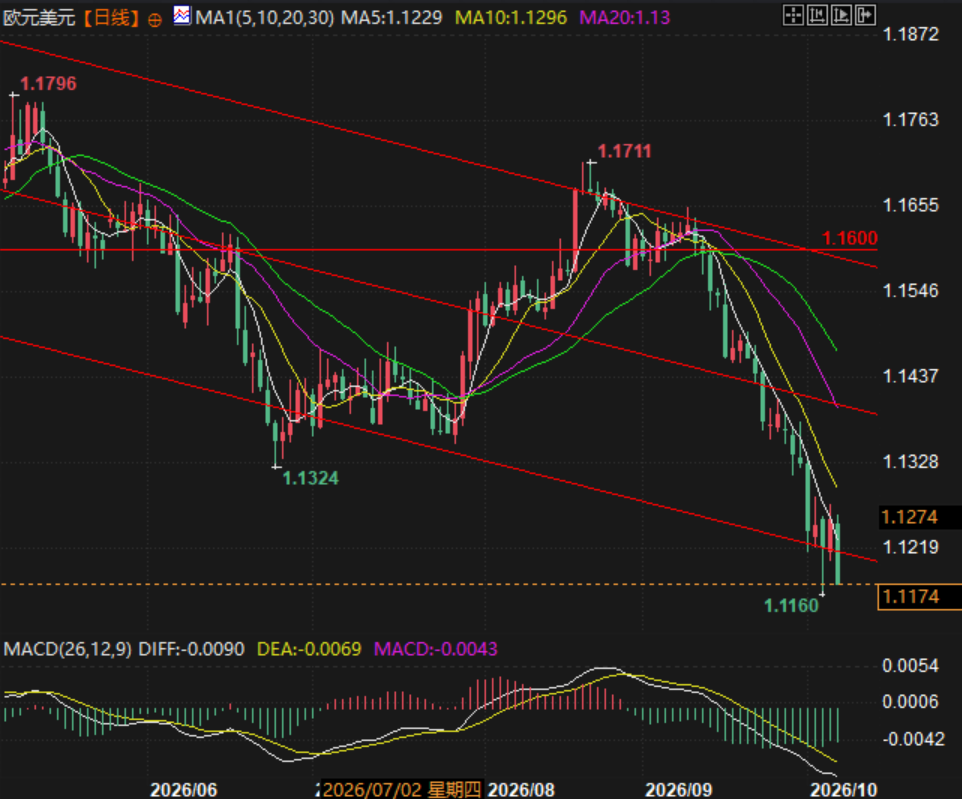 (Euro/USD daily chart, source: EasyForex) At 20:18 Beijing time, the euro/dollar exchange rate is currently 1.1173/74.
French bond yields continue to soar, significantly increasing sovereign risk.
Amid multiple overlapping risks, French government bonds (OATs) have faced sustained selling pressure, significantly increasing pressure on the bond market. To date, the yield on 10-year French government bonds has risen by over 100 basis points year-to-date, reaching a recent high of 4.925%, a sharp single-day increase. Bond prices have also fallen, marking the highest borrowing cost level since the 2008 financial crisis. More alarmingly, the yield on French government bonds has now surpassed that of Italian bonds, indicating that market concerns about French sovereign debt risk have exceeded those of traditionally highly indebted Southern European countries. Kristalina Georgieva stated bluntly that France's current predicament is the result of multiple overlapping contradictions: long-term, continuous excessive borrowing has created a vicious cycle, with debt risks accumulating layer by layer and proving difficult to resolve; coupled with a turbulent domestic political situation, the Ministry of Finance's fiscal austerity plans have been severely hampered, preventing France from establishing a clear and stable path to fiscal recovery. Currently, there is a general consensus in France that the fiscal deficit ratio must be reduced to below 5%. Data shows that France's fiscal deficit reached 5.1% of GDP last year, far exceeding the EU's benchmark of 3%, which is why it was included in the EU's deficit rectification monitoring list and faces mandatory fiscal adjustments.This is not a new round of the European debt crisis: Europe's risk control system has been significantly upgraded.
Regarding market concerns that the French debt crisis could mirror the Eurozone sovereign debt crisis of the early 2000s, Georgieva offered a relatively optimistic assessment. She stated that the European financial system's resilience has significantly improved and is vastly different from what it was then. The French domestic economy continues to grow positively, providing a certain buffer against risk; meanwhile, the Eurozone has established a more mature financial risk control system, relying on the European Central Bank's policy support capabilities and various financial stability protection tools to effectively prevent the spread of debt risk from a single country and avoid a regional crisis. Even so, she emphasized that France must proactively address fiscal loopholes and streamline its fiscal system to resolve debt risks at their root. The IMF acknowledged that implementing France's multi-billion euro fiscal adjustment plan will be extremely difficult. In the post-pandemic era, people in various countries have become accustomed to government bailout policies during crises and have very low acceptance of fiscal austerity and welfare cuts, which makes France's reforms face significant public resistance. In response, the IMF recommends that the French government abandon a singular propaganda approach and unite with labor unions, the business community, and other stakeholders to speak out and educate the public about the long-term value of fiscal consolidation, thereby building consensus on reform. Furthermore, the IMF points out that the pricing logic of the global bond market has undergone a fundamental shift, with high inflation, rising policy rates, and increasing government debt becoming the new market fundamentals. The bond market is significantly more sensitive to fiscal discipline and the scale of borrowing by various countries. Only by releasing clear signals of fiscal contraction and debt control can market expectations be stabilized; otherwise, French bond yields are likely to continue their upward trend, and debt risks will continue to escalate.Eurozone fundamentals: Localized risks, overall stability
The recent French crisis has led to a sharp decline in the euro, but this volatility also presents opportunities. One such opportunity lies in a common misconception: the market equates France's problems with a crisis across the entire Eurozone. In reality, the French crisis represents a typical localized "gray rhino" risk and does not alter the Eurozone's overall robust fundamentals. These two factors need to be considered separately. Firstly, the Eurozone is showing signs of a moderate recovery, partially shaking off its period of stagnation. Eurozone GDP showed a significant rebound in the second quarter of 2026, and the European Central Bank predicts steady regional economic expansion over the next two years, maintaining positive growth overall with no risk of systemic recession. Meanwhile, core Nordic countries like Germany and the Netherlands have healthy fiscal positions and stable economies, effectively offsetting the debt burdens of countries like France and Italy. Furthermore, rigid inflation supports monetary policy; although inflation may fluctuate due to geopolitical and energy disturbances, it remains within a controllable range and has not formed a vicious cycle of inflation. To suppress persistent inflation, the European Central Bank maintains a hawkish monetary policy, and the high-interest-rate environment will continue in the short term, providing sustained valuation support for the euro. The financial risk isolation mechanism is mature: After years of institutional reforms, the Eurozone has a sound fiscal supervision system and central bank risk protection tools, which can accurately isolate the debt risk of a single country, prevent the risk from spreading throughout the region, and prevent a repeat of the global European debt crisis of the past.Market trend assessment: A classic case of "everyone knows it's bad news," awaiting full pricing.
The current turmoil in the French bond market and the political protests are not sudden black swan events, but rather long-standing, publicly known negative factors that have been recently hyped up. The market is already fully aware of France's high deficit, high debt, political division, and the difficulty of reforms. The current market characteristics are: negative news is being continuously amplified by the media, sentiment has been fully priced in, and risk premiums are almost fully priced in. Without any new unexpected black swan events (such as government collapse, credit rating downgrade, or complete budget failure), current market prices have already priced in pessimistic expectations for France. Simply put: all the bad news has been priced in, and things are unlikely to get worse; there will only be marginal improvement or the status quo will be maintained.Euro Trading Opportunity: Excellent Left-Side Buying Point After Oversold Recovery
Given the misalignment between fundamentals and sentiment, the euro currently presents a highly cost-effective short-to-medium-term buying opportunity, potentially leading to a "sell-off and recovery" rally. The market's excessive pressure on the euro due to localized risks in France has completely ignored the core positive factors of the Eurozone's overall economic recovery, hawkish monetary policy, and a sound financial system, leaving significant room for oversold correction. The ECB's safety net mechanism and the Eurozone's overall robust fundamentals have averted systemic crisis risks, limiting further downside for the euro. We await marginal improvements; any subsequent signals such as easing protests, steady progress in budget negotiations, and a peak and subsequent decline in French bond yields and the Franco-German interest rate differential will trigger a recovery in market sentiment, driving a euro rebound. Technically, the euro/dollar pair has broken below the lower trendline of its descending channel, potentially creating a short-term bear trap, but in reality, it may be forming a double bottom pattern. (Euro/USD daily chart, source: EasyForex) At 20:18 Beijing time, the euro/dollar exchange rate is currently 1.1173/74.
- Risk Warning and Disclaimer
- The market involves risk, and trading may not be suitable for all investors. This article is for reference only and does not constitute personal investment advice, nor does it take into account certain users’ specific investment objectives, financial situation, or other needs. Any investment decisions made based on this information are at your own risk.