The market lowered its expectations for a Fed rate hike in October, causing the pound to rebound slightly against the dollar.
2026-10-09 14:22:17
The British pound rose to around 1.3240 against the US dollar during Friday's Asian trading session, with a weaker dollar providing short-term support. However, the pound's rebound still faces several constraints: while the Federal Reserve has shown some flexibility in the pace of recent interest rate hikes, its overall policy stance remains biased towards tightening; and the UK faces rising long-term financing costs and fiscal budget uncertainty, keeping the market cautious about the pound.  Federal Reserve Governor Waller said on Thursday that further interest rate hikes may still be needed to bring inflation down to the 2% target, but the pace of hikes will be flexible, and the possibility of pausing rate hikes at the October meeting was not ruled out. This statement eased market concerns about further rate hikes by the Fed in the near term, putting pressure on the dollar. According to the CME FedWatch Tool, the market's probability of a rate hike of at least 25 basis points at the Fed's October meeting has fallen from 38% a week ago to about 17.7%; meanwhile, the market's probability of a rate hike at the December meeting remains at about 83%. This reflects that the market is reducing its bets on near-term tightening, but still believes that further rate hikes by the Fed this year are quite likely. Hawkish voices within the Fed have also limited the downside for the dollar. Musalaim pointed out that the US economy and job market remain strong overall, and demand-side pressures persist. To bring inflation back to the 2% target, monetary policy may need to be further tightened. He also mentioned that factors such as investment in artificial intelligence, capital needs, and fiscal deficits may push real interest rates to remain relatively high. Related comments indicate that the Federal Reserve has not clearly shifted towards easing, and the market's repricing of policy path may still affect the dollar and pound sterling's exchange rate against the dollar. The UK's fiscal situation is one of the main risks facing the pound. Long-term borrowing costs in the UK have previously risen to their highest level since the 1990s, and the market is closely watching Chancellor John Healy's first budget to be announced on October 28. The UK government needs to strike a balance between fiscal sustainability, public spending, and economic growth, and the market is particularly concerned about whether the budget will involve raising taxes on banks. If fiscal measures lead to increased costs for financial institutions, decreased investment confidence, or further exacerbation of government financing pressures, the pound may be dragged down. Uncertainty about the UK's fiscal outlook also makes it difficult for the pound to achieve a sustained rebound simply through a weaker dollar. If the budget requires stricter fiscal measures, it may increase pressure on economic growth in the short term; if the market perceives a lack of credibility in the fiscal plan, UK government bond yields and the pound may also react in more complex ways. Therefore, investors need to not only focus on the fiscal measures themselves but also assess their combined impact on economic growth, government financing, and expectations of Bank of England policy. Next, the University of Michigan's October consumer confidence index and inflation expectations data will be key short-term focus. If US consumer confidence and inflation expectations are stronger than market expectations, it could strengthen the case for the Federal Reserve to maintain its tightening policy, providing support for the dollar; if the data is weak, the dollar may come under further pressure, providing room for a rebound in the pound against the dollar. However, UK fiscal risks may still limit the pound's gains, and whether the exchange rate can break through the current range still depends on changes in both US interest rate expectations and the UK fiscal outlook. From a daily chart perspective, the pound against the dollar remains bearish in the short term. The exchange rate is currently trading below the 20-day simple moving average corresponding to the middle Bollinger Band, and is also significantly below the 100-day simple moving average, indicating that the short-to-medium-term trend has not yet reversed. The 14-day Relative Strength Index (RSI) is around 39, below the neutral level of 50, indicating that sellers still have a certain advantage, but the indicator has not yet entered the typical oversold zone, meaning that while downward pressure continues, it has not reached extreme levels. On the upside, the first important resistance level is around 1.3295, corresponding to the middle Bollinger Band. If the exchange rate can effectively break through this level, the short-term rebound is expected to continue, with attention then focused on the 100-day simple moving average around 1.3402; further resistance lies around 1.3470, corresponding to the upper Bollinger Band. Until the exchange rate re-establishes itself above 1.3295, the rebound is more accurately viewed as a correction within a weak market rather than a trend reversal. On the downside, the lower Bollinger Band around 1.3115 forms the next important support level. If the exchange rate continues to be capped at 1.3295 and breaks below 1.3200 again, the market may retest the lower edge of the range around 1.3140. If the 1.3115 support is also effectively broken, a deeper pullback should be anticipated. On the 4-hour chart, current data does not provide complete moving average and momentum indicator values; therefore, the short-term focus should be on the struggle around 1.3200 and whether the exchange rate can re-break through 1.3295 to confirm the sustainability of the rebound.
 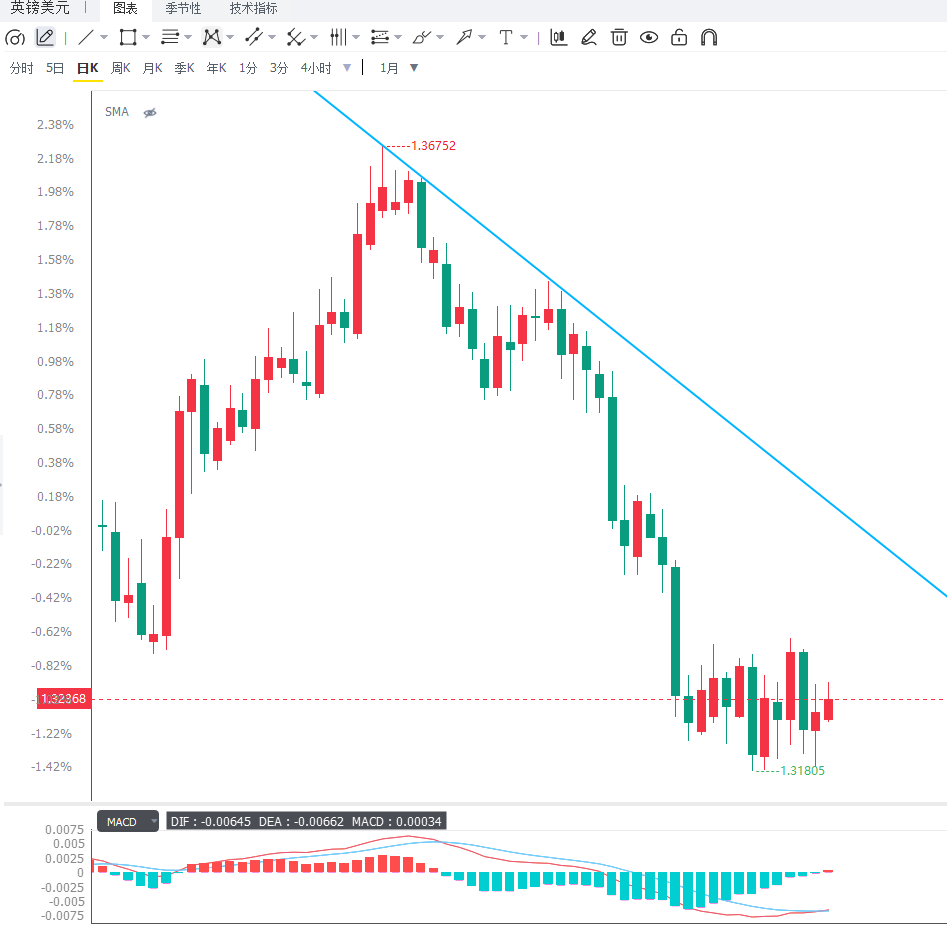 Editor's Summary: The GBP/USD pair is currently caught in a trade war, with the dollar's short-term weakness and UK fiscal risks weighing on each other. A lower expectation of a Fed rate hike in October has provided some upward momentum for the pair, but Fed officials have emphasized the possibility of further policy tightening, thus limiting the dollar's downside. The UK budget on October 28th is a key risk event for the pound, as fiscal measures and changes in long-term financing costs could impact market confidence. Technically, 1.3295 is a key resistance level for judging the strength of the short-term rebound, while the area around 1.3140 is a significant support level. Without new fundamental catalysts, the GBP/USD pair is more likely to continue its range-bound trading in the short term. Close attention should be paid to US consumer confidence and inflation expectations data, as well as the latest developments in UK fiscal policy.
Federal Reserve Governor Waller said on Thursday that further interest rate hikes may still be needed to bring inflation down to the 2% target, but the pace of hikes will be flexible, and the possibility of pausing rate hikes at the October meeting was not ruled out. This statement eased market concerns about further rate hikes by the Fed in the near term, putting pressure on the dollar. According to the CME FedWatch Tool, the market's probability of a rate hike of at least 25 basis points at the Fed's October meeting has fallen from 38% a week ago to about 17.7%; meanwhile, the market's probability of a rate hike at the December meeting remains at about 83%. This reflects that the market is reducing its bets on near-term tightening, but still believes that further rate hikes by the Fed this year are quite likely. Hawkish voices within the Fed have also limited the downside for the dollar. Musalaim pointed out that the US economy and job market remain strong overall, and demand-side pressures persist. To bring inflation back to the 2% target, monetary policy may need to be further tightened. He also mentioned that factors such as investment in artificial intelligence, capital needs, and fiscal deficits may push real interest rates to remain relatively high. Related comments indicate that the Federal Reserve has not clearly shifted towards easing, and the market's repricing of policy path may still affect the dollar and pound sterling's exchange rate against the dollar. The UK's fiscal situation is one of the main risks facing the pound. Long-term borrowing costs in the UK have previously risen to their highest level since the 1990s, and the market is closely watching Chancellor John Healy's first budget to be announced on October 28. The UK government needs to strike a balance between fiscal sustainability, public spending, and economic growth, and the market is particularly concerned about whether the budget will involve raising taxes on banks. If fiscal measures lead to increased costs for financial institutions, decreased investment confidence, or further exacerbation of government financing pressures, the pound may be dragged down. Uncertainty about the UK's fiscal outlook also makes it difficult for the pound to achieve a sustained rebound simply through a weaker dollar. If the budget requires stricter fiscal measures, it may increase pressure on economic growth in the short term; if the market perceives a lack of credibility in the fiscal plan, UK government bond yields and the pound may also react in more complex ways. Therefore, investors need to not only focus on the fiscal measures themselves but also assess their combined impact on economic growth, government financing, and expectations of Bank of England policy. Next, the University of Michigan's October consumer confidence index and inflation expectations data will be key short-term focus. If US consumer confidence and inflation expectations are stronger than market expectations, it could strengthen the case for the Federal Reserve to maintain its tightening policy, providing support for the dollar; if the data is weak, the dollar may come under further pressure, providing room for a rebound in the pound against the dollar. However, UK fiscal risks may still limit the pound's gains, and whether the exchange rate can break through the current range still depends on changes in both US interest rate expectations and the UK fiscal outlook. From a daily chart perspective, the pound against the dollar remains bearish in the short term. The exchange rate is currently trading below the 20-day simple moving average corresponding to the middle Bollinger Band, and is also significantly below the 100-day simple moving average, indicating that the short-to-medium-term trend has not yet reversed. The 14-day Relative Strength Index (RSI) is around 39, below the neutral level of 50, indicating that sellers still have a certain advantage, but the indicator has not yet entered the typical oversold zone, meaning that while downward pressure continues, it has not reached extreme levels. On the upside, the first important resistance level is around 1.3295, corresponding to the middle Bollinger Band. If the exchange rate can effectively break through this level, the short-term rebound is expected to continue, with attention then focused on the 100-day simple moving average around 1.3402; further resistance lies around 1.3470, corresponding to the upper Bollinger Band. Until the exchange rate re-establishes itself above 1.3295, the rebound is more accurately viewed as a correction within a weak market rather than a trend reversal. On the downside, the lower Bollinger Band around 1.3115 forms the next important support level. If the exchange rate continues to be capped at 1.3295 and breaks below 1.3200 again, the market may retest the lower edge of the range around 1.3140. If the 1.3115 support is also effectively broken, a deeper pullback should be anticipated. On the 4-hour chart, current data does not provide complete moving average and momentum indicator values; therefore, the short-term focus should be on the struggle around 1.3200 and whether the exchange rate can re-break through 1.3295 to confirm the sustainability of the rebound. Editor's Summary: The GBP/USD pair is currently caught in a trade war, with the dollar's short-term weakness and UK fiscal risks weighing on each other. A lower expectation of a Fed rate hike in October has provided some upward momentum for the pair, but Fed officials have emphasized the possibility of further policy tightening, thus limiting the dollar's downside. The UK budget on October 28th is a key risk event for the pound, as fiscal measures and changes in long-term financing costs could impact market confidence. Technically, 1.3295 is a key resistance level for judging the strength of the short-term rebound, while the area around 1.3140 is a significant support level. Without new fundamental catalysts, the GBP/USD pair is more likely to continue its range-bound trading in the short term. Close attention should be paid to US consumer confidence and inflation expectations data, as well as the latest developments in UK fiscal policy.
- Risk Warning and Disclaimer
- The market involves risk, and trading may not be suitable for all investors. This article is for reference only and does not constitute personal investment advice, nor does it take into account certain users’ specific investment objectives, financial situation, or other needs. Any investment decisions made based on this information are at your own risk.