Crude oil trading alert: Amidst fluctuating geopolitical tensions, US crude oil is consolidating around $90, awaiting a directional move.
2026-10-12 09:44:18
West Texas Intermediate (WTI) crude oil retreated after two consecutive days of gains, trading around $90.00 per barrel in Asian trading on Monday. However, the pullback in crude oil prices may be limited as a series of serious attacks in the Middle East reignites deep concerns about supply disruptions. Houthi rebels launched four large-scale attacks on Saudi Arabia in the past 24 hours, targeting King Khalid International Airport in Riyadh, Aramco gas facilities in the Eastern Province, and King Fahd International Airport near Dammam, causing multiple fires and flight disruptions.  This escalating situation has put the market on edge. More concerning is that US President Trump is seriously considering joining Saudi Arabia in a military strike against the Iranian-backed Houthi rebels. Market research indicates that the White House has asked the Department of Defense to develop a military action plan against the Houthis in Yemen, a move that completely overturns previous market expectations of US restraint in the Middle East. Trump himself has publicly stated that the US will respond strongly to Houthi attacks and hinted at possible retaliatory action in conjunction with Saudi Arabia. Supply-side risks are not limited to Saudi Arabia. Over the weekend, a drone struck an oil tanker near its anchorage in Sohar, Oman, an incident located just outside the Strait of Hormuz, highlighting the vulnerability of this crucial global energy transport route. The Strait of Hormuz handles approximately 20% of global seaborne crude oil transport, and several attacks on ships have been reported in the area this month, with a significantly increased frequency. Commodity analysis firm Kpler points out that a large number of ships are currently stranded in the Gulf region, posing a severe challenge to the recovery of shipping. Even with an improved security environment, energy exports are showing a "slow climb" rather than a rapid recovery. Saudi Aramco CEO Amin Nasser previously warned that global commercial oil inventories are below 6 billion barrels, the vast majority of which are not immediately usable. Since the escalation of the Middle East conflict, global oil supply has decreased by nearly 3 billion barrels, with countries allocating more than 1 billion barrels from their reserves to fill the gap. Nasser emphasized that even if the Strait of Hormuz reopens, it could take up to two years for global inventories to return to normal levels. While Saudi Aramco's East-West pipeline has resumed a transport capacity of approximately 5.8 million barrels per day, reaching more than 80% of its design capacity of approximately 7 million barrels, the full-capacity operation of alternative routes is still insufficient to completely replace the Strait's transport capacity. The U.S. Department of Energy announced the approval of an emergency swap plan to use up to 4 million barrels of crude oil from the Strategic Petroleum Reserve to alleviate supply disruptions caused by Hurricane Isaias. It is worth noting that the US Strategic Petroleum Reserve has fallen to its lowest level since 1982, significantly shrinking the domestic energy buffer. While this measure may alleviate regional supply pressure in the short term, it also reflects the deepening vulnerability of the global energy system to multiple shocks. From a technical perspective, WTI crude oil prices are fluctuating widely between $87.5 and $92.5 on the daily chart, with short-term moving averages showing a mixed pattern, indicating an unclear direction. The RSI indicator has flattened after falling from the previous overbought zone to the neutral zone, suggesting a temporary balance between bullish and bearish forces. On the upside resistance side, $90.5 is the resistance level of the recent densely traded area; a successful break above this level could lead to a retest of the early October highs of $91.5 and even $93.5. On the downside support side, $88.5 provides immediate support, followed by the psychological level of $87, with stronger support at $85.5. From a 4-hour chart perspective, oil prices have formed a higher low structure after rebounding from their lows. Short-term momentum indicators are running in the strong zone, and the MACD indicator is releasing a bullish signal. If prices break through $90.5 with increased volume, the short-term rebound is likely to continue; conversely, if the rebound is resisted and prices fall below $88.5, they may retest the $87 support level. According to TD Securities analysis, systematic trading strategies are repeatedly oscillating around the key CTA trigger level of $90/barrel, and the rapid inflow and outflow of trend-following funds has exacerbated price volatility in this area.
 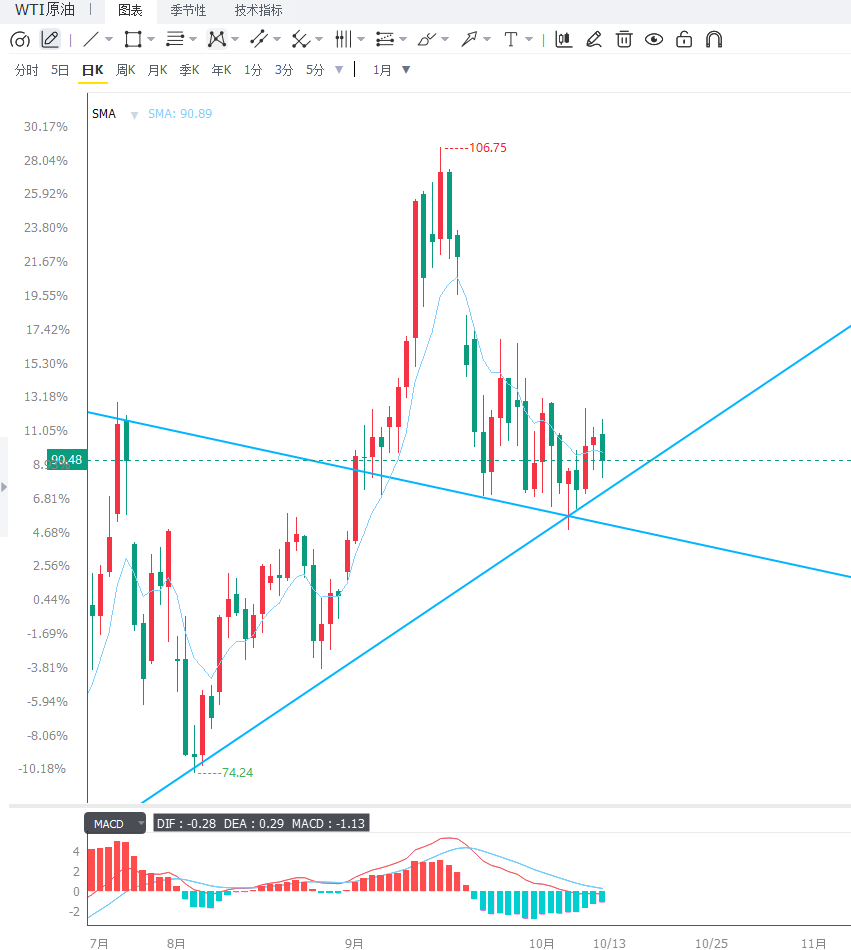 Editor's Summary: The current crude oil market is in a high-level consolidation pattern dominated by geopolitical risk premiums. The Houthi attacks on key Saudi facilities, rising expectations of potential US military intervention, and the ongoing risks associated with navigation in the Strait of Hormuz are the three main pillars supporting high oil prices. However, the rapid depletion of global commercial inventories, the shrinking space for strategic reserves, and the gradual recovery of alternative transportation routes are also limiting the upside potential of oil prices to some extent. Short-term oil price movements will depend on three core variables: whether the Middle East conflict escalates into a wider military confrontation, whether navigation in the Strait of Hormuz can remain relatively stable, and the actual effect of the release of US strategic reserves. If the conflict expands and leads to a substantial supply disruption, WTI is expected to break through $93 and challenge higher levels; conversely, if there are signs of easing tensions coupled with expectations of supply returning, oil prices may pull back to around $87 to seek support. Given the significantly narrowed global inventory buffer, even a nominal supply recovery is unlikely to quickly bridge the market's pricing of tail risks, and the volatility risks triggered by geopolitical events should be closely monitored.
This escalating situation has put the market on edge. More concerning is that US President Trump is seriously considering joining Saudi Arabia in a military strike against the Iranian-backed Houthi rebels. Market research indicates that the White House has asked the Department of Defense to develop a military action plan against the Houthis in Yemen, a move that completely overturns previous market expectations of US restraint in the Middle East. Trump himself has publicly stated that the US will respond strongly to Houthi attacks and hinted at possible retaliatory action in conjunction with Saudi Arabia. Supply-side risks are not limited to Saudi Arabia. Over the weekend, a drone struck an oil tanker near its anchorage in Sohar, Oman, an incident located just outside the Strait of Hormuz, highlighting the vulnerability of this crucial global energy transport route. The Strait of Hormuz handles approximately 20% of global seaborne crude oil transport, and several attacks on ships have been reported in the area this month, with a significantly increased frequency. Commodity analysis firm Kpler points out that a large number of ships are currently stranded in the Gulf region, posing a severe challenge to the recovery of shipping. Even with an improved security environment, energy exports are showing a "slow climb" rather than a rapid recovery. Saudi Aramco CEO Amin Nasser previously warned that global commercial oil inventories are below 6 billion barrels, the vast majority of which are not immediately usable. Since the escalation of the Middle East conflict, global oil supply has decreased by nearly 3 billion barrels, with countries allocating more than 1 billion barrels from their reserves to fill the gap. Nasser emphasized that even if the Strait of Hormuz reopens, it could take up to two years for global inventories to return to normal levels. While Saudi Aramco's East-West pipeline has resumed a transport capacity of approximately 5.8 million barrels per day, reaching more than 80% of its design capacity of approximately 7 million barrels, the full-capacity operation of alternative routes is still insufficient to completely replace the Strait's transport capacity. The U.S. Department of Energy announced the approval of an emergency swap plan to use up to 4 million barrels of crude oil from the Strategic Petroleum Reserve to alleviate supply disruptions caused by Hurricane Isaias. It is worth noting that the US Strategic Petroleum Reserve has fallen to its lowest level since 1982, significantly shrinking the domestic energy buffer. While this measure may alleviate regional supply pressure in the short term, it also reflects the deepening vulnerability of the global energy system to multiple shocks. From a technical perspective, WTI crude oil prices are fluctuating widely between $87.5 and $92.5 on the daily chart, with short-term moving averages showing a mixed pattern, indicating an unclear direction. The RSI indicator has flattened after falling from the previous overbought zone to the neutral zone, suggesting a temporary balance between bullish and bearish forces. On the upside resistance side, $90.5 is the resistance level of the recent densely traded area; a successful break above this level could lead to a retest of the early October highs of $91.5 and even $93.5. On the downside support side, $88.5 provides immediate support, followed by the psychological level of $87, with stronger support at $85.5. From a 4-hour chart perspective, oil prices have formed a higher low structure after rebounding from their lows. Short-term momentum indicators are running in the strong zone, and the MACD indicator is releasing a bullish signal. If prices break through $90.5 with increased volume, the short-term rebound is likely to continue; conversely, if the rebound is resisted and prices fall below $88.5, they may retest the $87 support level. According to TD Securities analysis, systematic trading strategies are repeatedly oscillating around the key CTA trigger level of $90/barrel, and the rapid inflow and outflow of trend-following funds has exacerbated price volatility in this area. Editor's Summary: The current crude oil market is in a high-level consolidation pattern dominated by geopolitical risk premiums. The Houthi attacks on key Saudi facilities, rising expectations of potential US military intervention, and the ongoing risks associated with navigation in the Strait of Hormuz are the three main pillars supporting high oil prices. However, the rapid depletion of global commercial inventories, the shrinking space for strategic reserves, and the gradual recovery of alternative transportation routes are also limiting the upside potential of oil prices to some extent. Short-term oil price movements will depend on three core variables: whether the Middle East conflict escalates into a wider military confrontation, whether navigation in the Strait of Hormuz can remain relatively stable, and the actual effect of the release of US strategic reserves. If the conflict expands and leads to a substantial supply disruption, WTI is expected to break through $93 and challenge higher levels; conversely, if there are signs of easing tensions coupled with expectations of supply returning, oil prices may pull back to around $87 to seek support. Given the significantly narrowed global inventory buffer, even a nominal supply recovery is unlikely to quickly bridge the market's pricing of tail risks, and the volatility risks triggered by geopolitical events should be closely monitored.
- Risk Warning and Disclaimer
- The market involves risk, and trading may not be suitable for all investors. This article is for reference only and does not constitute personal investment advice, nor does it take into account certain users’ specific investment objectives, financial situation, or other needs. Any investment decisions made based on this information are at your own risk.