LBMA Conference: Short-term gold price pressure does not change the long-term investment logic; predicted to reach $5,000 in one year.
2026-10-12 10:50:21
Since the beginning of spring this year, the gold market has been under continuous pressure. Rising bond yields and persistently high inflation have fueled expectations of a tightening monetary policy, making it difficult for precious metal prices to maintain sustained upward momentum. However, despite these short-term headwinds, the market's long-term bullish sentiment towards gold has remained steadfast. At the recent London Bullion Market Association (LBMA) Global Precious Metals Conference in Sorrento, Italy, attendees and investors received a clear signal: do not equate short-term weakness in gold with the collapse of long-term investment logic. This conference not only provided long-term gold price target forecasts but also explored in depth the significant shift in gold's role in the global financial system—a change whose speed and scale far exceeded most investors' expectations.
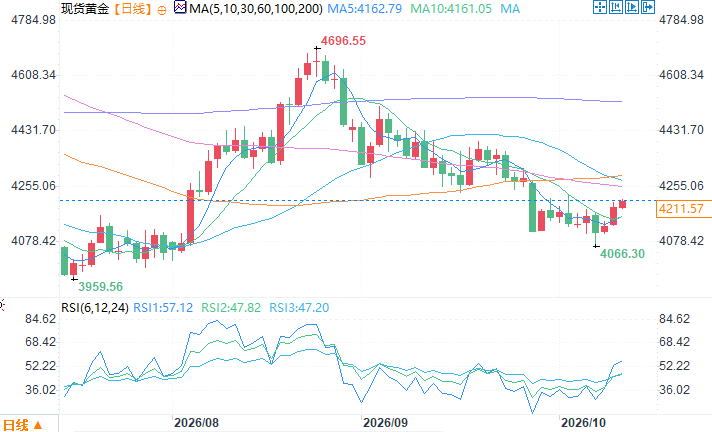 Spot gold daily chart source: FX678. At 10:49 AM Beijing time on October 12th, spot gold was trading at $4205.57 per ounce.
The long-term bullish outlook is clear; however, a distinction needs to be made between short-term and long-term market trends.
Participants predicted that gold prices could reach $5,000 per ounce by the same time next year, a target that fully reflects the analysts' strong long-term bullish stance. However, the market's focus should not be limited to price predictions alone. The most noteworthy core point of this conference is the evolving role of gold and other precious metals within the global financial system, a shift that is taking place at a faster and larger pace. For decades, gold has been viewed as a safe-haven asset against inflation, currency devaluation, and geopolitical instability. These factors still play a role, but investors' perspectives on gold are changing. In an environment where global market confidence in national fiscal conditions and traditional monetary systems is gradually weakening, gold is increasingly becoming a core asset protection tool.The global high-debt environment is reshaping gold's value as a reserve.
Debt issues were a core topic repeatedly discussed at this conference. With governments worldwide continuing to borrow on a massive scale, more and more investors are questioning the long-term sustainability of this debt expansion model. Rising bond yields will suppress gold's performance in the short term, but behind the higher yields lies a growing concern about the fiscal health of bond issuers. Central banks around the world are paying particular attention to this logic. Gold has always been a component of foreign exchange reserves, but its current appeal transcends its traditional safe-haven attributes. Unlike most financial assets, gold does not have counterparty risk, will not default on debt, and physical gold reserves are difficult for other countries to freeze or restrict. In today's increasingly fragmented political and economic landscape, these characteristics are extremely valuable. Joachim Nagel, President of the Bundesbank, stated that gold currently accounts for nearly a quarter of global central bank reserves. This increase largely stems from valuation increases due to rising gold prices, rather than new gold purchases, but this trend still carries strong indicative significance. Central banks are not simply pursuing asset returns, but rather reassessing the role gold can play in the context of rising geopolitical uncertainty.Technological innovation expands the application scenarios of gold, and tokenization opens up new possibilities.
The demand for gold is changing, and innovations are also emerging on the supply and application sides. The conference also explored how digital technology and asset tokenization can enhance the use value of gold as a global financial asset. Various digital platforms are expected to simplify gold trading and transfer processes, and allow gold to be used as collateral, making it easier for more types of investors to participate in gold investment. Of course, there are still many practical challenges to be solved in terms of asset regulation, asset custody, and trust mechanisms, but the potential of this innovation should not be underestimated. This conference conveyed a key conclusion: the future value direction of gold is determined by far more factors than the next interest rate decision by the Federal Reserve Chairman. Investors can debate the current reasonable valuation level of gold, but the more significant question is whether global development trends will continue to elevate the intrinsic value of gold in the future.Conclusion
Overall, short-term pressures from US Treasury yields and inflation data will continue to influence gold price fluctuations, and short-term price volatility and pullbacks are normal. However, the LBMA conference clearly conveyed the message that long-term variables such as high global debt, geopolitical divergence, and rising risks in traditional credit assets are continuously reshaping the underlying value of gold. Digital technology will further expand the scope of gold's applications. For investors, it is crucial to distinguish between short-term trading disturbances and long-term underlying logic, and to re-evaluate gold's role in asset allocation amidst macroeconomic changes. Spot gold daily chart source: FX678. At 10:49 AM Beijing time on October 12th, spot gold was trading at $4205.57 per ounce.
- Risk Warning and Disclaimer
- The market involves risk, and trading may not be suitable for all investors. This article is for reference only and does not constitute personal investment advice, nor does it take into account certain users’ specific investment objectives, financial situation, or other needs. Any investment decisions made based on this information are at your own risk.