The decline in US Treasury yields from their highs put pressure on the US dollar, causing the USD/CAD pair to remain range-bound at high levels.
2026-10-12 13:42:17
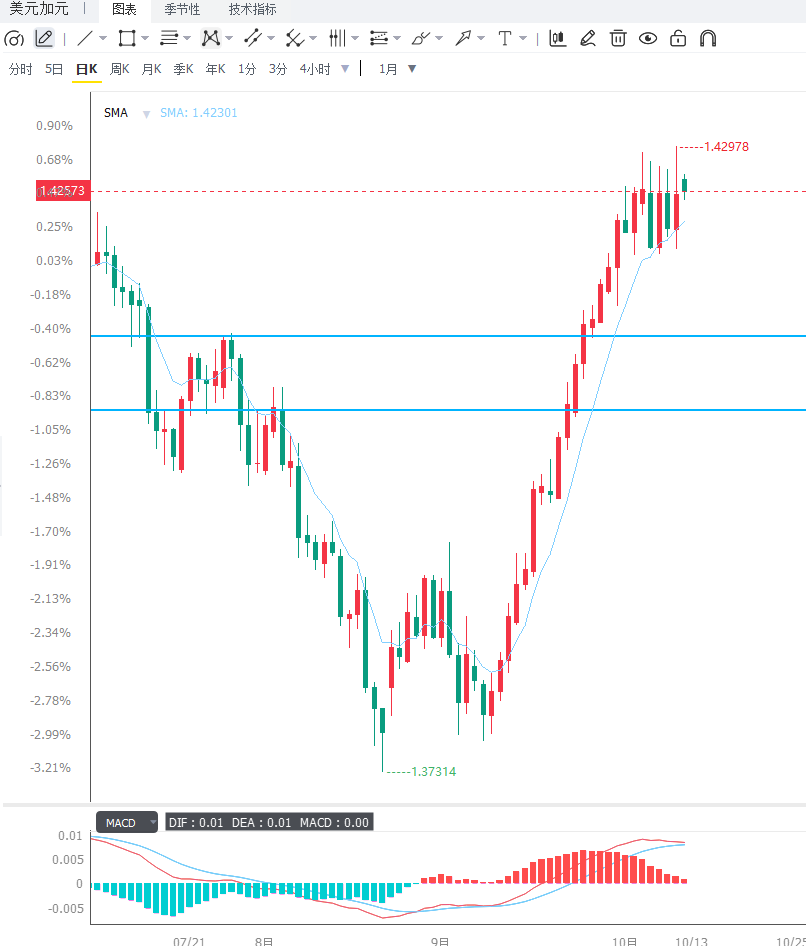
After last week's high-level consolidation, the USD/CAD pair opened slightly higher at 1.4271 in the Asian session of the new week, but failed to hold onto its gains, quickly falling back to around 1.4250, continuing the narrow range-bound consolidation pattern formed over the past week. The market is currently navigating a complex interplay of factors, including the divergence in monetary policies between the US and Canada, oil price volatility, changes in geopolitical risk premiums, and the release of a plethora of data this week. A directional breakout is temporarily lacking, but the fundamental balance still clearly favors the US dollar.  The pressure on the US dollar mainly stems from the pullback in US Treasury yields. The 10-year Treasury yield had previously climbed to over 5.30%, its highest level since 2002, but recently experienced a technical pullback, falling back to around 5.22%, weakening the core support logic for the dollar bulls. Data released by the University of Michigan last Friday further shook market confidence in the resilience of the US economy—the preliminary October consumer confidence index plummeted to 46.3, the lowest in five months; the current economic conditions sub-index even fell to a record low of 44.7. One-year and five- to ten-year inflation expectations rose simultaneously to a five-month peak. This contradictory combination of "deteriorating confidence + rising inflation expectations" has led to a subtle adjustment in market judgments regarding the Fed's policy path. The CME FedWatch Tool shows that the probability of a rate hike of at least 25 basis points in October has fallen to about 17.7%, a significant drop from about 24.4% a week earlier; however, the pricing probability of a rate hike in December remains as high as 84.1%, indicating that expectations for further policy tightening this year remain clear. In his latest speech, St. Louis Federal Reserve President Musaleem clearly stated that "more monetary policy tightening" is needed to bring inflation back to the 2% target level, while emphasizing that the US economy is "quite strong" and the job market is "balanced and stable." Federal Reserve Governor Waller also believes that further rate hikes are still necessary, but the pace is flexible and there is no need to take action at consecutive meetings. This policy tone of "short-term pause, but still raising rates this year" places the US dollar in a middle ground, unlikely to strengthen significantly but also unlikely to fall easily. Meanwhile, the fundamentals in Canada show a clear weakness. Canadian employment plummeted by 68,300 in September, far below market expectations of an increase of 9,200 and significantly lower than Capital Economics' previous forecast of no change. This marks the second consecutive month of large-scale job losses—August saw a decrease of 41,700 jobs, bringing the cumulative loss over the two months to approximately 110,000. The unemployment rate rose from 6.4% to 6.5%. The job losses were primarily concentrated in the public sector, particularly healthcare, social assistance, and education. Manufacturing lost 12,700 jobs, and employment among the 15-24 age group plummeted by 48,000, highlighting the uneven distribution of labor market pressures. BMO economist Douglas Porter warned that the manufacturing job losses could be an early sign of the escalating US-Canada trade conflict impacting the Canadian economy. He emphasized that the weak September jobs report significantly reduced the likelihood of a Bank of Canada rate hike. Capital Economics economist Thomas Ryan bluntly stated that after two consecutive months of sharp job declines, only a significantly stronger-than-expected September inflation data would bring the option of a rate hike later this month back into discussion. Ryan expects the Bank of Canada to wait until 2027 to begin normalizing policy rates. While Oxford Economics' Tony Stillow still expects the Bank of Canada to raise rates twice this year, he also acknowledged that the weak jobs data reduced the likelihood of a rate hike at the end of October, making a preemptive action rather than initiating a new tightening cycle more likely. The Bank of Canada has kept its policy rate unchanged at 2.25%, marking the seventh consecutive time it has held steady since December 2025. This creates a significant interest rate differential of 150 to 175 basis points with the Federal Reserve's 3.75% to 4.00% range. This differential directly reduces the attractiveness of Canadian dollar assets relative to US dollar assets, leading to a continuous flow of funds into US dollar assets and providing solid support for the USD/CAD exchange rate. The movement of crude oil prices constitutes another key transmission path affecting the Canadian dollar. As a major energy exporter, the Canadian dollar typically maintains a high positive correlation with crude oil prices. However, recent oil prices have seen some decline—Trump stated that the US would not attack Iran before the midterm elections and that the US and Iran were having "productive discussions." This statement eased market concerns about an immediate escalation of energy supply disruptions in the Middle East, causing Brent crude oil prices to retreat from recent highs. At the same time, rumors of an "energy ceasefire" between Russia and Ukraine have provided a new narrative for improved crude oil supply expectations, further suppressing the risk premium for oil prices. The decline in oil prices dealt a double blow to the Canadian dollar: on the one hand, it weakened expectations for energy export revenue, and on the other hand, it reduced the urgency for the Bank of Canada to raise interest rates due to imported inflation. However, geopolitical risks have not completely subsided. Iran's top security official announced that Washington's response to its proposal to reopen the Strait of Hormuz was "insufficient," and Trump is considering resuming military strikes against Iran. The repeated deadly attacks on Saudi airports by Houthi rebels have escalated the risk of spillover from regional conflict. If the situation in the Middle East deteriorates further and causes actual supply disruptions, oil prices may rebound rapidly. In this case, the Canadian dollar may actually find support through commodity price channels, thus limiting further upside for USD/CAD. This asymmetric transmission relationship—"declining oil prices are bearish for the Canadian dollar, while soaring oil prices are bullish for the Canadian dollar"—makes the short-term direction of USD/CAD more complex. This week, the market will face a dense test of several key data releases. The US September PPI and CPI data will be released on Wednesday and Thursday, respectively, directly affecting the market's pricing of the Federal Reserve's interest rate path. If inflation data is stronger than expected, it could reignite discussions about an October rate hike, providing new upward momentum for the US dollar; conversely, if the data is weak, the dollar may face profit-taking pressure. Furthermore, both Federal Reserve Chairman Warsh and Bank of Canada Governor Macklem are scheduled to speak at the IMF and World Bank annual meetings in Bangkok on Friday. The latest statements from these two central bank leaders will provide key clues to their respective policy paths. In Canada, September inflation data will also be released soon. If inflation significantly exceeds expectations, it could reignite discussions about a late October rate hike by the Bank of Canada, providing temporary support for the Canadian dollar. From a technical perspective, the USD/CAD pair's range-bound trading over the past week can be defined as a bullish consolidation phase within a strong upward trend. The exchange rate is steadily trading above the 100-day simple moving average and the Bollinger Band middle line, indicating an overall bullish trend. The 14-day Relative Strength Index (RSI) is around 65, in the neutral-to-strong zone but not yet reaching the overbought threshold of 70, showing solid upward momentum without reaching extreme levels. The area around 1.4300 forms a key psychological level and technical resistance. Only a sustained hold above this level can confirm the continuation of the bullish structure and open up further upside potential. A successful breakout could target 1.4310 (the 61.8% Fibonacci retracement of the decline in the first half of last year) and even 1.4335. On the downside, the first support level to watch is the 1.4200-1.4210 area, which corresponds to the recent low and forms the first line of defense. A deeper pullback is expected to find buying support around 1.4150 – as long as the price holds this level, the overall uptrend remains intact. Looking at the 4-hour chart, the price is consolidating within a range of 1.4200 to 1.4275, with short-term moving averages intertwined and the direction uncertain. The MACD has been declining from its highs and the lines are approaching the zero line, while the RSI remains in overbought territory, typical characteristics of a strong consolidation market. 1.4245 is the precise midline of the trading range, and this level is gaining increasing technical importance. A break below this level would likely lead to a test of the bottom of the consolidation range at 1.4200, which is also the intraday high on September 29th. A further break below this level would open up room for a daily correction, with strong buying support expected in the 1.4165-1.4150 range. On the upside, a breakout above 1.4275 with significant volume and subsequent consolidation could lead to a retest of the 1.4300 support level.
  Editor's Summary: The USD/CAD pair is currently caught in a tug-of-war between the "US interest rate advantage" and "short-term profit-taking in the US dollar." The Fed's hawkish stance and the 150-175 basis point USD-CAD interest rate differential provide solid support for the exchange rate, but the decline in US Treasury yields and the plunge in consumer confidence limit further expansion of the US dollar bulls. In Canada, the collapse in September's employment data has virtually eliminated the possibility of a Bank of Canada rate hike in October. The Canadian dollar, squeezed by both policy differentials and weak growth, is unlikely to gain sustained upward momentum, but fluctuations in oil prices may still intermittently alter the short-term balance. Looking ahead, the short-term direction will depend on three key variables: whether this week's US CPI/PPI data can change expectations regarding the Fed's rate hike pace, the policy signals conveyed by Warsh and Macklem's speeches at the IMF annual meeting, and the further impact of the Middle East situation on oil prices and risk sentiment. If strong US inflation data is coupled with a reduction in geopolitical risks, USD/CAD is expected to break through 1.4300 and challenge the 1.4310-1.4335 area; conversely, if the data is weak and oil prices rebound sharply due to supply disruptions, the exchange rate may fall back to the 1.4200 or even 1.4150 support area.
The pressure on the US dollar mainly stems from the pullback in US Treasury yields. The 10-year Treasury yield had previously climbed to over 5.30%, its highest level since 2002, but recently experienced a technical pullback, falling back to around 5.22%, weakening the core support logic for the dollar bulls. Data released by the University of Michigan last Friday further shook market confidence in the resilience of the US economy—the preliminary October consumer confidence index plummeted to 46.3, the lowest in five months; the current economic conditions sub-index even fell to a record low of 44.7. One-year and five- to ten-year inflation expectations rose simultaneously to a five-month peak. This contradictory combination of "deteriorating confidence + rising inflation expectations" has led to a subtle adjustment in market judgments regarding the Fed's policy path. The CME FedWatch Tool shows that the probability of a rate hike of at least 25 basis points in October has fallen to about 17.7%, a significant drop from about 24.4% a week earlier; however, the pricing probability of a rate hike in December remains as high as 84.1%, indicating that expectations for further policy tightening this year remain clear. In his latest speech, St. Louis Federal Reserve President Musaleem clearly stated that "more monetary policy tightening" is needed to bring inflation back to the 2% target level, while emphasizing that the US economy is "quite strong" and the job market is "balanced and stable." Federal Reserve Governor Waller also believes that further rate hikes are still necessary, but the pace is flexible and there is no need to take action at consecutive meetings. This policy tone of "short-term pause, but still raising rates this year" places the US dollar in a middle ground, unlikely to strengthen significantly but also unlikely to fall easily. Meanwhile, the fundamentals in Canada show a clear weakness. Canadian employment plummeted by 68,300 in September, far below market expectations of an increase of 9,200 and significantly lower than Capital Economics' previous forecast of no change. This marks the second consecutive month of large-scale job losses—August saw a decrease of 41,700 jobs, bringing the cumulative loss over the two months to approximately 110,000. The unemployment rate rose from 6.4% to 6.5%. The job losses were primarily concentrated in the public sector, particularly healthcare, social assistance, and education. Manufacturing lost 12,700 jobs, and employment among the 15-24 age group plummeted by 48,000, highlighting the uneven distribution of labor market pressures. BMO economist Douglas Porter warned that the manufacturing job losses could be an early sign of the escalating US-Canada trade conflict impacting the Canadian economy. He emphasized that the weak September jobs report significantly reduced the likelihood of a Bank of Canada rate hike. Capital Economics economist Thomas Ryan bluntly stated that after two consecutive months of sharp job declines, only a significantly stronger-than-expected September inflation data would bring the option of a rate hike later this month back into discussion. Ryan expects the Bank of Canada to wait until 2027 to begin normalizing policy rates. While Oxford Economics' Tony Stillow still expects the Bank of Canada to raise rates twice this year, he also acknowledged that the weak jobs data reduced the likelihood of a rate hike at the end of October, making a preemptive action rather than initiating a new tightening cycle more likely. The Bank of Canada has kept its policy rate unchanged at 2.25%, marking the seventh consecutive time it has held steady since December 2025. This creates a significant interest rate differential of 150 to 175 basis points with the Federal Reserve's 3.75% to 4.00% range. This differential directly reduces the attractiveness of Canadian dollar assets relative to US dollar assets, leading to a continuous flow of funds into US dollar assets and providing solid support for the USD/CAD exchange rate. The movement of crude oil prices constitutes another key transmission path affecting the Canadian dollar. As a major energy exporter, the Canadian dollar typically maintains a high positive correlation with crude oil prices. However, recent oil prices have seen some decline—Trump stated that the US would not attack Iran before the midterm elections and that the US and Iran were having "productive discussions." This statement eased market concerns about an immediate escalation of energy supply disruptions in the Middle East, causing Brent crude oil prices to retreat from recent highs. At the same time, rumors of an "energy ceasefire" between Russia and Ukraine have provided a new narrative for improved crude oil supply expectations, further suppressing the risk premium for oil prices. The decline in oil prices dealt a double blow to the Canadian dollar: on the one hand, it weakened expectations for energy export revenue, and on the other hand, it reduced the urgency for the Bank of Canada to raise interest rates due to imported inflation. However, geopolitical risks have not completely subsided. Iran's top security official announced that Washington's response to its proposal to reopen the Strait of Hormuz was "insufficient," and Trump is considering resuming military strikes against Iran. The repeated deadly attacks on Saudi airports by Houthi rebels have escalated the risk of spillover from regional conflict. If the situation in the Middle East deteriorates further and causes actual supply disruptions, oil prices may rebound rapidly. In this case, the Canadian dollar may actually find support through commodity price channels, thus limiting further upside for USD/CAD. This asymmetric transmission relationship—"declining oil prices are bearish for the Canadian dollar, while soaring oil prices are bullish for the Canadian dollar"—makes the short-term direction of USD/CAD more complex. This week, the market will face a dense test of several key data releases. The US September PPI and CPI data will be released on Wednesday and Thursday, respectively, directly affecting the market's pricing of the Federal Reserve's interest rate path. If inflation data is stronger than expected, it could reignite discussions about an October rate hike, providing new upward momentum for the US dollar; conversely, if the data is weak, the dollar may face profit-taking pressure. Furthermore, both Federal Reserve Chairman Warsh and Bank of Canada Governor Macklem are scheduled to speak at the IMF and World Bank annual meetings in Bangkok on Friday. The latest statements from these two central bank leaders will provide key clues to their respective policy paths. In Canada, September inflation data will also be released soon. If inflation significantly exceeds expectations, it could reignite discussions about a late October rate hike by the Bank of Canada, providing temporary support for the Canadian dollar. From a technical perspective, the USD/CAD pair's range-bound trading over the past week can be defined as a bullish consolidation phase within a strong upward trend. The exchange rate is steadily trading above the 100-day simple moving average and the Bollinger Band middle line, indicating an overall bullish trend. The 14-day Relative Strength Index (RSI) is around 65, in the neutral-to-strong zone but not yet reaching the overbought threshold of 70, showing solid upward momentum without reaching extreme levels. The area around 1.4300 forms a key psychological level and technical resistance. Only a sustained hold above this level can confirm the continuation of the bullish structure and open up further upside potential. A successful breakout could target 1.4310 (the 61.8% Fibonacci retracement of the decline in the first half of last year) and even 1.4335. On the downside, the first support level to watch is the 1.4200-1.4210 area, which corresponds to the recent low and forms the first line of defense. A deeper pullback is expected to find buying support around 1.4150 – as long as the price holds this level, the overall uptrend remains intact. Looking at the 4-hour chart, the price is consolidating within a range of 1.4200 to 1.4275, with short-term moving averages intertwined and the direction uncertain. The MACD has been declining from its highs and the lines are approaching the zero line, while the RSI remains in overbought territory, typical characteristics of a strong consolidation market. 1.4245 is the precise midline of the trading range, and this level is gaining increasing technical importance. A break below this level would likely lead to a test of the bottom of the consolidation range at 1.4200, which is also the intraday high on September 29th. A further break below this level would open up room for a daily correction, with strong buying support expected in the 1.4165-1.4150 range. On the upside, a breakout above 1.4275 with significant volume and subsequent consolidation could lead to a retest of the 1.4300 support level. Editor's Summary: The USD/CAD pair is currently caught in a tug-of-war between the "US interest rate advantage" and "short-term profit-taking in the US dollar." The Fed's hawkish stance and the 150-175 basis point USD-CAD interest rate differential provide solid support for the exchange rate, but the decline in US Treasury yields and the plunge in consumer confidence limit further expansion of the US dollar bulls. In Canada, the collapse in September's employment data has virtually eliminated the possibility of a Bank of Canada rate hike in October. The Canadian dollar, squeezed by both policy differentials and weak growth, is unlikely to gain sustained upward momentum, but fluctuations in oil prices may still intermittently alter the short-term balance. Looking ahead, the short-term direction will depend on three key variables: whether this week's US CPI/PPI data can change expectations regarding the Fed's rate hike pace, the policy signals conveyed by Warsh and Macklem's speeches at the IMF annual meeting, and the further impact of the Middle East situation on oil prices and risk sentiment. If strong US inflation data is coupled with a reduction in geopolitical risks, USD/CAD is expected to break through 1.4300 and challenge the 1.4310-1.4335 area; conversely, if the data is weak and oil prices rebound sharply due to supply disruptions, the exchange rate may fall back to the 1.4200 or even 1.4150 support area.
- Risk Warning and Disclaimer
- The market involves risk, and trading may not be suitable for all investors. This article is for reference only and does not constitute personal investment advice, nor does it take into account certain users’ specific investment objectives, financial situation, or other needs. Any investment decisions made based on this information are at your own risk.