A sharp drop in US consumer confidence weakened the dollar, while a postponement of the Bank of Japan's interest rate hike expectations kept the USD/JPY pair hovering around the 158 level.
2026-10-12 13:58:17
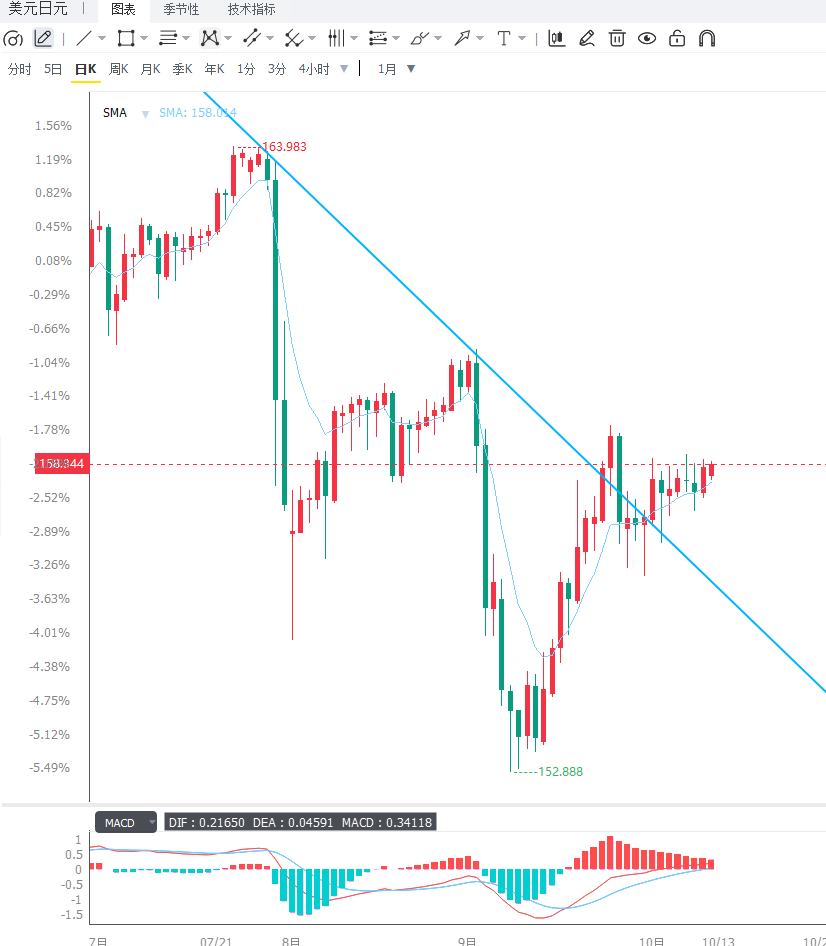
The USD/JPY currency pair retreated slightly during Monday's Asian session after a modest gain in the previous trading day, trading around 158.10. Trading volume is expected to be light due to the Japanese market being closed for the Sports Day public holiday, potentially limiting price fluctuations. The market is currently navigating a complex interplay of divergent monetary policy expectations between the US and Japan, intertwined geopolitical risks, and a flurry of macroeconomic data releases, leaving a directional breakout temporarily uncertain.  Pressure on the dollar stemmed from a sharp deterioration in consumer confidence. The University of Michigan's preliminary October consumer sentiment index plummeted to 46.3, not only far below the expected 48.1 in September and 47.6 in April, but also marking the third consecutive month of decline, nearing the record low set in May. The sub-index measuring consumer satisfaction with the current economic situation plunged even further to 44.7, a record low since the index's inception, reflecting the heavy blow to the confidence of ordinary American households from high oil prices, high borrowing costs, and slowing job growth. One-year inflation expectations rose from 4.6% to 4.7%, and long-term inflation expectations for the five to ten year period also rose from 3.4% to 3.5%, both reaching their highest levels in five months. Only about 31% of respondents expected to maintain normal consumption levels over the next year, with more than half indicating they would cut spending on home furnishings, automobiles, and dining out. This data directly impacted market confidence in the resilience of the US economy, weakening the narrative of the dollar's growth advantage. However, the Federal Reserve's policy expectations continue to provide a floor for the dollar. In his latest speech, St. Louis Federal Reserve President Mussaliem clearly stated that "more monetary policy tightening" is needed to bring inflation back to the 2% target level, while emphasizing that the US economy is "quite strong" and the job market is "balanced and stable." Market surveys, using the CME FedWatch Tool, show that traders have lowered their pricing probability for an October rate hike of at least 25 basis points to about 17.7%, down from about 24.4% a week earlier, but the pricing probability for a December rate hike remains as high as 84.1%. This indicates that market expectations for a near-term rate hike have cooled somewhat, but the expectation of further policy tightening this year remains clear. The Fed Sentiment Index, while slightly down 0.25 points to 138.33, remains firmly above the neutral benchmark of 100, indicating that overall policy communication remains hawkish. Regarding the yen, the Bank of Japan's policy path has become a core variable influencing exchange rate movements. At its September meeting, the Bank of Japan raised its policy rate by 25 basis points to 1.25%, the highest level since 1995, with the decision passed by a 7-2 vote. However, the market is more focused on the pace of subsequent interest rate hikes. In his latest speech, Bank of Japan Governor Kazuo Ueda hinted that a rapid and continuous series of rate hikes similar to those experienced by North America and Europe after the pandemic in 2022 is unlikely. This statement has been interpreted by the market as a clear signal that the Bank of Japan will hold rates steady at its October 29-30 meeting. Current swap market pricing indicates that the probability of another rate hike in October is less than 20%, while the pricing probability for a rate hike in December is about 90%. The market generally expects the Bank of Japan to further raise interest rates to 1.50% by the end of the year or early next year, and then possibly to 1.75% in March or April. It is worth noting that the Bank of Japan's newly appointed policy board member, Ayano Sato, recently expressed support for a phased approach to rate hikes, even though she was one of the two dissenters against a rate hike at the September meeting. Appointed by Prime Minister Sanae Takaichi, who advocates for loose monetary policy, Sato's shift in stance has reduced market concerns about dovish members blocking rate hikes, providing internal support for the expectation of a December rate hike within the central bank. However, after Kazuo Ueda clearly signaled a "no rush to take continuous action," the yen lacks a catalyst for sustained strength based on interest rate hike expectations in the short term. From an interest rate differential perspective, the Federal Reserve's target federal funds rate remains in the range of 3.75% to 4.00%, while the Bank of Japan's policy rate is 1.25%, a difference of 2.50 to 2.75 percentage points. This interest rate differential means that borrowing yen at a financing cost of 1.25% and buying dollar assets with a yield close to 4% can still generate a stable and considerable positive carry trade, and yen carry trades continue to exist and remain crowded. The US-Japan 10-year government bond yield differential is highly positively correlated with the USD/JPY exchange rate. The 10-year US Treasury yield has fallen from its highest level since 2002 last week to around 5.22%, putting substantial pressure on the USD/JPY. However, if the US Treasury yield stabilizes and rebounds or the Bank of Japan's tightening pace slows down, the interest rate differential advantage will continue to provide support for the exchange rate. Geopolitically, the continued tension in the Middle East affects the USD/JPY exchange rate through multiple channels. Following a series of deadly attacks by Houthi rebels at Riyadh Airport, Saudi Arabia, and with US President Trump considering joining Saudi Arabia in military retaliation against Yemen, the risk of energy supply disruptions has resurfaced. Brent crude oil prices remain above $104 per barrel, with high oil prices indirectly supporting the Federal Reserve's tight monetary policy by pushing up inflation expectations, thus benefiting the US dollar. However, as a highly energy-dependent economy, Japan faces increased imported inflationary pressures due to high energy costs, exacerbating the yen's depreciation and increasing the sensitivity of Japanese authorities to intervention in exchange rate fluctuations. A recent report by LGT Asia Private Bank points out that the risk of Japanese government intervention in the foreign exchange market to support the yen will limit further upside for the dollar, especially near the sensitive 160 level. Bank of America also warns that if the USD/JPY exchange rate breaks through 160, the likelihood of Japanese authorities taking foreign exchange intervention measures will further increase. Sarah Midgaard, an analyst at Nordea Bank, notes that the recent rise in US Treasury yields "mainly reflects higher expected short-term real interest rates, rather than a significant increase in term premiums." She explained that rising real interest rates often occur when the market "expects stronger real growth or a higher real interest rate path," meaning that the current rise in yields is driven more by growth and policy expectations than by a repricing of long-term risk premiums. This analysis has important implications for USD/JPY: if subsequent US economic data confirms a slowdown in growth, real interest rate expectations may decline, thus limiting the upside potential of USD/JPY. From a technical perspective, on the daily chart, USD/JPY is trading above the middle Bollinger Band, with the Bollinger Bands narrowing and volatility declining, indicating a clear high-level consolidation. The 20-day exponential moving average at 157.60 provides significant dynamic support, and the medium-term moving averages remain in a bullish alignment, meaning the larger trend has not yet turned bearish. The 14-day Relative Strength Index (RSI) remains around 58, not reaching the 70 overbought threshold, but the upward slope is weakening, suggesting a potential top divergence at high levels. The MACD is above the zero line, with the red bars continuing to narrow and the fast and slow lines converging, indicating weakening bullish momentum and insufficient upward drive. The key resistance level at 159.00 represents a previous high, with concentrated selling pressure. It also approaches a sensitive area for potential Japanese intervention, making a one-time breakout difficult. The 100-day moving average around 159.55 and the upper Bollinger Band around 159.80 form a dense resistance zone, where rebounds have repeatedly encountered resistance. On the downside, the first support level to watch is the 20-day EMA around 157.60. A decisive break below this level would open up further downside potential, with the next support level at the 50-day moving average around 156.90. A stronger support level lies near the lower Bollinger Band around 154.00. Looking at the 4-hour chart, the price is facing dynamic resistance from the short-term upper Bollinger Band around 158.35. A breakout with significant volume could potentially challenge the 159.00-159.55 area; conversely, a weak rebound would likely lead to a pullback to the 157.15-156.90 support zone. The 100-period simple moving average on the 4-hour chart, around 157.59, forms a significant dynamic support level. If the price can hold this area, there is still a chance to retest the upper limit of the range near 158.50 in the short term.
  Editor's Summary: The USD/JPY pair is currently caught in a dual struggle between the "US interest rate advantage" and the "risk of Japanese policy intervention." The Federal Reserve's hawkish stance and high US Treasury yields provide a floor for the dollar, but a sharp deterioration in consumer confidence and the approaching midterm elections increase uncertainty about the US economic outlook. The Bank of Japan's gradual interest rate hike path weakens the yen's attractiveness as a low-cost funding currency, but the intervention risk at the 160 level creates a hidden ceiling for the exchange rate. Looking ahead, the short-term direction will depend on three key variables: whether this week's US CPI and PPI data can alleviate concerns about sticky inflation, the policy signals released by the Bank of Japan at its meeting at the end of October, and the further impact of the Middle East situation on energy prices and risk aversion. If US inflation data is strong and Fed officials continue to reinforce their hawkish stance, USD/JPY is expected to challenge the dense resistance zone of 159.00 and even 159.55; if the data weakens and the Japanese authorities release clearer signals of exchange rate stabilization, the exchange rate may fall back to the support area of 157.00 to 156.90 to seek a new equilibrium.
Pressure on the dollar stemmed from a sharp deterioration in consumer confidence. The University of Michigan's preliminary October consumer sentiment index plummeted to 46.3, not only far below the expected 48.1 in September and 47.6 in April, but also marking the third consecutive month of decline, nearing the record low set in May. The sub-index measuring consumer satisfaction with the current economic situation plunged even further to 44.7, a record low since the index's inception, reflecting the heavy blow to the confidence of ordinary American households from high oil prices, high borrowing costs, and slowing job growth. One-year inflation expectations rose from 4.6% to 4.7%, and long-term inflation expectations for the five to ten year period also rose from 3.4% to 3.5%, both reaching their highest levels in five months. Only about 31% of respondents expected to maintain normal consumption levels over the next year, with more than half indicating they would cut spending on home furnishings, automobiles, and dining out. This data directly impacted market confidence in the resilience of the US economy, weakening the narrative of the dollar's growth advantage. However, the Federal Reserve's policy expectations continue to provide a floor for the dollar. In his latest speech, St. Louis Federal Reserve President Mussaliem clearly stated that "more monetary policy tightening" is needed to bring inflation back to the 2% target level, while emphasizing that the US economy is "quite strong" and the job market is "balanced and stable." Market surveys, using the CME FedWatch Tool, show that traders have lowered their pricing probability for an October rate hike of at least 25 basis points to about 17.7%, down from about 24.4% a week earlier, but the pricing probability for a December rate hike remains as high as 84.1%. This indicates that market expectations for a near-term rate hike have cooled somewhat, but the expectation of further policy tightening this year remains clear. The Fed Sentiment Index, while slightly down 0.25 points to 138.33, remains firmly above the neutral benchmark of 100, indicating that overall policy communication remains hawkish. Regarding the yen, the Bank of Japan's policy path has become a core variable influencing exchange rate movements. At its September meeting, the Bank of Japan raised its policy rate by 25 basis points to 1.25%, the highest level since 1995, with the decision passed by a 7-2 vote. However, the market is more focused on the pace of subsequent interest rate hikes. In his latest speech, Bank of Japan Governor Kazuo Ueda hinted that a rapid and continuous series of rate hikes similar to those experienced by North America and Europe after the pandemic in 2022 is unlikely. This statement has been interpreted by the market as a clear signal that the Bank of Japan will hold rates steady at its October 29-30 meeting. Current swap market pricing indicates that the probability of another rate hike in October is less than 20%, while the pricing probability for a rate hike in December is about 90%. The market generally expects the Bank of Japan to further raise interest rates to 1.50% by the end of the year or early next year, and then possibly to 1.75% in March or April. It is worth noting that the Bank of Japan's newly appointed policy board member, Ayano Sato, recently expressed support for a phased approach to rate hikes, even though she was one of the two dissenters against a rate hike at the September meeting. Appointed by Prime Minister Sanae Takaichi, who advocates for loose monetary policy, Sato's shift in stance has reduced market concerns about dovish members blocking rate hikes, providing internal support for the expectation of a December rate hike within the central bank. However, after Kazuo Ueda clearly signaled a "no rush to take continuous action," the yen lacks a catalyst for sustained strength based on interest rate hike expectations in the short term. From an interest rate differential perspective, the Federal Reserve's target federal funds rate remains in the range of 3.75% to 4.00%, while the Bank of Japan's policy rate is 1.25%, a difference of 2.50 to 2.75 percentage points. This interest rate differential means that borrowing yen at a financing cost of 1.25% and buying dollar assets with a yield close to 4% can still generate a stable and considerable positive carry trade, and yen carry trades continue to exist and remain crowded. The US-Japan 10-year government bond yield differential is highly positively correlated with the USD/JPY exchange rate. The 10-year US Treasury yield has fallen from its highest level since 2002 last week to around 5.22%, putting substantial pressure on the USD/JPY. However, if the US Treasury yield stabilizes and rebounds or the Bank of Japan's tightening pace slows down, the interest rate differential advantage will continue to provide support for the exchange rate. Geopolitically, the continued tension in the Middle East affects the USD/JPY exchange rate through multiple channels. Following a series of deadly attacks by Houthi rebels at Riyadh Airport, Saudi Arabia, and with US President Trump considering joining Saudi Arabia in military retaliation against Yemen, the risk of energy supply disruptions has resurfaced. Brent crude oil prices remain above $104 per barrel, with high oil prices indirectly supporting the Federal Reserve's tight monetary policy by pushing up inflation expectations, thus benefiting the US dollar. However, as a highly energy-dependent economy, Japan faces increased imported inflationary pressures due to high energy costs, exacerbating the yen's depreciation and increasing the sensitivity of Japanese authorities to intervention in exchange rate fluctuations. A recent report by LGT Asia Private Bank points out that the risk of Japanese government intervention in the foreign exchange market to support the yen will limit further upside for the dollar, especially near the sensitive 160 level. Bank of America also warns that if the USD/JPY exchange rate breaks through 160, the likelihood of Japanese authorities taking foreign exchange intervention measures will further increase. Sarah Midgaard, an analyst at Nordea Bank, notes that the recent rise in US Treasury yields "mainly reflects higher expected short-term real interest rates, rather than a significant increase in term premiums." She explained that rising real interest rates often occur when the market "expects stronger real growth or a higher real interest rate path," meaning that the current rise in yields is driven more by growth and policy expectations than by a repricing of long-term risk premiums. This analysis has important implications for USD/JPY: if subsequent US economic data confirms a slowdown in growth, real interest rate expectations may decline, thus limiting the upside potential of USD/JPY. From a technical perspective, on the daily chart, USD/JPY is trading above the middle Bollinger Band, with the Bollinger Bands narrowing and volatility declining, indicating a clear high-level consolidation. The 20-day exponential moving average at 157.60 provides significant dynamic support, and the medium-term moving averages remain in a bullish alignment, meaning the larger trend has not yet turned bearish. The 14-day Relative Strength Index (RSI) remains around 58, not reaching the 70 overbought threshold, but the upward slope is weakening, suggesting a potential top divergence at high levels. The MACD is above the zero line, with the red bars continuing to narrow and the fast and slow lines converging, indicating weakening bullish momentum and insufficient upward drive. The key resistance level at 159.00 represents a previous high, with concentrated selling pressure. It also approaches a sensitive area for potential Japanese intervention, making a one-time breakout difficult. The 100-day moving average around 159.55 and the upper Bollinger Band around 159.80 form a dense resistance zone, where rebounds have repeatedly encountered resistance. On the downside, the first support level to watch is the 20-day EMA around 157.60. A decisive break below this level would open up further downside potential, with the next support level at the 50-day moving average around 156.90. A stronger support level lies near the lower Bollinger Band around 154.00. Looking at the 4-hour chart, the price is facing dynamic resistance from the short-term upper Bollinger Band around 158.35. A breakout with significant volume could potentially challenge the 159.00-159.55 area; conversely, a weak rebound would likely lead to a pullback to the 157.15-156.90 support zone. The 100-period simple moving average on the 4-hour chart, around 157.59, forms a significant dynamic support level. If the price can hold this area, there is still a chance to retest the upper limit of the range near 158.50 in the short term. Editor's Summary: The USD/JPY pair is currently caught in a dual struggle between the "US interest rate advantage" and the "risk of Japanese policy intervention." The Federal Reserve's hawkish stance and high US Treasury yields provide a floor for the dollar, but a sharp deterioration in consumer confidence and the approaching midterm elections increase uncertainty about the US economic outlook. The Bank of Japan's gradual interest rate hike path weakens the yen's attractiveness as a low-cost funding currency, but the intervention risk at the 160 level creates a hidden ceiling for the exchange rate. Looking ahead, the short-term direction will depend on three key variables: whether this week's US CPI and PPI data can alleviate concerns about sticky inflation, the policy signals released by the Bank of Japan at its meeting at the end of October, and the further impact of the Middle East situation on energy prices and risk aversion. If US inflation data is strong and Fed officials continue to reinforce their hawkish stance, USD/JPY is expected to challenge the dense resistance zone of 159.00 and even 159.55; if the data weakens and the Japanese authorities release clearer signals of exchange rate stabilization, the exchange rate may fall back to the support area of 157.00 to 156.90 to seek a new equilibrium.
- Risk Warning and Disclaimer
- The market involves risk, and trading may not be suitable for all investors. This article is for reference only and does not constitute personal investment advice, nor does it take into account certain users’ specific investment objectives, financial situation, or other needs. Any investment decisions made based on this information are at your own risk.