Supported by hawkish comments from the Bank of England and a slight weakening of the US dollar, the pound/dollar pair rebounded for the third consecutive day.
2026-10-12 13:52:17
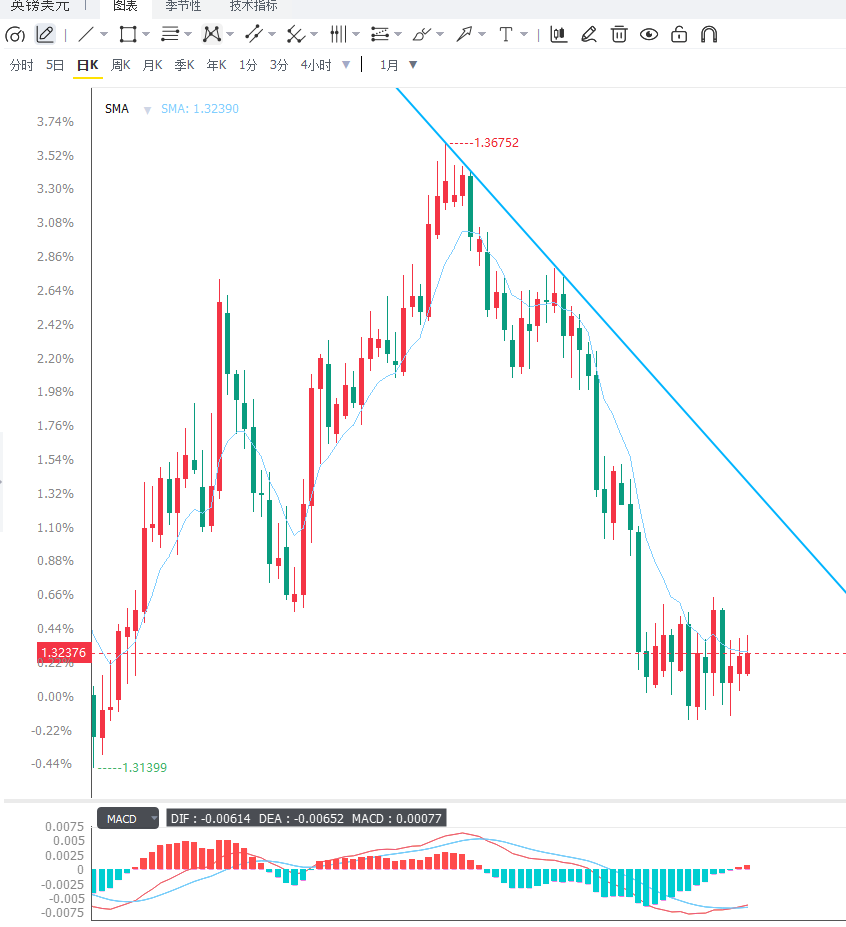
After stabilizing at last week's lows, the GBP/USD pair continued its modest rebound in Asian trading on Monday, trading around 1.3230, attracting bargain hunters for the third consecutive session. However, the pair remained confined to a narrow trading range formed over the past three weeks, with neither bulls nor bears demonstrating a decisive force to break the equilibrium. Market activity was relatively light – the US markets were closed for Columbus Day, and the resulting liquidity tightening amplified the uncertainty surrounding price movements.  The pressure on the US dollar mainly stems from the pullback in US Treasury yields. The 10-year Treasury yield had previously climbed to its highest level since 2002, but has recently retreated from its peak, weakening the core support logic for the dollar bulls. Data released by the University of Michigan last Friday further shook market confidence in the resilience of the US economy—the preliminary October consumer confidence index plummeted to 46.3, the lowest level in five months, far below the market expectation of 47.6; the current economic conditions sub-index even fell to a record low of 44.7. One-year inflation expectations rose from 4.6% to 4.7%, and long-term inflation expectations for the five to ten years both rose to 3.5%, reaching a five-month peak. This combination of "deteriorating confidence + rising inflation expectations" has led to a subtle adjustment in market judgments regarding the Fed's policy path—the CME FedWatch Tool shows that the probability of a rate hike of at least 25 basis points in October has fallen from about 24.4% a week ago to 17.7%, but the pricing probability of a rate hike in December remains as high as 84.1%. Federal Reserve Governor Waller previously stated that further rate hikes may still be necessary, but the pace will be flexible, and a pause in October was not ruled out. This statement was interpreted by the market as a decrease in the urgency of recent policy tightening, putting temporary pressure on the dollar. However, the downside potential of the dollar is also limited. Geopolitical tensions in the Middle East remain high—Iran's top security official announced that Washington's response to its proposal to reopen the Strait of Hormuz was "insufficient," and US President Trump is considering resuming military strikes against Iran. Saudi airports have been repeatedly and deadly attacked by Houthi rebels, escalating the risk of spillover from regional conflict. Geopolitical uncertainty provides a continued buffer for the safe-haven demand for the dollar, allowing traders to remain restrained when significantly shorting it. Support for the pound comes from multiple dimensions. Ahead of the first budget to be released on October 28, UK Chancellor of the Exchequer John Healy reiterated his commitment to strict fiscal discipline, which to some extent alleviated market concerns about the sustainability of UK public finances, providing positive support for the pound. More importantly, hawkish voices within the Bank of England are continuing to rise. Monetary Policy Committee member Mann explicitly warned that inflation above the 2% target has become "solidified" in the UK economic system, and there is a risk of inflation rising to 4% during the year-end wage negotiations window. Once a wage-price spiral effect forms, inflation will have endogenous persistence. Mann has consistently voted for a 25 basis point rate hike to 4% since July, making him a core hawk on the committee. Deputy Governor Brident also stated that raising interest rates to address inflation risks is "increasingly appropriate," and policymakers should not wait too long to act. Morgan Stanley recently revised its forecast, expecting the Bank of England to raise interest rates by 25 basis points each in November and February next year, whereas previously the bank had predicted no rate hikes in the foreseeable future. The Bank of England kept interest rates unchanged at 3.75% at its September meeting, but the vote was 6 to 3, with three members supporting a 4% rate hike—this divergence itself signals an approaching tightening of policy. However, the pound's rebound is not without constraints. The headwinds facing UK economic growth cannot be ignored – household consumption expenditure fell for the ninth consecutive month in August, although the decline was smaller than expected, and real wages have risen for the eighth consecutive month, but the foundation for domestic demand recovery remains fragile. High energy prices pose a double blow to the UK economy: on the one hand, they push up imported inflation, reinforcing the Bank of England's case for maintaining a tight stance; on the other hand, they compress real household income and corporate profits, dragging down economic growth. Goldman Sachs expects the UK's overall inflation rate to peak at 3.9% in early 2027, and producer price data is even more worrying – output prices rose 3.7% year-on-year in August, and input prices rose 6.1% year-on-year, both exceeding market expectations. While high inflation data has provided short-term support for the pound with a "central bank hawkish premium," if economic growth continues to weaken, market doubts about the Bank of England's ability to continue raising interest rates may resurface, at which point the pound's interest rate support will be tested. This week, the market will face a intensive test of several key data releases. The UK's monthly GDP report will be released first, providing the latest clues to assess the momentum of UK economic growth. US September CPI and PPI data will be released on Wednesday and Thursday respectively, directly impacting market pricing in the Federal Reserve's interest rate path. Furthermore, UK Chancellor of the Exchequer Healy will speak at the IMF and World Bank annual meetings, while Bank of England Governor Bailey and Federal Reserve Chairman Warsh are scheduled to speak on Friday – the latest statements from these two central bank leaders could be key catalysts breaking the current equilibrium in the exchange rate range. From a technical perspective, the GBP/USD pair maintains a bearish bias on the daily chart, with the price consistently trading below the 20-day simple moving average and the 100-day moving average, indicating that the short-to-medium-term trend has not yet reversed. The 14-day Relative Strength Index (RSI) is around 39, below the neutral level of 50, showing that sellers still have the upper hand, but the indicator has not yet entered the typical oversold zone, meaning that while downward pressure continues, it has not reached extreme levels. The Bollinger Band middle line at approximately 1.3295 forms the first significant resistance level. If the exchange rate can effectively break through this level, the short-term rebound is expected to continue, with the 100-day moving average at approximately 1.3402 to watch next. Further resistance lies near the upper Bollinger Band at approximately 1.3470. Until the exchange rate firmly establishes itself above 1.3295, the rebound is more accurately described as a correction within a weak market rather than a trend reversal. On the downside, the first support level to watch is the psychological level of 1.3200. A break below this level could lead to a retest of the lower boundary of the range around 1.3140. The lower Bollinger Band at approximately 1.3115 provides stronger support; a break below this level could result in a deeper pullback. Looking at the 4-hour chart, the exchange rate has entered a period of consolidation after rebounding from its lows, with slightly higher highs, forming a small short-term trading range. The MACD histogram continues to contract, with the fast line gradually approaching the slow line, indicating a moderate release of rebound momentum. The RSI has risen to around 47, suggesting a balance between bullish and bearish forces. Bollinger Bands are narrowing, volatility continues to converge, and the market awaits a directional breakout. The first short-term resistance is at 1.3275, a 4-hour supply zone; selling pressure is likely to emerge at this level. Short-term support is at 1.3220; if this level holds, the exchange rate is expected to continue testing the 1.3275-1.3300 resistance zone. A break below 1.3220 would signal the failure of this rebound, and the exchange rate would return to test 1.3200 and even 1.3180. The 100-period simple moving average around 1.3260 forms dynamic resistance; as long as the exchange rate remains below this moving average, any rebound is likely to encounter selling pressure, and only a valid breakout can confirm that the bulls have regained control.
  Editor's Summary: The GBP/USD pair is currently in a state of equilibrium, caught between a weakening dollar and concerns about UK growth. The decline in US Treasury yields from their highs and the plunge in consumer confidence have eroded the dollar's bullish momentum, but Middle East geopolitical risks have provided a floor for the safe-haven dollar. Hawkish statements from several Bank of England officials and Morgan Stanley's shift to a bullish rate hike forecast have created a policy premium for the pound, but continued contraction in household consumption and the double-edged sword effect of energy costs limit its further upside potential. The exchange rate has been confined to a narrow range of 1.3180 to 1.3300 for the past three weeks, with neither bulls nor bears possessing a core driving force to break the deadlock. Looking ahead, the short-term direction will depend on the evolution of three key variables: whether this week's UK GDP and US CPI data can change expectations regarding the UK-US interest rate differential, the forward-looking signals from UK Chancellor Healy's budget, and the policy direction conveyed by speeches from Bank of England Governor Bailey and Federal Reserve Chairman Warsh. If US CPI is weak and UK data is robust, GBP/USD is expected to break through the 1.3295-1.3300 resistance zone and challenge the 1.3400 area; conversely, if inflation data is strong and UK growth data deteriorates, the exchange rate may fall back to around 1.3200 or even 1.3140 to seek support.
The pressure on the US dollar mainly stems from the pullback in US Treasury yields. The 10-year Treasury yield had previously climbed to its highest level since 2002, but has recently retreated from its peak, weakening the core support logic for the dollar bulls. Data released by the University of Michigan last Friday further shook market confidence in the resilience of the US economy—the preliminary October consumer confidence index plummeted to 46.3, the lowest level in five months, far below the market expectation of 47.6; the current economic conditions sub-index even fell to a record low of 44.7. One-year inflation expectations rose from 4.6% to 4.7%, and long-term inflation expectations for the five to ten years both rose to 3.5%, reaching a five-month peak. This combination of "deteriorating confidence + rising inflation expectations" has led to a subtle adjustment in market judgments regarding the Fed's policy path—the CME FedWatch Tool shows that the probability of a rate hike of at least 25 basis points in October has fallen from about 24.4% a week ago to 17.7%, but the pricing probability of a rate hike in December remains as high as 84.1%. Federal Reserve Governor Waller previously stated that further rate hikes may still be necessary, but the pace will be flexible, and a pause in October was not ruled out. This statement was interpreted by the market as a decrease in the urgency of recent policy tightening, putting temporary pressure on the dollar. However, the downside potential of the dollar is also limited. Geopolitical tensions in the Middle East remain high—Iran's top security official announced that Washington's response to its proposal to reopen the Strait of Hormuz was "insufficient," and US President Trump is considering resuming military strikes against Iran. Saudi airports have been repeatedly and deadly attacked by Houthi rebels, escalating the risk of spillover from regional conflict. Geopolitical uncertainty provides a continued buffer for the safe-haven demand for the dollar, allowing traders to remain restrained when significantly shorting it. Support for the pound comes from multiple dimensions. Ahead of the first budget to be released on October 28, UK Chancellor of the Exchequer John Healy reiterated his commitment to strict fiscal discipline, which to some extent alleviated market concerns about the sustainability of UK public finances, providing positive support for the pound. More importantly, hawkish voices within the Bank of England are continuing to rise. Monetary Policy Committee member Mann explicitly warned that inflation above the 2% target has become "solidified" in the UK economic system, and there is a risk of inflation rising to 4% during the year-end wage negotiations window. Once a wage-price spiral effect forms, inflation will have endogenous persistence. Mann has consistently voted for a 25 basis point rate hike to 4% since July, making him a core hawk on the committee. Deputy Governor Brident also stated that raising interest rates to address inflation risks is "increasingly appropriate," and policymakers should not wait too long to act. Morgan Stanley recently revised its forecast, expecting the Bank of England to raise interest rates by 25 basis points each in November and February next year, whereas previously the bank had predicted no rate hikes in the foreseeable future. The Bank of England kept interest rates unchanged at 3.75% at its September meeting, but the vote was 6 to 3, with three members supporting a 4% rate hike—this divergence itself signals an approaching tightening of policy. However, the pound's rebound is not without constraints. The headwinds facing UK economic growth cannot be ignored – household consumption expenditure fell for the ninth consecutive month in August, although the decline was smaller than expected, and real wages have risen for the eighth consecutive month, but the foundation for domestic demand recovery remains fragile. High energy prices pose a double blow to the UK economy: on the one hand, they push up imported inflation, reinforcing the Bank of England's case for maintaining a tight stance; on the other hand, they compress real household income and corporate profits, dragging down economic growth. Goldman Sachs expects the UK's overall inflation rate to peak at 3.9% in early 2027, and producer price data is even more worrying – output prices rose 3.7% year-on-year in August, and input prices rose 6.1% year-on-year, both exceeding market expectations. While high inflation data has provided short-term support for the pound with a "central bank hawkish premium," if economic growth continues to weaken, market doubts about the Bank of England's ability to continue raising interest rates may resurface, at which point the pound's interest rate support will be tested. This week, the market will face a intensive test of several key data releases. The UK's monthly GDP report will be released first, providing the latest clues to assess the momentum of UK economic growth. US September CPI and PPI data will be released on Wednesday and Thursday respectively, directly impacting market pricing in the Federal Reserve's interest rate path. Furthermore, UK Chancellor of the Exchequer Healy will speak at the IMF and World Bank annual meetings, while Bank of England Governor Bailey and Federal Reserve Chairman Warsh are scheduled to speak on Friday – the latest statements from these two central bank leaders could be key catalysts breaking the current equilibrium in the exchange rate range. From a technical perspective, the GBP/USD pair maintains a bearish bias on the daily chart, with the price consistently trading below the 20-day simple moving average and the 100-day moving average, indicating that the short-to-medium-term trend has not yet reversed. The 14-day Relative Strength Index (RSI) is around 39, below the neutral level of 50, showing that sellers still have the upper hand, but the indicator has not yet entered the typical oversold zone, meaning that while downward pressure continues, it has not reached extreme levels. The Bollinger Band middle line at approximately 1.3295 forms the first significant resistance level. If the exchange rate can effectively break through this level, the short-term rebound is expected to continue, with the 100-day moving average at approximately 1.3402 to watch next. Further resistance lies near the upper Bollinger Band at approximately 1.3470. Until the exchange rate firmly establishes itself above 1.3295, the rebound is more accurately described as a correction within a weak market rather than a trend reversal. On the downside, the first support level to watch is the psychological level of 1.3200. A break below this level could lead to a retest of the lower boundary of the range around 1.3140. The lower Bollinger Band at approximately 1.3115 provides stronger support; a break below this level could result in a deeper pullback. Looking at the 4-hour chart, the exchange rate has entered a period of consolidation after rebounding from its lows, with slightly higher highs, forming a small short-term trading range. The MACD histogram continues to contract, with the fast line gradually approaching the slow line, indicating a moderate release of rebound momentum. The RSI has risen to around 47, suggesting a balance between bullish and bearish forces. Bollinger Bands are narrowing, volatility continues to converge, and the market awaits a directional breakout. The first short-term resistance is at 1.3275, a 4-hour supply zone; selling pressure is likely to emerge at this level. Short-term support is at 1.3220; if this level holds, the exchange rate is expected to continue testing the 1.3275-1.3300 resistance zone. A break below 1.3220 would signal the failure of this rebound, and the exchange rate would return to test 1.3200 and even 1.3180. The 100-period simple moving average around 1.3260 forms dynamic resistance; as long as the exchange rate remains below this moving average, any rebound is likely to encounter selling pressure, and only a valid breakout can confirm that the bulls have regained control. Editor's Summary: The GBP/USD pair is currently in a state of equilibrium, caught between a weakening dollar and concerns about UK growth. The decline in US Treasury yields from their highs and the plunge in consumer confidence have eroded the dollar's bullish momentum, but Middle East geopolitical risks have provided a floor for the safe-haven dollar. Hawkish statements from several Bank of England officials and Morgan Stanley's shift to a bullish rate hike forecast have created a policy premium for the pound, but continued contraction in household consumption and the double-edged sword effect of energy costs limit its further upside potential. The exchange rate has been confined to a narrow range of 1.3180 to 1.3300 for the past three weeks, with neither bulls nor bears possessing a core driving force to break the deadlock. Looking ahead, the short-term direction will depend on the evolution of three key variables: whether this week's UK GDP and US CPI data can change expectations regarding the UK-US interest rate differential, the forward-looking signals from UK Chancellor Healy's budget, and the policy direction conveyed by speeches from Bank of England Governor Bailey and Federal Reserve Chairman Warsh. If US CPI is weak and UK data is robust, GBP/USD is expected to break through the 1.3295-1.3300 resistance zone and challenge the 1.3400 area; conversely, if inflation data is strong and UK growth data deteriorates, the exchange rate may fall back to around 1.3200 or even 1.3140 to seek support.
- Risk Warning and Disclaimer
- The market involves risk, and trading may not be suitable for all investors. This article is for reference only and does not constitute personal investment advice, nor does it take into account certain users’ specific investment objectives, financial situation, or other needs. Any investment decisions made based on this information are at your own risk.