There is a possibility that crude oil prices will continue to rise above $100.
2026-10-13 18:50:18
Since the joint US-Israeli military action against Iran in late February 2026, which caused the largest disruption to the Middle East's energy supply chain in history, the international crude oil market has experienced dramatic fluctuations. WTI crude oil prices once surged to a high of around $120, but subsequently declined due to factors such as the gradual recovery of supply and proactive contraction of demand, even falling back to around $67 by the end of July. 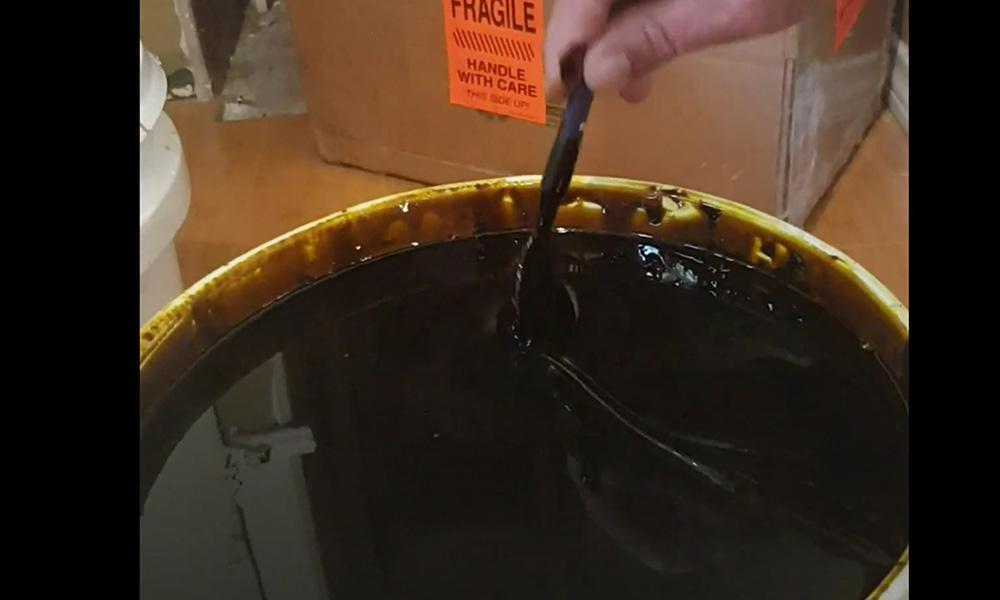 However, in mid-September, WTI once again surged to a high of $106, sparking widespread discussion about a "second upward cycle." Currently (mid-October), although prices have retreated somewhat to the $90 range, structural support remains solid, and the possibility of further upward movement cannot be ignored. Behind this round of price movements is not simply sentiment-driven, but rather profound changes on both the supply and demand sides, as well as geopolitical variables. The following is a professional analysis from three dimensions: the return of Chinese demand, escalating geopolitical tensions, and US policy perspectives. Price Trajectory Review: From Panic Premium to Structural Repricing In the early stages of the Iran-Iraq War, the Strait of Hormuz was blocked, and Middle Eastern exports declined sharply. The market quickly priced in a huge risk premium, causing both WTI and Brent to surge. Subsequently, with the recovery of some production capacity, the release of global inventories, and major importing countries actively reducing their output, prices entered a high-level downward trend. Near the low point in July, the market once believed that the supply crisis had peaked. The renewed surge in September showed a shift in market logic: short-term supply recovery was offset by new geopolitical shocks and potential demand replenishment. Data shows that oil prices have risen by over 70% cumulatively by 2026, fully reflecting the profound impact of this conflict on the energy market. Current prices still incorporate a significant geopolitical premium (some institutions estimate the Brent risk premium at around $20-24 per barrel), and any further disturbances could push the price up to the high. One major variable: the inevitability of China becoming a buyer in the international market again. As the world's largest crude oil importer, China's purchasing behavior is the most crucial "invisible stabilizer" in this round of price fluctuations and a core catalyst for future upward movement. Before the outbreak of the war, China's seaborne crude oil imports reached a high of nearly 11.8 million barrels per day, and inventories continued to accumulate. After the outbreak of the conflict, China did not join the global bidding war but instead significantly reduced imports—seaborne imports fell from approximately 11.8 million barrels per day in February to around 5.8 million barrels per day in June, before slowly recovering to around 7 million barrels per day in July and August. During this process, China primarily relied on its vast commercial and strategic reserves accumulated in the early stages (analysts estimate pre-war onshore reserves at approximately 1.2 billion barrels, with total reserves likely even higher) to meet domestic refinery demand, while simultaneously restricting refined oil exports to safeguard domestic needs. This strategy reflected China's considerations as a responsible major power: maintaining its own energy security while avoiding exacerbating drastic fluctuations in international oil prices, objectively alleviating global supply shortages. However, crude oil and diesel reserves are ultimately limited. With continued inventory reduction (some data show a significant decline from the April peak), coupled with a rebound in refinery operating rates and seasonal demand support, a renewed increase in international purchases by China is inevitable. Since September, China's imports have shown clear signs of recovery (some data indicate that both seaborne imports and customs imports have recovered from their lows), and are increasingly shifting towards non-Middle Eastern sources such as Iraq, Russia, West Africa, and Brazil. Once China's purchases further approach pre-war levels, even if only partially recovering the shortfall, it will significantly tighten global tradable supply, directly supporting prices. The "boundary effect" of reserves is becoming apparent, and China's shift from "inventory buffer" to "spot buyer" is a significant upside variable that the market has underestimated. Geopolitical escalation continues: risk premiums are unlikely to decline. Meanwhile, the geopolitical situation in the Middle East has not eased as quickly as the market initially expected, but rather exhibits characteristics of diffusion and protracted nature. Houthi attacks on key Saudi infrastructure (including airports), ongoing shipping risks in the Strait of Hormuz, and the escalation of regional proxy conflicts are all constantly reminding the market that supply recovery is highly fragile. Even if Middle Eastern exports have rebounded to near pre-war levels, any new major disruption could instantly reverse the situation. This combination of "fragile recovery + high risk premium" limits the downside potential of oil prices while increasing their upside potential. Historical experience shows that during prolonged geopolitical conflicts, oil prices often exhibit a pattern of "higher lows and repeated testing of highs." US Perspective: A Dual Game of Policy Intervention and Political Constraints From the US perspective, the Trump administration faces complex policy trade-offs. On the one hand, high fuel prices (especially diesel) are putting political pressure on domestic inflation and the midterm elections. The government is attempting to lower market expectations through verbal intervention, pushing Russia to increase diesel supply, emphasizing the Hormuz escort mission, and claiming the conflict will "end soon." On the other hand, the actual progress of military operations, the continued blockade of Iran, and the security needs of regional allies mean that fundamental improvements on the supply side are unlikely to happen overnight. The market's sensitivity to Trump's rhetoric has decreased. Although the president has repeatedly emphasized that the war will end and oil prices will plummet, actual price movements are more driven by physical supply and demand and geopolitical events. The limited capacity of US shale oil production and strategic petroleum reserves also makes it difficult to fully hedge against Middle East risks. In the short term, US policy is more about "curbing extreme price increases" than "driving a trend of decline." Conclusion and Outlook In summary, the crude oil market has moved from a stage of simple war panic to a rebalancing phase of "returning Chinese demand + geopolitical risk stickiness + US policy constraints." China's inventory reduction is approaching a critical threshold, significantly increasing the probability of re-entering the market for purchases; the prolonged geopolitical conflict maintains a high risk premium. With both factors converging, the probability of oil prices continuing to rise or maintaining high-level fluctuations is greater than a trend reversal. Investors need to closely monitor marginal changes in Chinese import data, actual air traffic volume in the Strait of Hormuz, and unforeseen events in the Middle East. If Chinese purchases accelerate and geopolitical tensions escalate further, WTI prices challenging higher levels is not out of reach; conversely, if the conflict subsides substantially and Chinese purchases remain at a controllable pace, prices may consolidate within a relatively high range. In any case, the current market is no longer simply a "supply shock story," but a new chapter jointly written by the return of the world's largest buyer and prolonged geopolitical tensions. Risks and opportunities coexist; careful assessment of the dynamic evolution of fundamentals and political variables remains crucial for professional decision-making. Technical Analysis
 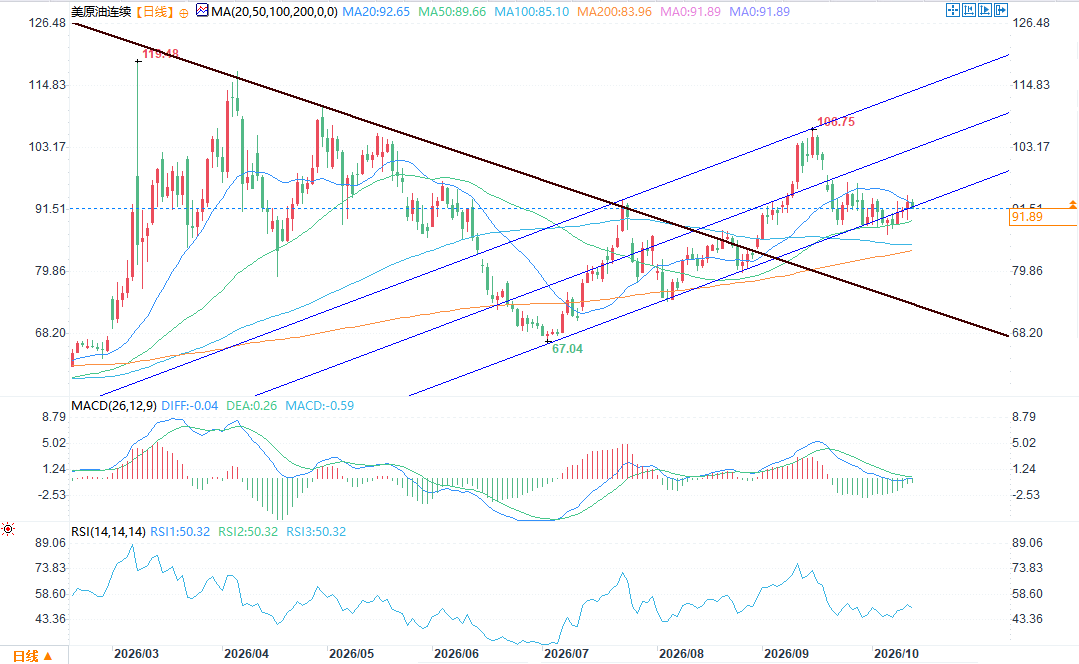 (WTI Crude Oil Daily Chart Source: EasyForex) From a long-term trend perspective, the brown downtrend line in the chart connects the previous high of 119.48, representing a core resistance line over a six-month period. This trend line was substantially broken upwards in early September. This breakout carries strong trend signal significance, marking the end of the previously dominant medium-to-long-term downtrend structure, a fundamental shift in the market's bullish and bearish power dynamics, the end of the bear-dominated downtrend cycle, and the official transition to a medium-to-long-term bullish narrative. Since the rebound began from the July low of 67.04, WTI crude oil has formed a clear upward channel on the daily chart, defined by the two blue trend lines. The current price pullback to near the lower channel line is a normal retracement confirmation within an uptrend and does not break the overall upward channel structure; it is a common support test phase in a bullish market. In terms of moving averages, the current price is steadily trading above the MA50, MA200, and other medium-to-long-term moving averages, which maintain an upward alignment, forming multiple support levels and confirming the solid foundation of the large-scale bullish trend. The moving average system forms a support zone, providing a floor for the price. As long as the price does not effectively break below the lower rail of the upward channel and the confluence of medium- and long-term moving averages, the large-scale bullish structure will not be broken, and the market still has the potential to continue its upward expansion. The primary target can be referenced to the previous high of 106.75. Supporting indicators confirm this: the MACD indicator's DIFF and DEA remain above the zero line, and the red bars are currently contracting, indicating that this price pullback is a consolidation of momentum during the upward trend, not a trend reversal; the RSI indicator is currently at 58.33, in the neutral-to-strong range and has not yet entered the overbought zone, indicating that the bullish momentum has not been overextended, and there is still room for further upward momentum. Risk warning: If the price effectively breaks below the lower rail of the upward channel and simultaneously breaks below the key MA50 moving average support, the current upward channel structure will be broken, and the market will enter a period of consolidation and adjustment, requiring a reassessment of the bullish logic.
However, in mid-September, WTI once again surged to a high of $106, sparking widespread discussion about a "second upward cycle." Currently (mid-October), although prices have retreated somewhat to the $90 range, structural support remains solid, and the possibility of further upward movement cannot be ignored. Behind this round of price movements is not simply sentiment-driven, but rather profound changes on both the supply and demand sides, as well as geopolitical variables. The following is a professional analysis from three dimensions: the return of Chinese demand, escalating geopolitical tensions, and US policy perspectives. Price Trajectory Review: From Panic Premium to Structural Repricing In the early stages of the Iran-Iraq War, the Strait of Hormuz was blocked, and Middle Eastern exports declined sharply. The market quickly priced in a huge risk premium, causing both WTI and Brent to surge. Subsequently, with the recovery of some production capacity, the release of global inventories, and major importing countries actively reducing their output, prices entered a high-level downward trend. Near the low point in July, the market once believed that the supply crisis had peaked. The renewed surge in September showed a shift in market logic: short-term supply recovery was offset by new geopolitical shocks and potential demand replenishment. Data shows that oil prices have risen by over 70% cumulatively by 2026, fully reflecting the profound impact of this conflict on the energy market. Current prices still incorporate a significant geopolitical premium (some institutions estimate the Brent risk premium at around $20-24 per barrel), and any further disturbances could push the price up to the high. One major variable: the inevitability of China becoming a buyer in the international market again. As the world's largest crude oil importer, China's purchasing behavior is the most crucial "invisible stabilizer" in this round of price fluctuations and a core catalyst for future upward movement. Before the outbreak of the war, China's seaborne crude oil imports reached a high of nearly 11.8 million barrels per day, and inventories continued to accumulate. After the outbreak of the conflict, China did not join the global bidding war but instead significantly reduced imports—seaborne imports fell from approximately 11.8 million barrels per day in February to around 5.8 million barrels per day in June, before slowly recovering to around 7 million barrels per day in July and August. During this process, China primarily relied on its vast commercial and strategic reserves accumulated in the early stages (analysts estimate pre-war onshore reserves at approximately 1.2 billion barrels, with total reserves likely even higher) to meet domestic refinery demand, while simultaneously restricting refined oil exports to safeguard domestic needs. This strategy reflected China's considerations as a responsible major power: maintaining its own energy security while avoiding exacerbating drastic fluctuations in international oil prices, objectively alleviating global supply shortages. However, crude oil and diesel reserves are ultimately limited. With continued inventory reduction (some data show a significant decline from the April peak), coupled with a rebound in refinery operating rates and seasonal demand support, a renewed increase in international purchases by China is inevitable. Since September, China's imports have shown clear signs of recovery (some data indicate that both seaborne imports and customs imports have recovered from their lows), and are increasingly shifting towards non-Middle Eastern sources such as Iraq, Russia, West Africa, and Brazil. Once China's purchases further approach pre-war levels, even if only partially recovering the shortfall, it will significantly tighten global tradable supply, directly supporting prices. The "boundary effect" of reserves is becoming apparent, and China's shift from "inventory buffer" to "spot buyer" is a significant upside variable that the market has underestimated. Geopolitical escalation continues: risk premiums are unlikely to decline. Meanwhile, the geopolitical situation in the Middle East has not eased as quickly as the market initially expected, but rather exhibits characteristics of diffusion and protracted nature. Houthi attacks on key Saudi infrastructure (including airports), ongoing shipping risks in the Strait of Hormuz, and the escalation of regional proxy conflicts are all constantly reminding the market that supply recovery is highly fragile. Even if Middle Eastern exports have rebounded to near pre-war levels, any new major disruption could instantly reverse the situation. This combination of "fragile recovery + high risk premium" limits the downside potential of oil prices while increasing their upside potential. Historical experience shows that during prolonged geopolitical conflicts, oil prices often exhibit a pattern of "higher lows and repeated testing of highs." US Perspective: A Dual Game of Policy Intervention and Political Constraints From the US perspective, the Trump administration faces complex policy trade-offs. On the one hand, high fuel prices (especially diesel) are putting political pressure on domestic inflation and the midterm elections. The government is attempting to lower market expectations through verbal intervention, pushing Russia to increase diesel supply, emphasizing the Hormuz escort mission, and claiming the conflict will "end soon." On the other hand, the actual progress of military operations, the continued blockade of Iran, and the security needs of regional allies mean that fundamental improvements on the supply side are unlikely to happen overnight. The market's sensitivity to Trump's rhetoric has decreased. Although the president has repeatedly emphasized that the war will end and oil prices will plummet, actual price movements are more driven by physical supply and demand and geopolitical events. The limited capacity of US shale oil production and strategic petroleum reserves also makes it difficult to fully hedge against Middle East risks. In the short term, US policy is more about "curbing extreme price increases" than "driving a trend of decline." Conclusion and Outlook In summary, the crude oil market has moved from a stage of simple war panic to a rebalancing phase of "returning Chinese demand + geopolitical risk stickiness + US policy constraints." China's inventory reduction is approaching a critical threshold, significantly increasing the probability of re-entering the market for purchases; the prolonged geopolitical conflict maintains a high risk premium. With both factors converging, the probability of oil prices continuing to rise or maintaining high-level fluctuations is greater than a trend reversal. Investors need to closely monitor marginal changes in Chinese import data, actual air traffic volume in the Strait of Hormuz, and unforeseen events in the Middle East. If Chinese purchases accelerate and geopolitical tensions escalate further, WTI prices challenging higher levels is not out of reach; conversely, if the conflict subsides substantially and Chinese purchases remain at a controllable pace, prices may consolidate within a relatively high range. In any case, the current market is no longer simply a "supply shock story," but a new chapter jointly written by the return of the world's largest buyer and prolonged geopolitical tensions. Risks and opportunities coexist; careful assessment of the dynamic evolution of fundamentals and political variables remains crucial for professional decision-making. Technical Analysis (WTI Crude Oil Daily Chart Source: EasyForex) From a long-term trend perspective, the brown downtrend line in the chart connects the previous high of 119.48, representing a core resistance line over a six-month period. This trend line was substantially broken upwards in early September. This breakout carries strong trend signal significance, marking the end of the previously dominant medium-to-long-term downtrend structure, a fundamental shift in the market's bullish and bearish power dynamics, the end of the bear-dominated downtrend cycle, and the official transition to a medium-to-long-term bullish narrative. Since the rebound began from the July low of 67.04, WTI crude oil has formed a clear upward channel on the daily chart, defined by the two blue trend lines. The current price pullback to near the lower channel line is a normal retracement confirmation within an uptrend and does not break the overall upward channel structure; it is a common support test phase in a bullish market. In terms of moving averages, the current price is steadily trading above the MA50, MA200, and other medium-to-long-term moving averages, which maintain an upward alignment, forming multiple support levels and confirming the solid foundation of the large-scale bullish trend. The moving average system forms a support zone, providing a floor for the price. As long as the price does not effectively break below the lower rail of the upward channel and the confluence of medium- and long-term moving averages, the large-scale bullish structure will not be broken, and the market still has the potential to continue its upward expansion. The primary target can be referenced to the previous high of 106.75. Supporting indicators confirm this: the MACD indicator's DIFF and DEA remain above the zero line, and the red bars are currently contracting, indicating that this price pullback is a consolidation of momentum during the upward trend, not a trend reversal; the RSI indicator is currently at 58.33, in the neutral-to-strong range and has not yet entered the overbought zone, indicating that the bullish momentum has not been overextended, and there is still room for further upward momentum. Risk warning: If the price effectively breaks below the lower rail of the upward channel and simultaneously breaks below the key MA50 moving average support, the current upward channel structure will be broken, and the market will enter a period of consolidation and adjustment, requiring a reassessment of the bullish logic.- Risk Warning and Disclaimer
- The market involves risk, and trading may not be suitable for all investors. This article is for reference only and does not constitute personal investment advice, nor does it take into account certain users’ specific investment objectives, financial situation, or other needs. Any investment decisions made based on this information are at your own risk.