The US dollar retreated slightly, while the British pound rebounded against the dollar, nearing the upper limit of its trading range, awaiting a pressure test.
2026-10-14 14:14:19
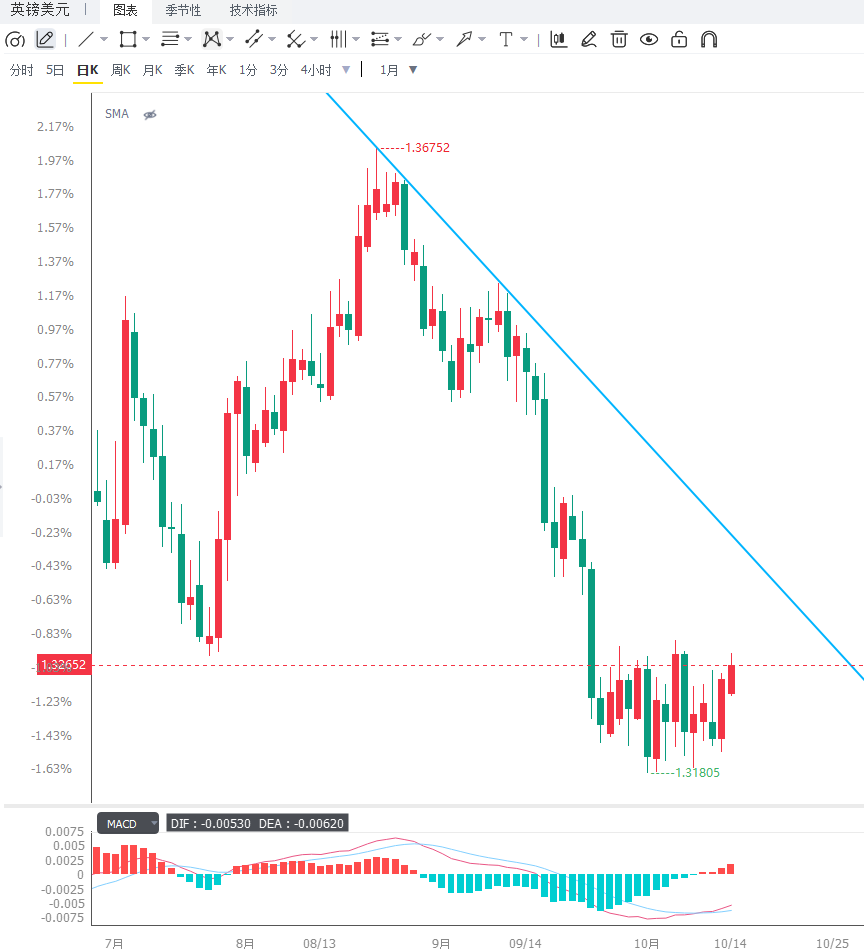
After stabilizing at lower levels on Monday, the GBP/USD pair continued its modest rebound in Asian trading on Wednesday, trading around 1.3260, a rise of about 80 basis points from the low of around 1.3177 reached last week. The continued weakness of the US dollar index was the direct catalyst for the rebound – the DXY index retreated after hitting a yearly high of 102.61 on Monday, trading around 102.11 in Asian trading on Wednesday, after closing down 0.38% at 102.20 on Tuesday. However, the pound faces equally complex bullish and bearish factors, and the sustainability of the rebound still needs confirmation from tonight's US CPI data and internal policy signals from the Bank of England.  The core factor driving the dollar's weakness came from dovish remarks by New York Fed President Williams on Tuesday. Williams made it clear that he believed another rate hike this year might be appropriate, but there was no reason to believe further rate hikes were needed in 2027. "I haven't changed my view that there might be one more rate hike," he said, "but I don't think there's any reason to believe we need to take more steps right now." This statement was the clearest signal of the "end of the rate hike cycle" released by a key official in this tightening cycle. A speech tracking indicator showed that Williams' dovish rating for this speech was only 3.4 points, far below his historical average of 5.8 points. The Fed's sentiment index fell 3.09 points to 133.86 that day, still above the 100 neutral line, but showing a meaningful marginal shift to dovishness. Scotiabank strategists noted that "the Fed's recent communication has been mixed but overall softening the intensity of hawkish rhetoric," a shift that has clearly eased overall tightening expectations, with the market currently pricing in only about 5 basis points of tightening in October and 25 basis points in December. However, internal divisions within the Federal Reserve have not disappeared. Boston Fed President Collins stated on the same day that further rate hikes before the end of the year are still under consideration; Chicago Fed President Goolsby emphasized that rising costs from AI data center construction are spreading to a wider range of sectors; and Cleveland Fed President Hammark bluntly stated that inflationary pressures have extended beyond the energy sector. The CME FedWatch Tool shows that the probability of keeping interest rates unchanged in October is approximately 77.3%, a significant jump from 51% a month ago, but the pricing probability of a December rate hike remains as high as 87.8%. This means the market consensus is "skip October, act in December," rather than the rate hike cycle having ended. The US September CPI data, to be released tonight at 8:30 PM, will directly test this consensus. The market generally expects the overall CPI to rise from 3.4% year-on-year to 3.6%, and to increase by 0.6% month-on-month, mainly driven by gasoline prices—the average price of gasoline in the US reached a record $4.33 per gallon in September. Core CPI is expected to rise by 0.2% month-on-month and to 2.5% year-on-year. StoneX senior market strategist Habercohn said, "There are some inflation data to be released later this week, so the market is watching closely." Societe Generale strategists pointed out that if core CPI reaches 2.5% as expected, it will "virtually not change the market's assessment of the future policy path." However, core CPI forecasts are widely divergent—Deutsche Bank's most dovish forecast is 0.16%, while Goldman Sachs, Barclays, and Morgan Stanley forecast 0.24%. Bank of America economist Juno explicitly stated that a 0.2% month-on-month core CPI increase will not push up expectations of a rate hike, but a 0.3% increase could reignite speculation about a rate hike in October. For GBP/USD, weaker CPI data will reinforce Williams' dovish stance and push the dollar further down, with the exchange rate potentially testing the 1.3375 resistance level; stronger data could reignite hawkish expectations, with the exchange rate possibly falling back to 1.3200 or even 1.3150. Policy signals on the pound side show a divergent pattern: "prudent governor, hawkish committee members." Bank of England Governor Andrew Bailey said at the IMF annual meetings in Bangkok on Tuesday that British businesses are working hard to control costs, and the transmission of the energy shock to broader inflation has been "so far mild." Bailey emphasized that monetary policy needs a "firm commitment to restoring inflation to the target level," but did not directly address the timing of interest rate hikes, suggesting he prefers to wait for more data before making a judgment. The market currently prices in a near certainty of a 25 basis point rate hike in November, but Bailey's cautious approach indicates that the central bank is still weighing the persistence of the energy shock against the resilience of economic growth. However, hawkish members of the Monetary Policy Committee are accelerating their pronouncements. Committee member Green boldly declared on Monday that interest rates should be higher than the current 3.75%, arguing that the IMF had just raised its 2026 UK economic growth forecast from 1% to 1.3%, and that faster-than-expected economic growth indicated insufficient tightening by current policies. Green also warned his colleagues not to rely on the market to tighten financial conditions. Monetary Policy Committee member Mann also pointed out that conditions are forming for wages and prices to potentially rise in tandem, and she has voted for a 25 basis point rate hike to 4% for the past few months. UK government bond yields surged in tandem – the 10-year yield rose to 5.527%, a new high since 2007; the 30-year yield climbed to 6.047%, the highest level since 1998. High borrowing costs and hawkish policy signals combined to provide support for the pound in terms of interest rate differentials. ING provided a detailed assessment of the pound's policy environment in its latest report. ING believes the Bank of England's interest rate forecast for 2027 is "too hawkish" (the market is pricing in a cumulative 100 basis point rate hike by July), but acknowledges that "one or two rate hikes look increasingly likely," and any "dovish shift" may "not occur until the second half of 2027, which will support a stronger pound." On the fiscal front, ING lists the UK budget on October 28th as a "potential risk to the pound," as the market is currently underpricing fiscal issues. However, ING noted that Chancellor of the Exchequer Healy and Prime Minister Bernham "seem to be aware of market sensitivity," and while the budget "will be closely scrutinized," they "do not currently expect it to trigger significant bond volatility or leave a lasting negative impact on the pound." Regarding the exchange rate outlook, ING has lowered its EUR/USD forecast to 1.13 in both Q4 and Q1, and warned that "1.1100 remains a downside risk for EUR/USD"—a judgment that also indirectly applies to GBP/USD. From a technical perspective, GBP/USD maintains a bearish bias on the daily chart, with the price hovering near the 20-day simple moving average of the Bollinger Bands, while remaining constrained by the 100-day simple moving average and the upper Bollinger Band. The recent bearish tone remains intact. The 14-day Relative Strength Index (RSI) is around 44-45, below the neutral level of 50, indicating that the recent rebound lacks convincing upward momentum, and sellers still hold a structural advantage. The MACD indicator is below the zero line, releasing a bearish signal. The 10-day simple moving average at around 1.3230 provides immediate dynamic support, while the 50-day moving average at around 1.3420 and the 250-day moving average at around 1.3400 form a dense resistance zone in the medium term. On the upside resistance side, the upper Bollinger Band at around 1.3375 and the 100-day moving average at around 1.3395 form a dense supply area, where sellers are likely to re-enter the market on any rebound to this area. Only a decisive break above 1.3395 and a sustained hold above it could substantially alleviate the short-term bearish trend. On the downside support side, the lower Bollinger Band at around 1.3150 forms the most immediate downside defense. A daily close below this level would further strengthen the current bearish tone and open up room for a deeper pullback, with targets at 1.3100 and even 1.3044. From a 4-hour chart perspective, the exchange rate has formed a higher low structure after rebounding from the low of 1.3177. Short-term moving averages are starting to turn upwards, the MACD histogram is continuously shrinking, and the fast line is gradually approaching the slow line, indicating a moderate release of rebound momentum. The first short-term resistance is at 1.3275, which is the intraday high area; strong resistance is in the 1.3300-1.3375 area. Only by holding above this level can a larger-scale rebound be restarted. The first support is at 1.3220, and the core support is the psychological level of 1.3200. A break below this level would lead to a further test of the lower Bollinger Band at 1.3150.
  Editor's Summary: GBP/USD is currently in a window of opportunity, benefiting from both a receding dovish stance on the US dollar and a rising hawkish stance in the UK. However, the sustainability of the rebound faces a triple test. Williams' rare statement that the 2027 rate hike cycle is the final year has put downward pressure on the dollar. The frequent pronouncements from hawkish Bank of England members Green and Mann, along with the near-certainty pricing of a November rate hike, have provided support for the pound in terms of interest rate differentials. However, tonight's US CPI data is the ultimate variable determining the short-term direction—a moderate core CPI (0.2% or below) will reinforce the dovish logic, pushing the exchange rate towards the dense resistance zone of 1.3375 to 1.3395; a stronger core CPI (0.3% or above) may reignite hawkish expectations, risking a pullback to 1.3200 or even 1.3150. In the medium term, the fiscal risks posed by the UK budget on October 28th, ING's cautious outlook for the pound, and the dense supply area formed by the 100-day moving average and the upper Bollinger Band on the technical chart, all limit the pound's potential for further gains. Remain cautious until the CPI data is released.
The core factor driving the dollar's weakness came from dovish remarks by New York Fed President Williams on Tuesday. Williams made it clear that he believed another rate hike this year might be appropriate, but there was no reason to believe further rate hikes were needed in 2027. "I haven't changed my view that there might be one more rate hike," he said, "but I don't think there's any reason to believe we need to take more steps right now." This statement was the clearest signal of the "end of the rate hike cycle" released by a key official in this tightening cycle. A speech tracking indicator showed that Williams' dovish rating for this speech was only 3.4 points, far below his historical average of 5.8 points. The Fed's sentiment index fell 3.09 points to 133.86 that day, still above the 100 neutral line, but showing a meaningful marginal shift to dovishness. Scotiabank strategists noted that "the Fed's recent communication has been mixed but overall softening the intensity of hawkish rhetoric," a shift that has clearly eased overall tightening expectations, with the market currently pricing in only about 5 basis points of tightening in October and 25 basis points in December. However, internal divisions within the Federal Reserve have not disappeared. Boston Fed President Collins stated on the same day that further rate hikes before the end of the year are still under consideration; Chicago Fed President Goolsby emphasized that rising costs from AI data center construction are spreading to a wider range of sectors; and Cleveland Fed President Hammark bluntly stated that inflationary pressures have extended beyond the energy sector. The CME FedWatch Tool shows that the probability of keeping interest rates unchanged in October is approximately 77.3%, a significant jump from 51% a month ago, but the pricing probability of a December rate hike remains as high as 87.8%. This means the market consensus is "skip October, act in December," rather than the rate hike cycle having ended. The US September CPI data, to be released tonight at 8:30 PM, will directly test this consensus. The market generally expects the overall CPI to rise from 3.4% year-on-year to 3.6%, and to increase by 0.6% month-on-month, mainly driven by gasoline prices—the average price of gasoline in the US reached a record $4.33 per gallon in September. Core CPI is expected to rise by 0.2% month-on-month and to 2.5% year-on-year. StoneX senior market strategist Habercohn said, "There are some inflation data to be released later this week, so the market is watching closely." Societe Generale strategists pointed out that if core CPI reaches 2.5% as expected, it will "virtually not change the market's assessment of the future policy path." However, core CPI forecasts are widely divergent—Deutsche Bank's most dovish forecast is 0.16%, while Goldman Sachs, Barclays, and Morgan Stanley forecast 0.24%. Bank of America economist Juno explicitly stated that a 0.2% month-on-month core CPI increase will not push up expectations of a rate hike, but a 0.3% increase could reignite speculation about a rate hike in October. For GBP/USD, weaker CPI data will reinforce Williams' dovish stance and push the dollar further down, with the exchange rate potentially testing the 1.3375 resistance level; stronger data could reignite hawkish expectations, with the exchange rate possibly falling back to 1.3200 or even 1.3150. Policy signals on the pound side show a divergent pattern: "prudent governor, hawkish committee members." Bank of England Governor Andrew Bailey said at the IMF annual meetings in Bangkok on Tuesday that British businesses are working hard to control costs, and the transmission of the energy shock to broader inflation has been "so far mild." Bailey emphasized that monetary policy needs a "firm commitment to restoring inflation to the target level," but did not directly address the timing of interest rate hikes, suggesting he prefers to wait for more data before making a judgment. The market currently prices in a near certainty of a 25 basis point rate hike in November, but Bailey's cautious approach indicates that the central bank is still weighing the persistence of the energy shock against the resilience of economic growth. However, hawkish members of the Monetary Policy Committee are accelerating their pronouncements. Committee member Green boldly declared on Monday that interest rates should be higher than the current 3.75%, arguing that the IMF had just raised its 2026 UK economic growth forecast from 1% to 1.3%, and that faster-than-expected economic growth indicated insufficient tightening by current policies. Green also warned his colleagues not to rely on the market to tighten financial conditions. Monetary Policy Committee member Mann also pointed out that conditions are forming for wages and prices to potentially rise in tandem, and she has voted for a 25 basis point rate hike to 4% for the past few months. UK government bond yields surged in tandem – the 10-year yield rose to 5.527%, a new high since 2007; the 30-year yield climbed to 6.047%, the highest level since 1998. High borrowing costs and hawkish policy signals combined to provide support for the pound in terms of interest rate differentials. ING provided a detailed assessment of the pound's policy environment in its latest report. ING believes the Bank of England's interest rate forecast for 2027 is "too hawkish" (the market is pricing in a cumulative 100 basis point rate hike by July), but acknowledges that "one or two rate hikes look increasingly likely," and any "dovish shift" may "not occur until the second half of 2027, which will support a stronger pound." On the fiscal front, ING lists the UK budget on October 28th as a "potential risk to the pound," as the market is currently underpricing fiscal issues. However, ING noted that Chancellor of the Exchequer Healy and Prime Minister Bernham "seem to be aware of market sensitivity," and while the budget "will be closely scrutinized," they "do not currently expect it to trigger significant bond volatility or leave a lasting negative impact on the pound." Regarding the exchange rate outlook, ING has lowered its EUR/USD forecast to 1.13 in both Q4 and Q1, and warned that "1.1100 remains a downside risk for EUR/USD"—a judgment that also indirectly applies to GBP/USD. From a technical perspective, GBP/USD maintains a bearish bias on the daily chart, with the price hovering near the 20-day simple moving average of the Bollinger Bands, while remaining constrained by the 100-day simple moving average and the upper Bollinger Band. The recent bearish tone remains intact. The 14-day Relative Strength Index (RSI) is around 44-45, below the neutral level of 50, indicating that the recent rebound lacks convincing upward momentum, and sellers still hold a structural advantage. The MACD indicator is below the zero line, releasing a bearish signal. The 10-day simple moving average at around 1.3230 provides immediate dynamic support, while the 50-day moving average at around 1.3420 and the 250-day moving average at around 1.3400 form a dense resistance zone in the medium term. On the upside resistance side, the upper Bollinger Band at around 1.3375 and the 100-day moving average at around 1.3395 form a dense supply area, where sellers are likely to re-enter the market on any rebound to this area. Only a decisive break above 1.3395 and a sustained hold above it could substantially alleviate the short-term bearish trend. On the downside support side, the lower Bollinger Band at around 1.3150 forms the most immediate downside defense. A daily close below this level would further strengthen the current bearish tone and open up room for a deeper pullback, with targets at 1.3100 and even 1.3044. From a 4-hour chart perspective, the exchange rate has formed a higher low structure after rebounding from the low of 1.3177. Short-term moving averages are starting to turn upwards, the MACD histogram is continuously shrinking, and the fast line is gradually approaching the slow line, indicating a moderate release of rebound momentum. The first short-term resistance is at 1.3275, which is the intraday high area; strong resistance is in the 1.3300-1.3375 area. Only by holding above this level can a larger-scale rebound be restarted. The first support is at 1.3220, and the core support is the psychological level of 1.3200. A break below this level would lead to a further test of the lower Bollinger Band at 1.3150. Editor's Summary: GBP/USD is currently in a window of opportunity, benefiting from both a receding dovish stance on the US dollar and a rising hawkish stance in the UK. However, the sustainability of the rebound faces a triple test. Williams' rare statement that the 2027 rate hike cycle is the final year has put downward pressure on the dollar. The frequent pronouncements from hawkish Bank of England members Green and Mann, along with the near-certainty pricing of a November rate hike, have provided support for the pound in terms of interest rate differentials. However, tonight's US CPI data is the ultimate variable determining the short-term direction—a moderate core CPI (0.2% or below) will reinforce the dovish logic, pushing the exchange rate towards the dense resistance zone of 1.3375 to 1.3395; a stronger core CPI (0.3% or above) may reignite hawkish expectations, risking a pullback to 1.3200 or even 1.3150. In the medium term, the fiscal risks posed by the UK budget on October 28th, ING's cautious outlook for the pound, and the dense supply area formed by the 100-day moving average and the upper Bollinger Band on the technical chart, all limit the pound's potential for further gains. Remain cautious until the CPI data is released.
- Risk Warning and Disclaimer
- The market involves risk, and trading may not be suitable for all investors. This article is for reference only and does not constitute personal investment advice, nor does it take into account certain users’ specific investment objectives, financial situation, or other needs. Any investment decisions made based on this information are at your own risk.