A major Asian nation's PPI exceeded expectations, and the Reserve Bank of Australia's statement sent the Australian dollar soaring against the Japanese yen to two new highs.
2026-10-14 14:40:22
The Australian dollar extended its gains against the Japanese yen during Wednesday's Asian trading session, rising for the second consecutive trading day. It reached a high of 110.85, its highest level since September 28, representing a gain of approximately 0.3%. The Australian dollar's strength was directly supported by inflation data released by a major Asian trading partner. The Asian nation's September Producer Price Index (PPI) rose sharply year-on-year, exceeding market expectations, while the Consumer Price Index (CPI) rose moderately, injecting upward momentum into the Australian dollar. Meanwhile, the yen remained under pressure, with reports suggesting that Bank of Japan officials were inclined to avoid consecutive interest rate hikes, and rumors of potential official intervention keeping traders highly vigilant. With these mixed factors, the short-term trend of the Australian dollar against the yen is being jointly dominated by expectations regarding monetary policy in both countries and the interplay of foreign exchange intervention.
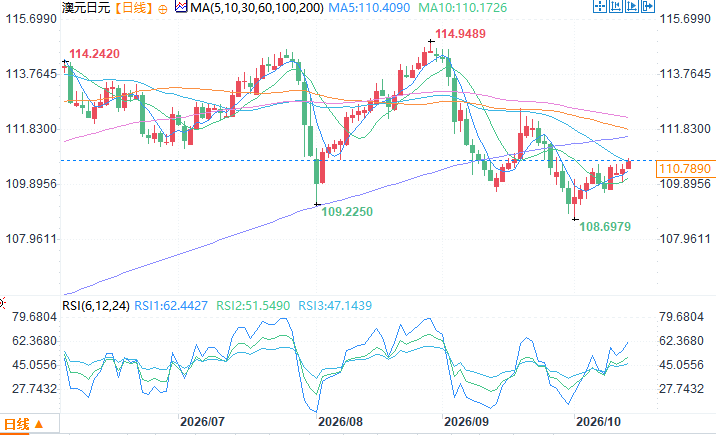 Australian Dollar/Japanese Yen Daily Chart Source: EasyTrade. At 14:38 Beijing time on October 14, the Australian Dollar/Japanese Yen was trading at 110.82/83.
Inflation data released by a major Asian country boosted the Australian dollar as PPI accelerated its rise.
Data released by the National Bureau of Statistics of Australia, a major Asian country, on Wednesday (October 14) showed that the Consumer Price Index (CPI) rose 0.9% year-on-year in September, a slight increase from 0.8% in August, but slightly lower than the market expectation of 1.0%; the month-on-month increase was 0.2%, compared to 0.4% in the previous month, also falling short of the expected 0.3%. The more closely watched Producer Price Index (PPI) performed strongly, surging 5.0% year-on-year in September, a significant acceleration from 3.8% in August, and also higher than the market expectation of 4.5%. The strong rebound in upstream industrial product prices confirms an improvement in the manufacturing sector. As Australia's most important trading partner, this signal of recovering demand in the Asian giant directly supports the Australian dollar exchange rate.The Reserve Bank of Australia has signaled that a weaker Australian dollar could exacerbate import inflation.
Analysts at Commerzbank pointed out that the Reserve Bank of Australia's (RBA) latest statement sent an important message to the foreign exchange market. The RBA expressed concern that a weaker Australian dollar could push up domestic price pressures through import inflation, highlighting the crucial role of exchange rates in the inflation outlook. Analysts further interpreted this as the RBA believing that if global neutral interest rates rise while Australia's neutral interest rate does not rise in tandem, the Australian dollar may face depreciation pressure; however, the RBA seems to implicitly acknowledge that Australia's neutral interest rate has already kept pace with global changes. This assessment suggests that policymakers believe the domestic neutral interest rate is aligned with global trends and have relative confidence in the medium-term outlook for the Australian dollar.The yen is under pressure from two sides: a cooling of interest rate hike expectations coupled with the risk of intervention.
The strengthening of the Australian dollar against the Japanese yen is accompanied by the continued weakness of the yen. Reports indicate that Bank of Japan officials are inclined to avoid a rare series of interest rate hikes, putting pressure on the yen. However, the market generally expects the Bank of Japan to continue its overall policy normalization path. Meanwhile, traders remain highly vigilant, with continued speculation that Japanese authorities may intervene again to support the yen's exchange rate. Analysts at MUFG/BTMU pointed out that Japanese Prime Minister Sanae Takaichi reiterated in parliament that the finance ministers of the US and Japan "continue to maintain close communication on foreign exchange issues," and the yen issue was also mentioned "in a general manner" at the latest US-Japan summit. She also acknowledged that "a weak yen has both advantages and disadvantages," highlighting the policy trade-offs faced by the authorities. Analysts added that since the joint US-Japan intervention at the end of July, the yen "has remained at a stronger level," proving that the intervention measures have effectively prevented further yen weakness in recent months.Conclusion
In summary, the Australian dollar rose against the Japanese yen for two consecutive trading days, supported in the short term by both inflation data from major Asian countries and policy signals from the Reserve Bank of Australia. The yen, on the other hand, faces depreciation pressure from easing expectations of interest rate hikes, while also being supported by anticipated potential official intervention. The monetary policy paths of both countries, inflation trends, and potential foreign exchange intervention will continue to dominate the short-term direction of the Australian dollar against the yen. Traders need to closely monitor the Bank of Japan's policy statements and intervention moves to grasp the rhythm of exchange rate fluctuations. Australian Dollar/Japanese Yen Daily Chart Source: EasyTrade. At 14:38 Beijing time on October 14, the Australian Dollar/Japanese Yen was trading at 110.82/83.
- Risk Warning and Disclaimer
- The market involves risk, and trading may not be suitable for all investors. This article is for reference only and does not constitute personal investment advice, nor does it take into account certain users’ specific investment objectives, financial situation, or other needs. Any investment decisions made based on this information are at your own risk.