New York Fed President Williams' unusual move to set a ceiling for interest rate hikes put pressure on the dollar; tonight's US CPI data may be the deciding factor for both bulls and bears.
2026-10-14 14:26:19
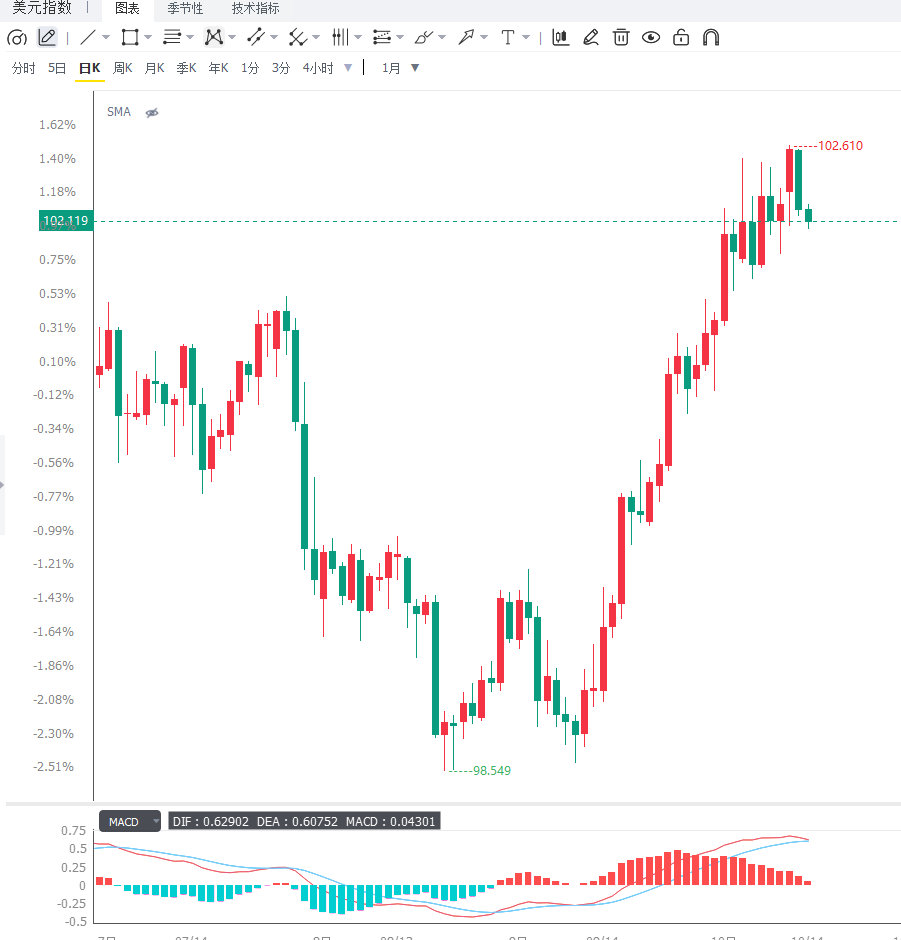
The US dollar index retreated for the second consecutive trading day after hitting a year-to-date high of 102.61 on Monday, trading around 102.15 in Asian trading on Wednesday, continuing its mild pullback. Previously, the dollar index fell 0.38% to close at 102.20 on Tuesday, and also fell 0.4% to 102.18 on Monday. The short-term weakness of the dollar was mainly driven by dovish comments from New York Fed President Williams, while the market generally adopted a wait-and-see attitude ahead of tonight's release of key CPI data.  The core catalyst driving the dollar's pullback came from Williams' rare and explicit statement on Tuesday. Williams stated that he still believes another rate hike this year might be appropriate, but there is no reason to believe further rate hikes are needed in 2027. "I haven't changed my view that there might be one more rate hike," Williams said, "but I don't think there's any reason to believe we need to take more steps at this time." This statement is one of the clearest signals of the "end of rate hikes" from a core Fed official in this tightening cycle. Speech tracking indicators show that Williams' dovish rating for this speech was only 3.4 out of 10, far below his historical average of 5.8, highlighting a significant softening of his policy stance. The Fed sentiment index fell 3.09 points to 133.86 that day. While still above the neutral benchmark of 100, it showed a meaningful dovish shift at the margin, indicating that the Fed's overall communication is transitioning from "continued tightening" to "prudent assessment." In a recent report, Scotiabank strategists noted that the Federal Reserve's recent communications, while "mixed in wording, have generally softened the intensity of hawkish rhetoric," a shift that has clearly eased overall tightening expectations. Market surveys show that federal funds rate futures pricing indicates a probability of maintaining rates unchanged at the October meeting has risen to approximately 77.3%, a significant jump from 51% a month ago; the market is pricing in only about 5 basis points of tightening in October and 25 basis points in December, reflecting a systematic postponement of the timing of rate hikes. Scotiabank also pointed out that "DXY continues to be above our fair value estimate," with fundamentals generally reflecting the softening of Fed expectations and the narrowing trend in interest rate spreads—which puts downward pressure on the dollar in the medium term. However, significant internal divisions within the Fed add complexity to the market reaction to tonight's CPI data. Boston Fed President Collins stated on the same day that further rate hikes before the end of the year are still under consideration, noting that AI-related investments, tariffs, and the Middle East situation pushing up energy costs could all increase the difficulty of a decline in inflation. Chicago Fed President Goolsby emphasized that rising costs from AI data center construction are spreading beyond related industries, indicating broader signs of overheated demand and inflation. Cleveland Fed President Hammark went even further, stating that inflationary pressures have extended beyond the energy sector, with some companies planning to raise product prices at a rate exceeding the rate of increase in input costs. This internal divergence between hawks and doves means that tonight's CPI data will directly determine which side gains market dominance. The US September CPI data, released tonight at 8:30 PM, is the most closely watched event in global financial markets this week. The market generally expects the overall CPI to rise from 3.4% year-on-year to 3.6%, a 0.6% increase month-on-month, marking the largest monthly increase in five months, primarily driven by gasoline prices—according to the American Automobile Association, the average price of gasoline in the US reached a record $4.33 per gallon in September, a 37.6% year-on-year increase. Core CPI is expected to rise only 0.2% month-on-month, lower than August's 0.3%, and is expected to rise from 2.4% to 2.5% year-on-year. StoneX senior market strategist Bob Habercohn said, "There are some inflation data coming out later this week, so the market is watching closely." The market is more focused on the direction of the core CPI's deviation from expectations. There is considerable divergence in core data forecasts: Deutsche Bank is the most conservative, predicting only 0.16% month-on-month; Citigroup and JPMorgan Chase both predict 0.18%; Goldman Sachs, Barclays, and Morgan Stanley predict 0.24%. Bank of America economist Juno explicitly stated that a 0.2% month-on-month core CPI increase will not push up expectations of a rate hike, but if it reaches 0.3%, it could reignite speculation about a rate hike in October. CIBC chief economist Shenfield is more aggressive, predicting a 0.3% month-on-month core CPI increase and believing the Fed will raise rates this month, arguing that "too many items are still growing at rates exceeding 3%." Natixis believes the September CPI is likely in line with expectations, and the unusually high August data was a one-off exception, suggesting the Fed may have already completed its only rate hike in this cycle. Societe Generale strategists point out that if core CPI reaches 2.5% as expected by the market, it will "almost not change the market's judgment on the future policy path"—that is, there will be no rate hike in October, but the probability of a rate hike in December is very high, and there may be another rate hike in the first quarter of 2027. If the data is strong, it may reignite bets on an October rate hike, pushing up US Treasury yields and the dollar; if it is weak, it will further solidify Williams' dovish logic and accelerate the dollar's pullback. On the geopolitical risk front, the continued tension in the Middle East provides a floor for the dollar's safe-haven demand. Riyadh airport in Saudi Arabia has been repeatedly attacked by Houthi rebels, and Saudi Arabia has vowed retaliation. US President Trump is considering joining the fight against the Houthis. Iran's top security official announced that Washington's response to its proposal to reopen the Strait of Hormuz was "insufficient," and the risk of spillover from regional conflict continues to escalate. However, Trump's simultaneous announcement of an "energy ceasefire" between Russia and Ukraine and Russia's phased diesel supply arrangements have, to some extent, alleviated the extreme scenario of an immediate deterioration in global energy supply, giving geopolitical factors a "flooring" but not a "boosting" effect on the dollar. From a technical perspective, the pullback in the US dollar index over the past week on the daily chart can be defined as a technical correction within a strong upward trend, and the overall medium-term bullish structure remains intact. The exchange rate is trading steadily above the 20-day simple moving average and the 100-day moving average, maintaining the medium-term bullish framework. The 14-day Relative Strength Index (RSI) is around 64.47, in positive territory but not yet overbought, indicating that buying power remains dominant and there is still room for further gains before the upward conditions become overextended. The MACD indicator is above the zero line; although the red bars are narrowing, the fast and slow lines have not formed a death cross, indicating weakening upward momentum but not turning negative. The Bollinger Bands remain open upwards, showing that the medium-term trend remains upward. On the upside resistance side, the upper Bollinger Band at approximately 102.95 constitutes the most immediate upward ceiling, which is also an extension of the yearly high of 102.61 reached last week. Multiple attempts to break through this level have failed, resulting in a large accumulation of profit-taking selling. If buying pressure strengthens further and breaks through this area effectively, it could potentially challenge the psychological level of 103.00 and even 103.50. On the downside, the Bollinger Band middle line around 101.50 forms the first line of defense, which is also a support level that has transformed from a previous resistance breakout. Next is the 100-day moving average around 100.40, a key level for medium-term strength or weakness. Stronger support lies near the lower Bollinger Band around 100.05. As long as the price remains above the 100-day moving average, the overall uptrend remains intact, and pullbacks should be seen as opportunities to find support rather than signals of a trend reversal. Looking at the daily chart's PP pivot point, it is located at 102.156, corresponding to a maximum support and resistance range of 101.563 to 102.823. The current price is trading near this pivot point, and a directional move could occur at any moment.
  Editor's Summary: The US dollar index is currently at a critical juncture, oscillating between "reconstructed dovish expectations" and "uncertainty surrounding CPI data." Williams' rare statement that no rate hikes are needed in 2027, coupled with the systematic softening of the Fed's hawkish rhetoric, has put downward pressure on the dollar, with the DXY index retreating approximately 0.5% from its year-to-date high of 102.61. Scotiabank explicitly points out that the DXY is above its fair value estimate, and the narrowing interest rate spread is exerting medium-term downward pressure on the dollar. However, tonight's US CPI data will directly determine whether this pullback is a short-term technical correction or a deeper trend adjustment. If core CPI is moderate (0.2% or below month-on-month), it will reinforce Williams' dovish logic, and the dollar may further consolidate towards the 101.50 Bollinger Band middle line; if core data is strong (0.3% or above), it may reignite speculation about an October rate hike, driving the dollar to rebound and retest the 102.95 Bollinger Band upper line. In the medium term, the transition of the Federal Reserve's policy stance from "continued tightening" to "prudent assessment," the suppression of non-US currencies by European fiscal risks, and the safe-haven premium maintained by the Middle East geopolitical situation will jointly determine the basic pattern of the US dollar index fluctuating within a wide range of 100 to 103.
The core catalyst driving the dollar's pullback came from Williams' rare and explicit statement on Tuesday. Williams stated that he still believes another rate hike this year might be appropriate, but there is no reason to believe further rate hikes are needed in 2027. "I haven't changed my view that there might be one more rate hike," Williams said, "but I don't think there's any reason to believe we need to take more steps at this time." This statement is one of the clearest signals of the "end of rate hikes" from a core Fed official in this tightening cycle. Speech tracking indicators show that Williams' dovish rating for this speech was only 3.4 out of 10, far below his historical average of 5.8, highlighting a significant softening of his policy stance. The Fed sentiment index fell 3.09 points to 133.86 that day. While still above the neutral benchmark of 100, it showed a meaningful dovish shift at the margin, indicating that the Fed's overall communication is transitioning from "continued tightening" to "prudent assessment." In a recent report, Scotiabank strategists noted that the Federal Reserve's recent communications, while "mixed in wording, have generally softened the intensity of hawkish rhetoric," a shift that has clearly eased overall tightening expectations. Market surveys show that federal funds rate futures pricing indicates a probability of maintaining rates unchanged at the October meeting has risen to approximately 77.3%, a significant jump from 51% a month ago; the market is pricing in only about 5 basis points of tightening in October and 25 basis points in December, reflecting a systematic postponement of the timing of rate hikes. Scotiabank also pointed out that "DXY continues to be above our fair value estimate," with fundamentals generally reflecting the softening of Fed expectations and the narrowing trend in interest rate spreads—which puts downward pressure on the dollar in the medium term. However, significant internal divisions within the Fed add complexity to the market reaction to tonight's CPI data. Boston Fed President Collins stated on the same day that further rate hikes before the end of the year are still under consideration, noting that AI-related investments, tariffs, and the Middle East situation pushing up energy costs could all increase the difficulty of a decline in inflation. Chicago Fed President Goolsby emphasized that rising costs from AI data center construction are spreading beyond related industries, indicating broader signs of overheated demand and inflation. Cleveland Fed President Hammark went even further, stating that inflationary pressures have extended beyond the energy sector, with some companies planning to raise product prices at a rate exceeding the rate of increase in input costs. This internal divergence between hawks and doves means that tonight's CPI data will directly determine which side gains market dominance. The US September CPI data, released tonight at 8:30 PM, is the most closely watched event in global financial markets this week. The market generally expects the overall CPI to rise from 3.4% year-on-year to 3.6%, a 0.6% increase month-on-month, marking the largest monthly increase in five months, primarily driven by gasoline prices—according to the American Automobile Association, the average price of gasoline in the US reached a record $4.33 per gallon in September, a 37.6% year-on-year increase. Core CPI is expected to rise only 0.2% month-on-month, lower than August's 0.3%, and is expected to rise from 2.4% to 2.5% year-on-year. StoneX senior market strategist Bob Habercohn said, "There are some inflation data coming out later this week, so the market is watching closely." The market is more focused on the direction of the core CPI's deviation from expectations. There is considerable divergence in core data forecasts: Deutsche Bank is the most conservative, predicting only 0.16% month-on-month; Citigroup and JPMorgan Chase both predict 0.18%; Goldman Sachs, Barclays, and Morgan Stanley predict 0.24%. Bank of America economist Juno explicitly stated that a 0.2% month-on-month core CPI increase will not push up expectations of a rate hike, but if it reaches 0.3%, it could reignite speculation about a rate hike in October. CIBC chief economist Shenfield is more aggressive, predicting a 0.3% month-on-month core CPI increase and believing the Fed will raise rates this month, arguing that "too many items are still growing at rates exceeding 3%." Natixis believes the September CPI is likely in line with expectations, and the unusually high August data was a one-off exception, suggesting the Fed may have already completed its only rate hike in this cycle. Societe Generale strategists point out that if core CPI reaches 2.5% as expected by the market, it will "almost not change the market's judgment on the future policy path"—that is, there will be no rate hike in October, but the probability of a rate hike in December is very high, and there may be another rate hike in the first quarter of 2027. If the data is strong, it may reignite bets on an October rate hike, pushing up US Treasury yields and the dollar; if it is weak, it will further solidify Williams' dovish logic and accelerate the dollar's pullback. On the geopolitical risk front, the continued tension in the Middle East provides a floor for the dollar's safe-haven demand. Riyadh airport in Saudi Arabia has been repeatedly attacked by Houthi rebels, and Saudi Arabia has vowed retaliation. US President Trump is considering joining the fight against the Houthis. Iran's top security official announced that Washington's response to its proposal to reopen the Strait of Hormuz was "insufficient," and the risk of spillover from regional conflict continues to escalate. However, Trump's simultaneous announcement of an "energy ceasefire" between Russia and Ukraine and Russia's phased diesel supply arrangements have, to some extent, alleviated the extreme scenario of an immediate deterioration in global energy supply, giving geopolitical factors a "flooring" but not a "boosting" effect on the dollar. From a technical perspective, the pullback in the US dollar index over the past week on the daily chart can be defined as a technical correction within a strong upward trend, and the overall medium-term bullish structure remains intact. The exchange rate is trading steadily above the 20-day simple moving average and the 100-day moving average, maintaining the medium-term bullish framework. The 14-day Relative Strength Index (RSI) is around 64.47, in positive territory but not yet overbought, indicating that buying power remains dominant and there is still room for further gains before the upward conditions become overextended. The MACD indicator is above the zero line; although the red bars are narrowing, the fast and slow lines have not formed a death cross, indicating weakening upward momentum but not turning negative. The Bollinger Bands remain open upwards, showing that the medium-term trend remains upward. On the upside resistance side, the upper Bollinger Band at approximately 102.95 constitutes the most immediate upward ceiling, which is also an extension of the yearly high of 102.61 reached last week. Multiple attempts to break through this level have failed, resulting in a large accumulation of profit-taking selling. If buying pressure strengthens further and breaks through this area effectively, it could potentially challenge the psychological level of 103.00 and even 103.50. On the downside, the Bollinger Band middle line around 101.50 forms the first line of defense, which is also a support level that has transformed from a previous resistance breakout. Next is the 100-day moving average around 100.40, a key level for medium-term strength or weakness. Stronger support lies near the lower Bollinger Band around 100.05. As long as the price remains above the 100-day moving average, the overall uptrend remains intact, and pullbacks should be seen as opportunities to find support rather than signals of a trend reversal. Looking at the daily chart's PP pivot point, it is located at 102.156, corresponding to a maximum support and resistance range of 101.563 to 102.823. The current price is trading near this pivot point, and a directional move could occur at any moment. Editor's Summary: The US dollar index is currently at a critical juncture, oscillating between "reconstructed dovish expectations" and "uncertainty surrounding CPI data." Williams' rare statement that no rate hikes are needed in 2027, coupled with the systematic softening of the Fed's hawkish rhetoric, has put downward pressure on the dollar, with the DXY index retreating approximately 0.5% from its year-to-date high of 102.61. Scotiabank explicitly points out that the DXY is above its fair value estimate, and the narrowing interest rate spread is exerting medium-term downward pressure on the dollar. However, tonight's US CPI data will directly determine whether this pullback is a short-term technical correction or a deeper trend adjustment. If core CPI is moderate (0.2% or below month-on-month), it will reinforce Williams' dovish logic, and the dollar may further consolidate towards the 101.50 Bollinger Band middle line; if core data is strong (0.3% or above), it may reignite speculation about an October rate hike, driving the dollar to rebound and retest the 102.95 Bollinger Band upper line. In the medium term, the transition of the Federal Reserve's policy stance from "continued tightening" to "prudent assessment," the suppression of non-US currencies by European fiscal risks, and the safe-haven premium maintained by the Middle East geopolitical situation will jointly determine the basic pattern of the US dollar index fluctuating within a wide range of 100 to 103.
- Risk Warning and Disclaimer
- The market involves risk, and trading may not be suitable for all investors. This article is for reference only and does not constitute personal investment advice, nor does it take into account certain users’ specific investment objectives, financial situation, or other needs. Any investment decisions made based on this information are at your own risk.