The US dollar index is trading around 102. How will the September inflation data rewrite the Fed's path?
2026-10-14 15:24:20
On Wednesday, October 14th, the U.S. Bureau of Labor Statistics will release the September Consumer Price Index (CPI) this evening. Previously, the annualized inflation rate in August was 3.4%, and core inflation was 2.4%. The market expects September's annualized inflation rate to rise to 3.6%, a month-on-month increase of 0.6%, the largest increase in nearly five months, mainly driven by energy prices. Gasoline prices are expected to rise by more than 7% month-on-month. The core annualized rate is expected to rise to 2.5%, with a month-on-month decrease to 0.2%. The U.S. dollar index has recently been trading around 102, and the 10-year U.S. Treasury yield remains around 5.2%. The Federal Reserve's target range for the federal funds rate is 3.75% to 4.00%. 
Composition of US Energy Prices and Inflation
The core driver of accelerating inflation expectations in the US in September was the energy component. The average retail price of gasoline in September was approximately $4.36 per gallon, up 7.3% month-over-month and 37.6% year-over-year. Diesel prices hit a record high of $6.29 per gallon. Conflicts in the Middle East disrupted traffic in the Strait of Hormuz, causing disruptions to crude oil supply and pushing up energy costs. Airfares continued to rise due to increased jet fuel prices, while charter rate increases remained moderate. Food prices rose slightly. Commodity prices saw only marginal increases, with the impact of tariffs gradually diminishing. Core inflation expectations slowed to 0.2% month-over-month, indicating that underlying price pressures excluding energy and food were relatively under control. Although the energy component does not have the largest weighting in the CPI, its dramatic month-over-month fluctuations are sufficient to dominate the overall reading. Energy's contribution to the monthly CPI in September is expected to be significantly higher than the previous month.Federal Reserve Policy and Inflation Path
The Federal Reserve raised the target range for the federal funds rate by 25 basis points to 3.75% to 4.00% in September. The meeting minutes showed that most participants believed a further rate hike was possible later this year. Chairman Warsh stated at the Jackson Hole symposium, "We must be confident that underlying inflation is moving clearly and at a sufficient pace toward our target, otherwise we have work to do." He also noted that the responsibility for persistently high inflation lies with the central bank. Warsh emphasized that inflation has been above the 2% target for more than five years, and current financial conditions cannot be described as restrictive. Market expectations are high that the October meeting will keep rates unchanged, but there is a possibility of another rate hike at the December meeting. If core inflation rises to 2.5% as expected, it will strengthen discussions about the policy path for the year. The PCE price index, a preferred indicator of the Fed's policy stance, has also previously remained above the target.Characteristics of the US Dollar Index
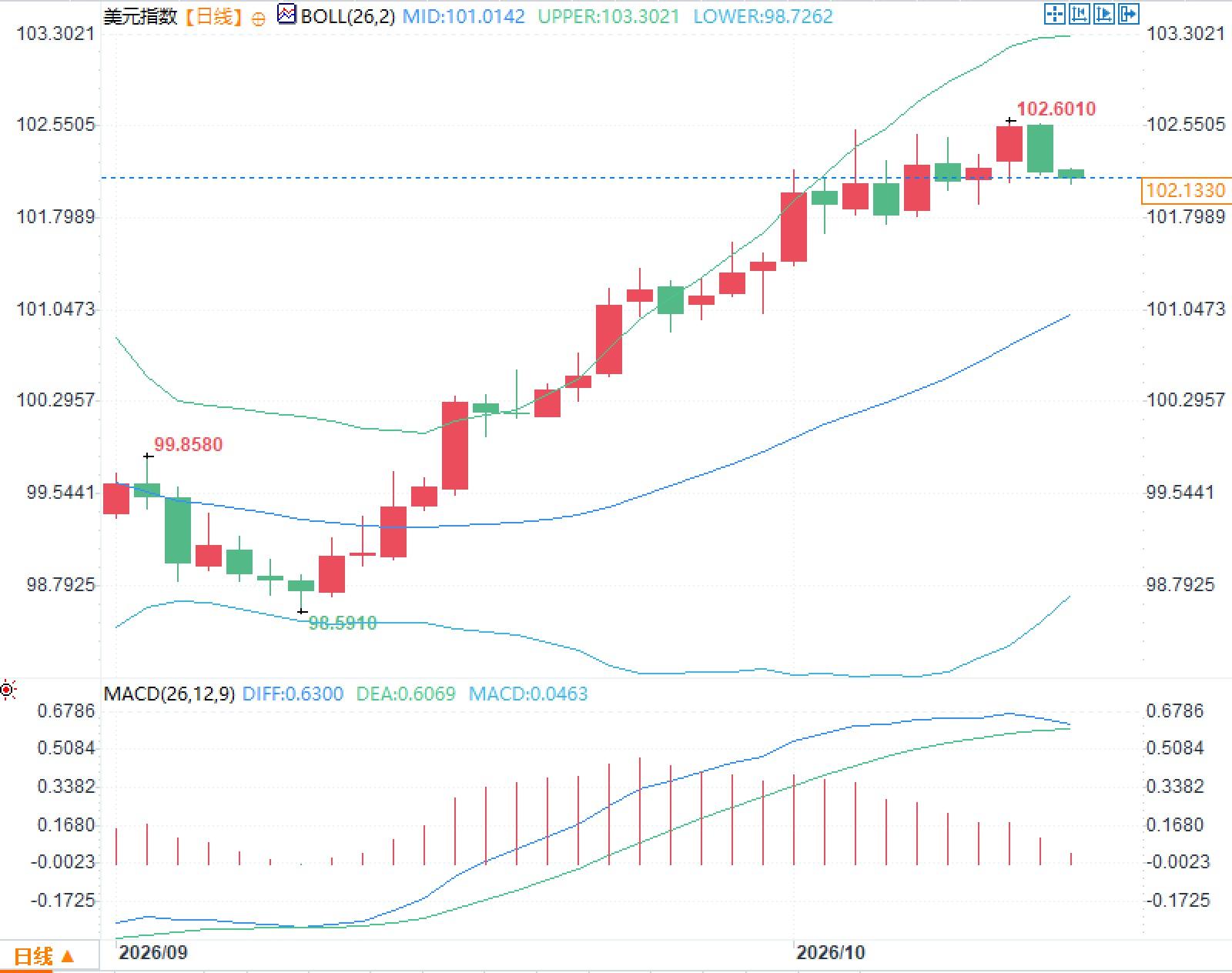
The US dollar index has risen from near its September lows to the 102 area. The daily chart shows the price above the Bollinger Band's middle band, which is around 101.01, the upper band around 103.30, and the lower band around 98.73. Recently, the price has been trading around 102.10, having touched around 102.60. The MACD indicator shows the DIFF at 0.6300, the DEA at 0.6069, and the histogram at 0.0463, both in positive territory, although the histogram has narrowed somewhat compared to the previous period. The 10-year US Treasury yield is around 5.21%, providing support for the dollar index. The market is focused on the impact of inflation data releases on the relative value of the dollar.Data Release and Market Focus
The US September CPI will be released at 8:30 PM on October 14th. Market focus will be on whether the actual month-on-month increase in the energy component meets or exceeds expectations, whether the core month-on-month increase remains at 0.2%, and whether the housing component continues to slow. If the overall energy-driven reading is higher than expected, while the core remains stable, the market will differentiate between short-term supply disturbances and underlying inflation trends. Federal Reserve officials have previously made it clear that inflation control is a priority. The bond market is sensitive to the data, and yields are already at high levels. The US dollar index will remain range-bound before the data release. Participants will be observing the implications of the data for subsequent policy discussions, rather than the reading itself.Frequently Asked Questions
Question 1: What are the main reasons for the rise in US inflation expectations to 3.6% in September? Answer: Primarily due to rising energy prices, with gasoline expected to rise more than 7% month-on-month, and supply disruptions in the Middle East pushing up costs. Question 2: Why did US core inflation expectations only rise slightly? Answer: The month-on-month increase slowed to 0.2%, housing and commodity price pressures were relatively mild, and the underlying trend did not accelerate significantly. Question 3: How does the Federal Reserve view the current inflation level? Answer: Warsh emphasized the need to be confident that core inflation is moving towards the 2% target at a sufficient pace; otherwise, there is work to be done, and there is discussion about adjusting interest rates again this year.- Risk Warning and Disclaimer
- The market involves risk, and trading may not be suitable for all investors. This article is for reference only and does not constitute personal investment advice, nor does it take into account certain users’ specific investment objectives, financial situation, or other needs. Any investment decisions made based on this information are at your own risk.