The release of US CPI data tonight, coupled with a rebound in oil prices, has caused the USD/CAD pair to retreat from its highs; a break below key support levels should be anticipated.
2026-10-14 14:52:18
After last week's high-level consolidation, the USD/CAD pair continued its mild pullback during Wednesday's Asian session, trading around 1.4200 to 1.4203, a slight decline from the high of around 1.4300 reached last week, the highest level since April 2025. The US dollar index also weakened, with the DXY falling 0.38% to close at 102.20 on Tuesday and further declining to around 102.11 during Wednesday's Asian session, a cumulative pullback of about 0.5% from Monday's year-to-date high of 102.61. Short-term profit-taking pressure on the US dollar, coupled with market caution ahead of tonight's key CPI data release, constituted the core drivers of the USD/CAD pullback.  The US September CPI data, to be released tonight at 8:30 PM, is the most closely watched data point in global financial markets this week. The market widely expects the overall CPI to rise from 3.4% year-on-year to 3.6%, a 0.6% increase month-on-month, marking the largest monthly increase in five months, primarily driven by gasoline prices—the average price of gasoline in the US reached a record $4.33 per gallon in September, a year-on-year increase of 37.6%. However, the core CPI is expected to rise only 0.2% month-on-month, lower than August's 0.3%, and is projected to rise from 2.4% to 2.5% year-on-year. This divergence between "overall inflation jumping while core inflation remains moderate" has already been largely priced in by the market. In a recent report, strategists at Societe Generale pointed out that if the core CPI records 2.5% as expected by the market, it will "almost not change the market's judgment on the future policy path"—that is, no rate hike in October, but a very high probability of a rate hike in December, and possibly another rate hike in the first quarter of 2027. This assessment aligns closely with the pricing of the CME Group's FedWatch Tool: the probability of an October rate hike is only about 17% to 20%, while the probability of a December rate hike is as high as 84% to 88%. However, there is significant divergence in core CPI forecasts, constituting a potential source of volatility after the data release. Deutsche Bank's forecast is the most dovish, with a core CPI month-on-month increase of only 0.16%; Citigroup and JPMorgan Chase both predict 0.18%; while Goldman Sachs, Barclays, and Morgan Stanley predict 0.24%. Bank of America economist Juno explicitly stated that a core CPI month-on-month increase of 0.2% would not push up rate hike expectations, but if it reaches 0.3%, it could reignite speculation about an October rate hike. CIBC's chief economist, Shenfield, is even more aggressive, predicting a core CPI month-on-month increase of 0.3% and believing that the Fed will raise rates this month. The deviation of the actual value of core data from expectations will drive market pricing more than the overall data—this is the core trading logic behind tonight's CPI data. New York Fed President Williams' dovish remarks on Tuesday brought additional downward pressure to the dollar. Williams explicitly stated that no further rate hikes are needed in 2027, one of the clearest signals from key officials indicating the "end of rate hikes" in this tightening cycle. However, significant internal divisions remain within the Federal Reserve—Boston Fed President Collins, Chicago Fed President Goolsby, and Cleveland Fed President Hammark all expressed hawkish stances on the same day, emphasizing that inflationary pressures are spreading to a wider range of areas. This internal divergence complicates market judgments on the policy path and foreshadows potential two-way fluctuations after the release of CPI data. Support for the Canadian dollar primarily comes from the rebound in international oil prices. WTI crude oil prices rebounded from a six-week low of $86.32 last week to above $96, a gain of over 11%. The core factor driving higher oil prices is the continued geopolitical tensions in the Middle East—the escalating conflict between Saudi Arabia and the Iranian-backed Houthi rebels, the deadly attacks on Riyadh airport, Saudi Arabia's vow of retaliation, and US President Trump's consideration of joining military action against the Houthis. As a major net oil exporter, the Canadian dollar typically maintains a high positive correlation with oil prices. Rising oil prices have directly improved Canada's trade revenue expectations and the profit outlook for energy companies, providing solid commodity currency support for the Canadian dollar. This transmission mechanism is particularly prominent in the current environment—even with the overall weakening of the US dollar, the pullback in USD/CAD is significantly constrained by the support of oil prices for the Canadian dollar. However, the Canadian dollar also faces constraints from Canada's domestic fundamentals. Canada's employment fell sharply by 68,300 in September, far below market expectations of an increase of 9,200, and the unemployment rate rose from 6.4% to 6.5%. This dismal employment data has virtually eliminated the possibility of a rate hike by the Bank of Canada at the end of October. Capital Economics economist Ryan points out that only a significant exceedance of inflation data could bring the option of a rate hike back into discussion. The Bank of Canada's current policy rate remains unchanged at 2.25%, marking the seventh consecutive time since December 2025, creating a large interest rate differential of 150 to 175 basis points with the Federal Reserve's interest rate range of 3.75% to 4.00%. This interest rate differential fundamentally reduces the attractiveness of Canadian dollar assets relative to US dollar assets, providing medium-term bottom support for USD/CAD. From a technical perspective, the pullback in USD/CAD over the past week on the daily chart can be defined as a bullish technical correction within a strong uptrend, rather than a trend reversal. The exchange rate is steadily trading above the 20-day exponential moving average, and the medium-term bullish structure remains intact. The 20-day EMA of approximately 1.4163 provides the most direct technical support, consistently offering dynamic support since the end of September, with multiple pullbacks finding support here. The 14-day Relative Strength Index (RSI) is around 59.0, in positive territory but not yet overbought, indicating that buyers remain in control and there is still room for further gains before the upside becomes excessive. While the MACD indicator is above the zero line, the red bars are narrowing, and the fast and slow lines show signs of convergence, indicating that upward momentum is gradually weakening but has not turned negative. On the upside resistance side, the 1.4245-1.4250 area represents the midpoint of last week's trading range and is gaining increasing technical importance. Further up, the 1.4300 level forms a key psychological level and a previous swing high; only a sustained hold above this level can confirm the continuation of the bullish structure and open up further upside potential. A break above this level could target 1.4310 (the 61.8% Fibonacci retracement of the decline in the first half of last year). On the downside support side, a break below the 20-day EMA around 1.4163 would signal a deeper correction phase, with the next support level to watch being the 1.4150-1.4145 area, followed by the psychological level of 1.4100 and the 1.4050 area. However, until these major support levels are effectively broken, the current technical structure should focus on finding support during pullbacks rather than immediately identifying a trend reversal.
 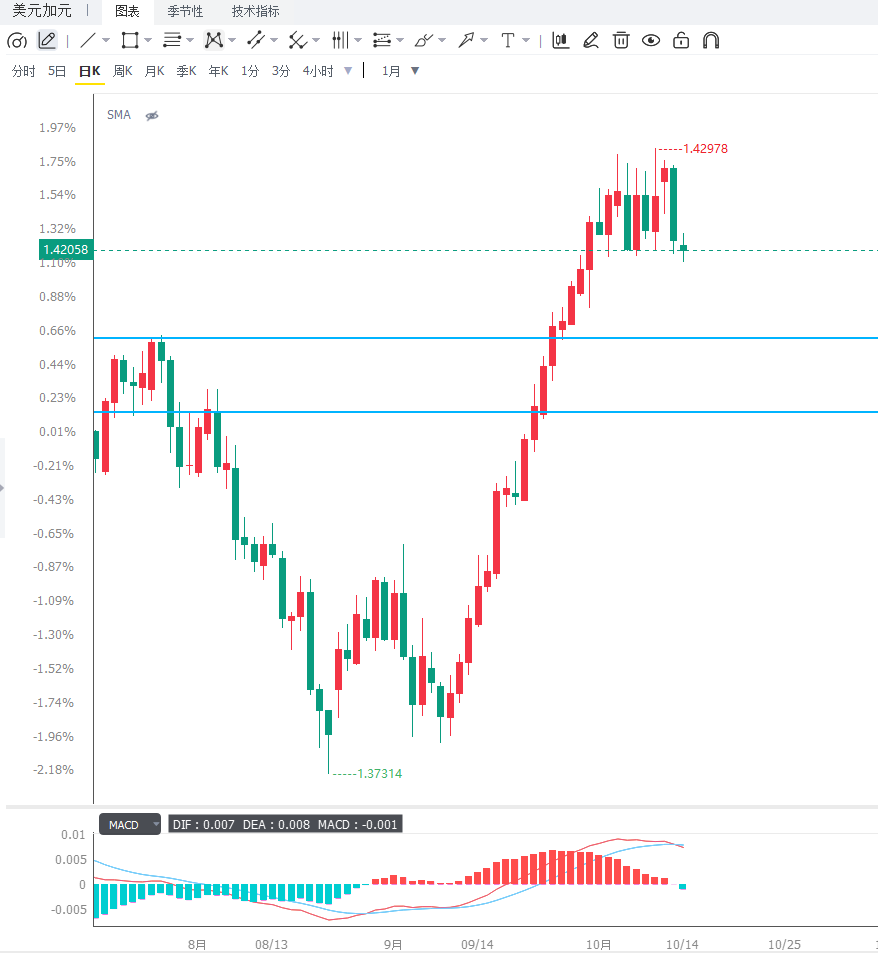 Editor's Summary: The USD/CAD pair is currently in a balancing act between the uncertainty surrounding the CPI data and the support from the rebounding oil prices. Tonight's US September CPI data will be the key variable determining the short-term direction. Societe Generale's baseline scenario is that the core CPI will meet the 2.5% expectation, not changing the market's pricing of "no change in October, rate hike in December," and the USD/CAD pair will likely maintain its current range-bound pattern. If the core data is stronger (0.3% or above), it may reignite speculation about an October rate hike, driving a dollar rebound, and the pair could retest 1.4250 or even 1.4300. If the core data is weaker (0.16% to 0.18%), the dollar may face further pressure, and the pair may consolidate towards the 20-day EMA at 1.4163 or even the 1.4150 area. In the medium term, the 150-175 basis point USD/CAD interest rate differential, weak Canadian employment data, and the Bank of Canada's dovish stance collectively provide structural support for the USD/CAD bulls. Meanwhile, the rebound in WTI crude oil prices above $96 provides a solid buffer for the Canadian dollar through the commodity currency channel, limiting the upside potential of the exchange rate. Caution is advised ahead of the CPI data release and Fed Chair Warsh's IMF speech on Friday.
The US September CPI data, to be released tonight at 8:30 PM, is the most closely watched data point in global financial markets this week. The market widely expects the overall CPI to rise from 3.4% year-on-year to 3.6%, a 0.6% increase month-on-month, marking the largest monthly increase in five months, primarily driven by gasoline prices—the average price of gasoline in the US reached a record $4.33 per gallon in September, a year-on-year increase of 37.6%. However, the core CPI is expected to rise only 0.2% month-on-month, lower than August's 0.3%, and is projected to rise from 2.4% to 2.5% year-on-year. This divergence between "overall inflation jumping while core inflation remains moderate" has already been largely priced in by the market. In a recent report, strategists at Societe Generale pointed out that if the core CPI records 2.5% as expected by the market, it will "almost not change the market's judgment on the future policy path"—that is, no rate hike in October, but a very high probability of a rate hike in December, and possibly another rate hike in the first quarter of 2027. This assessment aligns closely with the pricing of the CME Group's FedWatch Tool: the probability of an October rate hike is only about 17% to 20%, while the probability of a December rate hike is as high as 84% to 88%. However, there is significant divergence in core CPI forecasts, constituting a potential source of volatility after the data release. Deutsche Bank's forecast is the most dovish, with a core CPI month-on-month increase of only 0.16%; Citigroup and JPMorgan Chase both predict 0.18%; while Goldman Sachs, Barclays, and Morgan Stanley predict 0.24%. Bank of America economist Juno explicitly stated that a core CPI month-on-month increase of 0.2% would not push up rate hike expectations, but if it reaches 0.3%, it could reignite speculation about an October rate hike. CIBC's chief economist, Shenfield, is even more aggressive, predicting a core CPI month-on-month increase of 0.3% and believing that the Fed will raise rates this month. The deviation of the actual value of core data from expectations will drive market pricing more than the overall data—this is the core trading logic behind tonight's CPI data. New York Fed President Williams' dovish remarks on Tuesday brought additional downward pressure to the dollar. Williams explicitly stated that no further rate hikes are needed in 2027, one of the clearest signals from key officials indicating the "end of rate hikes" in this tightening cycle. However, significant internal divisions remain within the Federal Reserve—Boston Fed President Collins, Chicago Fed President Goolsby, and Cleveland Fed President Hammark all expressed hawkish stances on the same day, emphasizing that inflationary pressures are spreading to a wider range of areas. This internal divergence complicates market judgments on the policy path and foreshadows potential two-way fluctuations after the release of CPI data. Support for the Canadian dollar primarily comes from the rebound in international oil prices. WTI crude oil prices rebounded from a six-week low of $86.32 last week to above $96, a gain of over 11%. The core factor driving higher oil prices is the continued geopolitical tensions in the Middle East—the escalating conflict between Saudi Arabia and the Iranian-backed Houthi rebels, the deadly attacks on Riyadh airport, Saudi Arabia's vow of retaliation, and US President Trump's consideration of joining military action against the Houthis. As a major net oil exporter, the Canadian dollar typically maintains a high positive correlation with oil prices. Rising oil prices have directly improved Canada's trade revenue expectations and the profit outlook for energy companies, providing solid commodity currency support for the Canadian dollar. This transmission mechanism is particularly prominent in the current environment—even with the overall weakening of the US dollar, the pullback in USD/CAD is significantly constrained by the support of oil prices for the Canadian dollar. However, the Canadian dollar also faces constraints from Canada's domestic fundamentals. Canada's employment fell sharply by 68,300 in September, far below market expectations of an increase of 9,200, and the unemployment rate rose from 6.4% to 6.5%. This dismal employment data has virtually eliminated the possibility of a rate hike by the Bank of Canada at the end of October. Capital Economics economist Ryan points out that only a significant exceedance of inflation data could bring the option of a rate hike back into discussion. The Bank of Canada's current policy rate remains unchanged at 2.25%, marking the seventh consecutive time since December 2025, creating a large interest rate differential of 150 to 175 basis points with the Federal Reserve's interest rate range of 3.75% to 4.00%. This interest rate differential fundamentally reduces the attractiveness of Canadian dollar assets relative to US dollar assets, providing medium-term bottom support for USD/CAD. From a technical perspective, the pullback in USD/CAD over the past week on the daily chart can be defined as a bullish technical correction within a strong uptrend, rather than a trend reversal. The exchange rate is steadily trading above the 20-day exponential moving average, and the medium-term bullish structure remains intact. The 20-day EMA of approximately 1.4163 provides the most direct technical support, consistently offering dynamic support since the end of September, with multiple pullbacks finding support here. The 14-day Relative Strength Index (RSI) is around 59.0, in positive territory but not yet overbought, indicating that buyers remain in control and there is still room for further gains before the upside becomes excessive. While the MACD indicator is above the zero line, the red bars are narrowing, and the fast and slow lines show signs of convergence, indicating that upward momentum is gradually weakening but has not turned negative. On the upside resistance side, the 1.4245-1.4250 area represents the midpoint of last week's trading range and is gaining increasing technical importance. Further up, the 1.4300 level forms a key psychological level and a previous swing high; only a sustained hold above this level can confirm the continuation of the bullish structure and open up further upside potential. A break above this level could target 1.4310 (the 61.8% Fibonacci retracement of the decline in the first half of last year). On the downside support side, a break below the 20-day EMA around 1.4163 would signal a deeper correction phase, with the next support level to watch being the 1.4150-1.4145 area, followed by the psychological level of 1.4100 and the 1.4050 area. However, until these major support levels are effectively broken, the current technical structure should focus on finding support during pullbacks rather than immediately identifying a trend reversal. Editor's Summary: The USD/CAD pair is currently in a balancing act between the uncertainty surrounding the CPI data and the support from the rebounding oil prices. Tonight's US September CPI data will be the key variable determining the short-term direction. Societe Generale's baseline scenario is that the core CPI will meet the 2.5% expectation, not changing the market's pricing of "no change in October, rate hike in December," and the USD/CAD pair will likely maintain its current range-bound pattern. If the core data is stronger (0.3% or above), it may reignite speculation about an October rate hike, driving a dollar rebound, and the pair could retest 1.4250 or even 1.4300. If the core data is weaker (0.16% to 0.18%), the dollar may face further pressure, and the pair may consolidate towards the 20-day EMA at 1.4163 or even the 1.4150 area. In the medium term, the 150-175 basis point USD/CAD interest rate differential, weak Canadian employment data, and the Bank of Canada's dovish stance collectively provide structural support for the USD/CAD bulls. Meanwhile, the rebound in WTI crude oil prices above $96 provides a solid buffer for the Canadian dollar through the commodity currency channel, limiting the upside potential of the exchange rate. Caution is advised ahead of the CPI data release and Fed Chair Warsh's IMF speech on Friday.
- Risk Warning and Disclaimer
- The market involves risk, and trading may not be suitable for all investors. This article is for reference only and does not constitute personal investment advice, nor does it take into account certain users’ specific investment objectives, financial situation, or other needs. Any investment decisions made based on this information are at your own risk.