The Bank of Japan's inclination to hold rates steady in October is putting pressure on the yen, with USD/JPY hovering near the upper end of its trading range awaiting the release of US CPI data.
2026-10-14 15:32:19
After a slight pullback on Monday, the USD/JPY pair traded around 158.20 in Asian trading on Wednesday, just shy of the monthly high reached last week. However, the pair remains confined to the familiar range of 157.60 to 158.75 formed over the past two weeks, with neither bulls nor bears demonstrating a decisive force to break the equilibrium. Market trading is relatively cautious, with traders awaiting tonight's key CPI data and Friday's speech by Federal Reserve Chairman Warsh for clues on the next directional breakout.  Pressure on the yen mainly stems from a marginal cooling of expectations regarding the Bank of Japan's (BOJ) policy. BOJ officials are inclined to avoid a rare series of rate hikes this month, as policymakers see no need for consecutive action unless there is a sudden and significant increase in upside risks to inflation. The central bank will continue to assess economic data to determine whether further action is necessary at its December meeting. At its September meeting, the BOJ raised its policy rate by 25 basis points to 1.25%, the highest level since 1995, marking its second rate hike in three months and the fastest pace since 1990. However, the BOJ has never raised rates in two consecutive months since 1980, a long-standing practice reflecting policymakers' tendency to observe the transmission effects of previous actions before making further adjustments. Overnight swap market pricing is highly consistent with this expectation. Traders price only about a 10% probability of a BOJ rate hike in October, while pricing in an 88% to 90% probability of a December hike. The market widely expects the central bank to further raise rates to 1.50% by the end of the year or early next year, followed by a possible rise to 1.75% in March or April next year. Bank of Japan Governor Kazuo Ueda stated in a parliamentary address that Japan's underlying inflation rate is very close to the 2% target, but the key is to stabilize price trends around 2%. The Bank of Japan may hint in its October 30th quarterly outlook that underlying inflation has roughly reached the 2% target. This symbolic shift would provide a theoretical basis for subsequent interest rate hikes, but in the short term, the yen lacks a catalyst for sustained strength based on expectations of interest rate increases. The latest price data shows that inflationary pressures in Japan have not subsided. The corporate price index rose 6.8% year-on-year in September, lower than August's 7.6%, but still at a high level; the yen-denominated import price index surged 24.5% year-on-year, with chemical products rising 13.3% and non-ferrous metal products soaring 40.2%, reflecting that the yen's depreciation and Middle East geopolitical risks have jointly pushed up imported costs. A Bank of Japan household survey shows that 88.6% of households expect prices to rise in the coming year, indicating deeply entrenched inflation expectations. However, corporate prices fell 0.3% month-on-month in September, marking the second consecutive month of decline. The main drag came from falling agricultural and oil/coal product prices, indicating a marginal easing of upstream cost pressures. Support for the US dollar remains strong. The minutes of the Fed's September meeting confirmed that most officials believed further rate hikes before the end of the year were likely appropriate. The market currently prices a 77.3% probability of keeping rates unchanged in October, but a 90% probability of at least a 25 basis point rate hike in December. While the 10-year US Treasury yield has fallen from its previous high of 5.36% to around 5.22%, it remains at multi-year highs. The US-Japan interest rate differential remains wide at over 150 basis points, and carry trade logic continues to provide structural support for USD/JPY. The US September CPI data, released tonight at 8:30 PM, will be a key variable for short-term direction. The market generally expects overall CPI to rise from 3.4% year-on-year to 3.6%, and to increase by 0.6% month-on-month, mainly driven by gasoline prices; core CPI is expected to rise 0.2% month-on-month and to increase to 2.5% year-on-year. Danske Bank points out that "for the Fed, the focus will be on whether underlying inflationary pressures are widening," and a "significant upside surprise" would be needed to prompt the Fed to signal an October rate hike. If core CPI is strong, it could reignite hawkish expectations, pushing US Treasury yields and the dollar higher, with the exchange rate potentially challenging the upper limit of the 158.75 range and even the 159 level. If core data is moderate, the dollar may face further pressure, with the exchange rate consolidating towards the 4-hour 100-period moving average at 157.93. Furthermore, Fed Chairman Warsh is scheduled to speak at the IMF and World Bank annual meetings in Bangkok on Friday. As his last public appearance before the October policy meeting, his latest assessment of the inflation outlook and policy path could be the decisive force in breaking the current equilibrium. Geopolitical risks also provide continued safe-haven support for the dollar. The situation in the Middle East has not eased despite the Russia-Ukraine "energy ceasefire"—Iran's top security official declared Washington's response to its proposal to reopen the Strait of Hormuz "insufficient," Saudi Arabia's capital airport suffered a series of deadly attacks by Houthi rebels, Saudi Arabia vowed retaliation, and Trump considered joining military strikes against the Houthis. These events have maintained a high level of geopolitical risk premium, ensuring that the US dollar's appeal as the ultimate safe-haven asset has not diminished. From a fundamental perspective, the core contradiction currently facing USD/JPY is the direct interplay between the "USD/JPY interest rate advantage" and "intervention risk constraints." Brown Brothers Harriman points out that persistently high energy prices will raise inflation expectations through cost-push channels, thereby reinforcing the pricing of "higher" policy interest rates for a longer period. This transmission chain provides dual support for the US dollar—the expansion of real interest rates and interest rate differentials attracts carry trade funds back to the US, while relatively strong US economic growth reduces recession pricing. LGT Asia Private Bank anticipates that the USD/JPY pair may remain range-bound between 155 and 160 in the short term. The risk of Japanese government intervention in the currency market to support the yen will limit further upside for the dollar, but the significant interest rate differential between the US and Japan, along with continued overseas investment activities by Japanese investors, will limit the yen's appreciation potential. From a technical perspective, the USD/JPY pair maintains a short-term bullish structure on the 4-hour chart, with the price steadily trading above the 100-period simple moving average at approximately 157.93. This moving average continues to provide dynamic support, indicating that the previous upward trend has not been definitively broken. Short-term moving averages remain upwardly diverging, and the MACD indicator is above the zero line, but the red bars are narrowing, with the fast and slow lines converging, indicating weakening bullish momentum but not yet turning negative. The 14-period RSI is around 58, in the neutral-to-strong zone but not yet reaching the overbought threshold, suggesting that buyers still control the market but upward momentum is weakening. The Bollinger Bands remain upwardly open but are narrowing, volatility is converging, and the market awaits a directional breakout. On the upside, the area around 158.75 forms the upper edge of the short-term trading range. This level also represents the area where the price repeatedly faced resistance and fell back last week, indicating concentrated selling pressure. Only a breakout and sustained hold above this level with significant volume can confirm that the bulls have regained control, with the next target being the dense resistance zone between 159.00 and 159.55. The 100-day moving average around 159.55 and the upper Bollinger Band around 159.80 form a stronger structural barrier, having been tested multiple times without a successful breakout. This area is also a sensitive zone for Japanese intervention. On the downside, the 100-period moving average around 157.93 forms the first line of support, followed by the lower edge of the range at 157.60, which coincides with the middle Bollinger Band, further reinforcing the broader bullish structure. If the price breaks below 157.60, caution is warranted as the short-term bullish structure may weaken, with further pullbacks potentially targeting the 50-day moving average area around 156.90. On the daily chart, the exchange rate is trading above the middle Bollinger Band, with the Bollinger Bands narrowing and volatility declining, indicating a clear high-level consolidation pattern. The 20-day EMA at approximately 157.60 provides significant dynamic support, and the medium-term moving averages remain in a bullish alignment, suggesting the larger-scale trend has not yet turned bearish. The daily RSI is around 58, with the upward slope becoming less pronounced, raising concerns about a potential top divergence at higher levels.
 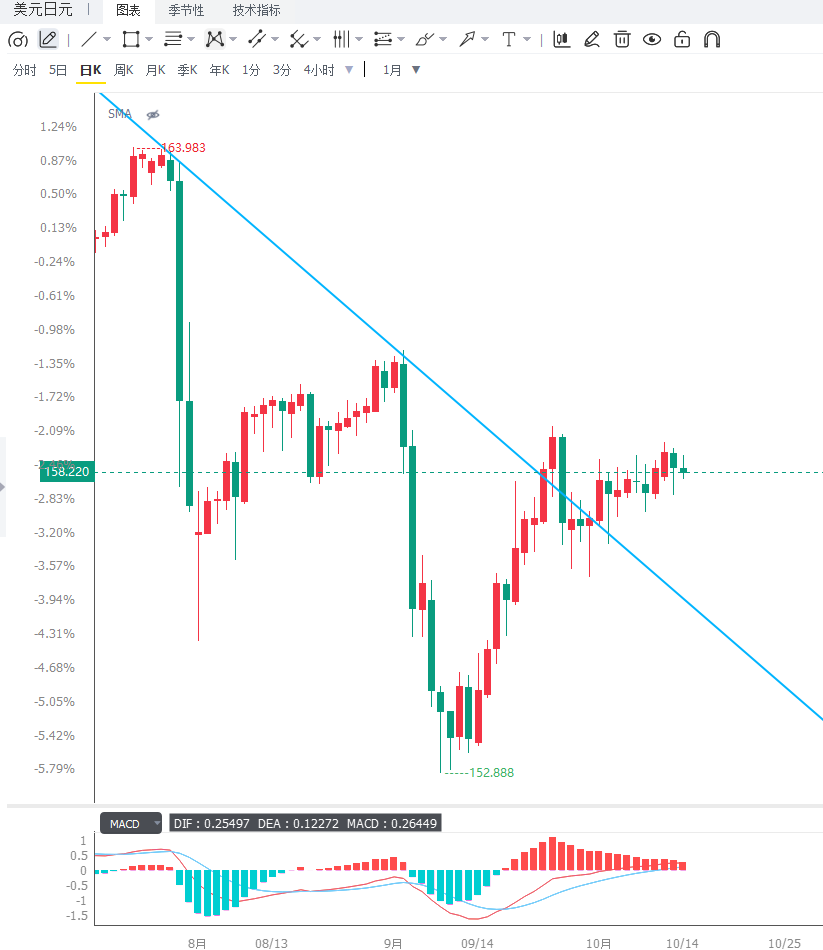 Editor's Summary: The USD/JPY pair is currently in a delicate balance between "USD/JPY interest rate differential support" and "intervention risk constraints." Market pricing in a Bank of Japan reportly favoring holding rates steady in October and a 90% probability of a December rate hike has exerted temporary downward pressure on the yen. Meanwhile, the Fed's hawkish stance and Middle East geopolitical risks have provided solid support for the dollar. However, the intervention sensitivity at the 160 level and the continued policy communication from Japanese authorities have created an implicit ceiling for the exchange rate, significantly worsening the odds of bulls chasing higher levels. Looking ahead, tonight's US CPI data and Warsh's speech on Friday will be key catalysts for breaking the equilibrium between 157.60 and 158.75. If the core CPI data is strong and Warsh releases hawkish signals, the exchange rate is expected to challenge the upper limit of 158.75 and launch an attack on the dense resistance zone of 159.00 to 159.55. If the data is moderate and Warsh's speech is dovish, the exchange rate may retrace and consolidate towards the 4-hour moving average at 157.93 or even the lower limit of the 157.60 range. Near the 160 mark, we need to be highly vigilant about the risk of impulsive fluctuations caused by expectations of intervention from the Japanese authorities.
Pressure on the yen mainly stems from a marginal cooling of expectations regarding the Bank of Japan's (BOJ) policy. BOJ officials are inclined to avoid a rare series of rate hikes this month, as policymakers see no need for consecutive action unless there is a sudden and significant increase in upside risks to inflation. The central bank will continue to assess economic data to determine whether further action is necessary at its December meeting. At its September meeting, the BOJ raised its policy rate by 25 basis points to 1.25%, the highest level since 1995, marking its second rate hike in three months and the fastest pace since 1990. However, the BOJ has never raised rates in two consecutive months since 1980, a long-standing practice reflecting policymakers' tendency to observe the transmission effects of previous actions before making further adjustments. Overnight swap market pricing is highly consistent with this expectation. Traders price only about a 10% probability of a BOJ rate hike in October, while pricing in an 88% to 90% probability of a December hike. The market widely expects the central bank to further raise rates to 1.50% by the end of the year or early next year, followed by a possible rise to 1.75% in March or April next year. Bank of Japan Governor Kazuo Ueda stated in a parliamentary address that Japan's underlying inflation rate is very close to the 2% target, but the key is to stabilize price trends around 2%. The Bank of Japan may hint in its October 30th quarterly outlook that underlying inflation has roughly reached the 2% target. This symbolic shift would provide a theoretical basis for subsequent interest rate hikes, but in the short term, the yen lacks a catalyst for sustained strength based on expectations of interest rate increases. The latest price data shows that inflationary pressures in Japan have not subsided. The corporate price index rose 6.8% year-on-year in September, lower than August's 7.6%, but still at a high level; the yen-denominated import price index surged 24.5% year-on-year, with chemical products rising 13.3% and non-ferrous metal products soaring 40.2%, reflecting that the yen's depreciation and Middle East geopolitical risks have jointly pushed up imported costs. A Bank of Japan household survey shows that 88.6% of households expect prices to rise in the coming year, indicating deeply entrenched inflation expectations. However, corporate prices fell 0.3% month-on-month in September, marking the second consecutive month of decline. The main drag came from falling agricultural and oil/coal product prices, indicating a marginal easing of upstream cost pressures. Support for the US dollar remains strong. The minutes of the Fed's September meeting confirmed that most officials believed further rate hikes before the end of the year were likely appropriate. The market currently prices a 77.3% probability of keeping rates unchanged in October, but a 90% probability of at least a 25 basis point rate hike in December. While the 10-year US Treasury yield has fallen from its previous high of 5.36% to around 5.22%, it remains at multi-year highs. The US-Japan interest rate differential remains wide at over 150 basis points, and carry trade logic continues to provide structural support for USD/JPY. The US September CPI data, released tonight at 8:30 PM, will be a key variable for short-term direction. The market generally expects overall CPI to rise from 3.4% year-on-year to 3.6%, and to increase by 0.6% month-on-month, mainly driven by gasoline prices; core CPI is expected to rise 0.2% month-on-month and to increase to 2.5% year-on-year. Danske Bank points out that "for the Fed, the focus will be on whether underlying inflationary pressures are widening," and a "significant upside surprise" would be needed to prompt the Fed to signal an October rate hike. If core CPI is strong, it could reignite hawkish expectations, pushing US Treasury yields and the dollar higher, with the exchange rate potentially challenging the upper limit of the 158.75 range and even the 159 level. If core data is moderate, the dollar may face further pressure, with the exchange rate consolidating towards the 4-hour 100-period moving average at 157.93. Furthermore, Fed Chairman Warsh is scheduled to speak at the IMF and World Bank annual meetings in Bangkok on Friday. As his last public appearance before the October policy meeting, his latest assessment of the inflation outlook and policy path could be the decisive force in breaking the current equilibrium. Geopolitical risks also provide continued safe-haven support for the dollar. The situation in the Middle East has not eased despite the Russia-Ukraine "energy ceasefire"—Iran's top security official declared Washington's response to its proposal to reopen the Strait of Hormuz "insufficient," Saudi Arabia's capital airport suffered a series of deadly attacks by Houthi rebels, Saudi Arabia vowed retaliation, and Trump considered joining military strikes against the Houthis. These events have maintained a high level of geopolitical risk premium, ensuring that the US dollar's appeal as the ultimate safe-haven asset has not diminished. From a fundamental perspective, the core contradiction currently facing USD/JPY is the direct interplay between the "USD/JPY interest rate advantage" and "intervention risk constraints." Brown Brothers Harriman points out that persistently high energy prices will raise inflation expectations through cost-push channels, thereby reinforcing the pricing of "higher" policy interest rates for a longer period. This transmission chain provides dual support for the US dollar—the expansion of real interest rates and interest rate differentials attracts carry trade funds back to the US, while relatively strong US economic growth reduces recession pricing. LGT Asia Private Bank anticipates that the USD/JPY pair may remain range-bound between 155 and 160 in the short term. The risk of Japanese government intervention in the currency market to support the yen will limit further upside for the dollar, but the significant interest rate differential between the US and Japan, along with continued overseas investment activities by Japanese investors, will limit the yen's appreciation potential. From a technical perspective, the USD/JPY pair maintains a short-term bullish structure on the 4-hour chart, with the price steadily trading above the 100-period simple moving average at approximately 157.93. This moving average continues to provide dynamic support, indicating that the previous upward trend has not been definitively broken. Short-term moving averages remain upwardly diverging, and the MACD indicator is above the zero line, but the red bars are narrowing, with the fast and slow lines converging, indicating weakening bullish momentum but not yet turning negative. The 14-period RSI is around 58, in the neutral-to-strong zone but not yet reaching the overbought threshold, suggesting that buyers still control the market but upward momentum is weakening. The Bollinger Bands remain upwardly open but are narrowing, volatility is converging, and the market awaits a directional breakout. On the upside, the area around 158.75 forms the upper edge of the short-term trading range. This level also represents the area where the price repeatedly faced resistance and fell back last week, indicating concentrated selling pressure. Only a breakout and sustained hold above this level with significant volume can confirm that the bulls have regained control, with the next target being the dense resistance zone between 159.00 and 159.55. The 100-day moving average around 159.55 and the upper Bollinger Band around 159.80 form a stronger structural barrier, having been tested multiple times without a successful breakout. This area is also a sensitive zone for Japanese intervention. On the downside, the 100-period moving average around 157.93 forms the first line of support, followed by the lower edge of the range at 157.60, which coincides with the middle Bollinger Band, further reinforcing the broader bullish structure. If the price breaks below 157.60, caution is warranted as the short-term bullish structure may weaken, with further pullbacks potentially targeting the 50-day moving average area around 156.90. On the daily chart, the exchange rate is trading above the middle Bollinger Band, with the Bollinger Bands narrowing and volatility declining, indicating a clear high-level consolidation pattern. The 20-day EMA at approximately 157.60 provides significant dynamic support, and the medium-term moving averages remain in a bullish alignment, suggesting the larger-scale trend has not yet turned bearish. The daily RSI is around 58, with the upward slope becoming less pronounced, raising concerns about a potential top divergence at higher levels. Editor's Summary: The USD/JPY pair is currently in a delicate balance between "USD/JPY interest rate differential support" and "intervention risk constraints." Market pricing in a Bank of Japan reportly favoring holding rates steady in October and a 90% probability of a December rate hike has exerted temporary downward pressure on the yen. Meanwhile, the Fed's hawkish stance and Middle East geopolitical risks have provided solid support for the dollar. However, the intervention sensitivity at the 160 level and the continued policy communication from Japanese authorities have created an implicit ceiling for the exchange rate, significantly worsening the odds of bulls chasing higher levels. Looking ahead, tonight's US CPI data and Warsh's speech on Friday will be key catalysts for breaking the equilibrium between 157.60 and 158.75. If the core CPI data is strong and Warsh releases hawkish signals, the exchange rate is expected to challenge the upper limit of 158.75 and launch an attack on the dense resistance zone of 159.00 to 159.55. If the data is moderate and Warsh's speech is dovish, the exchange rate may retrace and consolidate towards the 4-hour moving average at 157.93 or even the lower limit of the 157.60 range. Near the 160 mark, we need to be highly vigilant about the risk of impulsive fluctuations caused by expectations of intervention from the Japanese authorities.
- Risk Warning and Disclaimer
- The market involves risk, and trading may not be suitable for all investors. This article is for reference only and does not constitute personal investment advice, nor does it take into account certain users’ specific investment objectives, financial situation, or other needs. Any investment decisions made based on this information are at your own risk.