The European Central Bank sends a dovish signal: inflation has not yet spread, and it is closely monitoring winter natural gas prices.
2026-10-15 13:20:19
The euro rebounded slightly against the dollar during Asian trading hours on Thursday (October 15), currently trading around 1.1215. The exchange rate remains near its lowest levels since the end of May 2025. Recent comments from European Central Bank officials further revealed the central bank's views on inflation and subsequent monetary policy.  Álvaro Santos Pereira, a member of the European Central Bank's Governing Council and Governor of the Bank of Portugal, recently stated at the Bangkok Economic Festival that energy-driven inflation in the Eurozone has not yet spread to broader prices of goods and services.
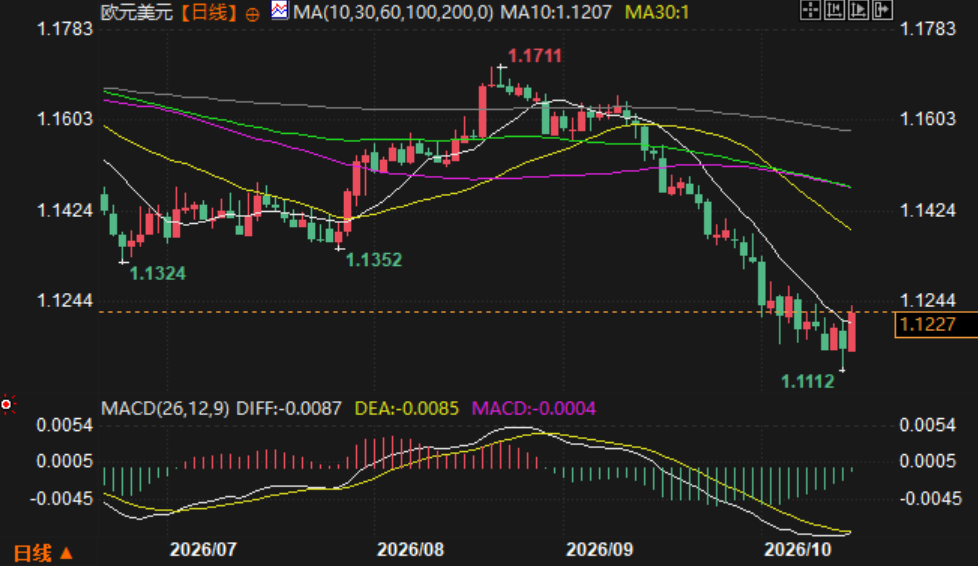 (Euro/USD daily chart, source: FX678) At 13:18 Beijing time, the euro was trading at 1.1212/13 against the US dollar.
Álvaro Santos Pereira, a member of the European Central Bank's Governing Council and Governor of the Bank of Portugal, recently stated at the Bangkok Economic Festival that energy-driven inflation in the Eurozone has not yet spread to broader prices of goods and services.Key takeaway: Energy inflation has not yet spread to broader prices.
Santos Pereira explicitly pointed out that the main characteristic of current inflation in the Eurozone is energy price-driven, and this shock has not yet significantly spread to other price categories. He emphasized that the good news is that inflation "has not spread." This assessment is of great significance to the European Central Bank. Energy price fluctuations are usually highly temporary; if their impact can be proven to be confined to the energy sector, the central bank has more room to "see through" the short-term shock and avoid premature or excessive tightening of monetary policy. Currently, overall Eurozone inflation is still affected by rising energy costs due to geopolitical conflicts in the Middle East, but the relative stability of core inflation and the smooth performance of indicators of the breadth of price increases jointly support the conclusion that "the shock has not spread." Santos Pereira's statement echoes the cautious optimism of some other officials recently, indicating that there is still a consensus within the Governing Council on the nature of current price pressures: as long as the energy shock does not evolve into a broader cost-push or wage-price spiral, policy can remain patient. This stance helps stabilize market expectations for the ECB's short-term path and reduces overly hawkish pricing caused by energy fluctuations.Diffusion indicators remain stable, providing policy space.
Santos Pereira specifically cited the breadth or diffusion indicator of price increases—the percentage of goods and services in the overall basket whose prices have risen by more than 3% or 4%. He stated that this indicator has remained largely stable over the past two years. Unlike simply focusing on the average inflation rate, the diffusion indicator better reflects whether price pressures are spreading widely throughout the economy. If a large number of goods and services experience significant price increases simultaneously, it indicates that inflation has become more sticky and diffuse; conversely, if only a few categories (mainly energy) experience significant increases, while other categories see limited increases, it supports the assessment of a "localized shock." The stability of this indicator provides the European Central Bank with an important observation window and policy space. It means that the current high inflation is more a result of relative energy price adjustments than a manifestation of overheated overall demand or a general rise in costs. Markets and policymakers can therefore focus more on the energy trend itself, rather than rushing to assume that a second round of effects has already occurred. This data perspective also echoes the focus of other major central banks on diffusion indicators, demonstrating that global policymakers attach importance to the "breadth" of inflation rather than just its "height."The policy bottom line is clear: if the virus spreads, the central bank will be forced to take action.
Despite a currently optimistic outlook, Santos Pereira also drew a clear policy bottom line. He stated that if inflation begins to spread, the central bank will be forced to take action. This statement conveys two meanings: first, the ECB is currently willing to tolerate short-term energy-driven inflation; second, policy flexibility has boundaries, and tightening action will be back on the agenda once price pressures spread to services, core goods, or wages. This statement helps balance market expectations, avoiding premature pricing of significant interest rate hikes due to energy volatility, while also preventing the market from underestimating subsequent risks. For investors, this means the ECB's policy response function remains clear: an energy shock itself does not necessarily trigger an interest rate hike, but a spread signal will be a crucial trigger. Subsequent Eurozone inflation data, service sector price trends, and wage negotiation results will all be key observation points for determining whether this bottom line has been reached. Santos Pereira's statement thus provides both short-term reassurance and preserves room for medium-term policy adjustments.Key risks: Natural gas prices and winter demand
In his risk warnings, Santos Pereira specifically highlighted natural gas. He stated that if a winter similar to last year's occurs, natural gas prices will face problems. The European natural gas market is highly sensitive to weather; if heating demand surges while supply is constrained by geopolitics or infrastructure, prices could rise rapidly, directly pushing up energy costs for households and businesses. This risk exhibits significant seasonality and uncertainty. The current situation in the Middle East has already put pressure on the overall energy market; if compounded by a severe winter, natural gas could become a new inflation amplifier. For the European Central Bank, the trajectory of natural gas prices will directly impact the inflation path in the coming months and may also test the validity of the assessment that "energy shocks are predictable." The market needs to closely monitor European natural gas inventories, weather forecasts, and related futures prices. If a severe winter materializes and pushes up gas prices, the "good news" described by Santos Pereira could be quickly challenged, and policy discussions could shift back towards a more hawkish direction.The rise in bond yields is largely due to fiscal factors.
Regarding the recent rise in Eurozone bond yields, Santos Pereira offered an explanation different from the inflation perspective. He stated that the higher yields are more related to fiscal issues than the inflation outlook. This statement has direct implications for the bond market. It indicates that the European Central Bank (ECB) attributes the rise in sovereign bond yields primarily to concerns about national fiscal paths and debt sustainability, rather than a signal that monetary policy needs further tightening. In other words, the central bank is unlikely to adjust its policy stance simply because of rising yields, but rather tends to believe that the responsibility for fiscal consolidation lies with the government. For traders, this means that the ECB has limited willingness to directly intervene or suppress yields through policy tools in the short term. The debt and interest rate spread issues in countries like France require more solutions through fiscal consolidation than relying on monetary authorities to "bail them out." This distinction helps the market more clearly assess the sources of risk and also brings the issue of fiscal discipline to a more prominent position.Summarize
Santos Pereira's statement sends a clear signal: the ECB can currently tolerate energy-driven inflationary shocks, provided that price pressures do not spread to a wider range of sectors. The stability in the breadth of price increases over the past two years provides data support for this stance. The policy bottom line is clear—once spread occurs, the central bank will be forced to act. Natural gas and winter demand pose the main downside risks, while the rise in bond yields is largely attributed to fiscal factors. Overall, the ECB lacks the urgency to further tighten significantly in the short term due to energy shocks, and market support for interest rate-driven movements in the euro is correspondingly limited. The focus will now shift to Eurozone inflation data, natural gas price trends, and fiscal progress. The evolution of these variables will determine whether the current assessment of "seeing through energy shocks" will hold true. (Euro/USD daily chart, source: FX678) At 13:18 Beijing time, the euro was trading at 1.1212/13 against the US dollar.
- Risk Warning and Disclaimer
- The market involves risk, and trading may not be suitable for all investors. This article is for reference only and does not constitute personal investment advice, nor does it take into account certain users’ specific investment objectives, financial situation, or other needs. Any investment decisions made based on this information are at your own risk.