Oxford Economics: Commodity prices will hit record highs, gradually declining from 2027.
2026-10-16 18:24:19
Driven by ongoing energy supply disruptions in the Middle East, global commodity prices are projected to reach record highs in the fourth quarter of 2026. While we predict a gradual decline in prices in 2027, the recovery will be uneven, with significant divergence between the energy, metals, and agricultural markets. According to the S&P GSCI spot index, the average annual increase in 2026 will reach 28%, hitting a record high in the fourth quarter. This surge is primarily driven by rising energy prices; as increased fuel, electricity, and transportation costs are transmitted to production, the price hikes are spreading throughout the entire commodity market.  This bears similarities to the supply shocks following the COVID-19 pandemic and the Russia-Ukraine conflict: at those times, production, trade, and logistics were disrupted, impacting multiple markets simultaneously. However, the current shock is concentrated in the energy sector, with vastly different prospects for various commodities. Our baseline forecast is that overall commodity prices will gradually decline in 2027 as Middle Eastern exports recover and supply constraints ease. However, the pace of adjustment will depend on the speed of physical supply recovery and whether geopolitical risks subside.
 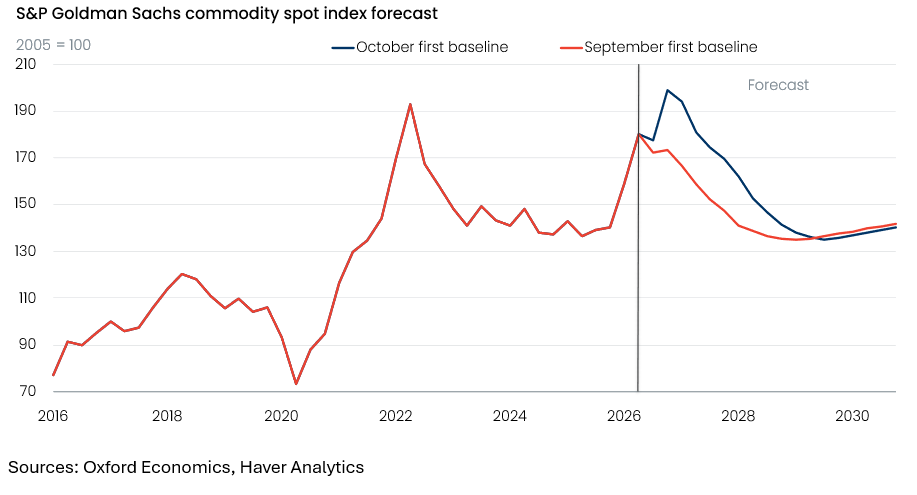 (Due to energy supply constraints, the Goldman Sachs Commodity Index is projected to reach its historical peak in the fourth quarter of 2026.) Oil prices will remain above $100 per barrel until mid-2027 . Crude oil remains the core of this commodity price shock. With repeated attacks on Red Sea export infrastructure, coupled with a persistently rising geopolitical risk premium, we currently expect Brent crude to average above $100 per barrel until the second quarter of 2027. The September attack on Saudi Arabia's East-West oil pipeline highlighted the vulnerability of alternative export routes. This pipeline, with a daily capacity of approximately 4 million barrels, helps Saudi crude oil exports bypass the Strait of Hormuz. Although the pipeline has partially resumed operation, the risk of further disruption continues to support oil prices. It is worth noting that as export capacity recovers, the core factor hindering oil prices from returning to normal is increasingly becoming the geopolitical risk premium, rather than a shortage of physical crude oil supply. Even with ample market supply, continued uncertainty in regional security could keep oil prices high. We still expect Brent crude to eventually converge towards its long-term equilibrium price of around $60 per barrel, but this adjustment process is expected to be delayed until 2029, rather than the previously anticipated 2028. The impact extends beyond crude oil. Tight supply in the refined product market, with the European diesel refining spread approaching $100 per barrel, further pushes up transportation and production costs. Rising fuel prices will significantly impact diesel-consuming mining operations, agricultural machinery, and the freight industry, transmitting the energy shock to other commodity markets. Natural gas faces winter supply shortages, highlighting uncertainty. Compared to crude oil, liquefied natural gas (LNG) is more difficult to divert, making the natural gas market highly vulnerable to supply disruptions in the Middle East. Before the conflict, Qatar and the UAE accounted for approximately 20% of global LNG trade; since March, their LNG exports have been effectively blocked by the Strait of Hormuz. As a result, LNG-linked natural gas prices in Europe and Asia have risen by approximately 130% since before the conflict, while Brent crude has increased by 45%. We expect natural gas prices to remain high during the 2026–2027 winter, before declining after global LNG supply expands. However, the market outlook is highly dependent on weather, gas storage levels, and the likelihood of further supply disruptions. Current European natural gas inventories are at their lowest level for this time of year in over a decade. In our baseline scenario, by April 1, 2027, storage levels will be only 17% of capacity, putting significant pressure on the market should winter temperatures fall below expectations. A cold snap, coupled with disruptions to US LNG or Norwegian pipeline supplies, could push prices as high as $35 per million British thermal units (MMBtu). Conversely, if winter is mild and global LNG supply continues to increase, peak winter prices may be capped at around $21 per MMBtu. Nevertheless, Europe's resilience is better than during the 2021–2022 energy crisis. Natural gas demand is down by about one-fifth compared to 2021, and new LNG import facilities have increased supply resilience. These two contrasting scenarios illustrate that natural gas price movements depend not only on Middle Eastern exports but also on Europe's ability to manage winter gas demand and secure alternative sources.
 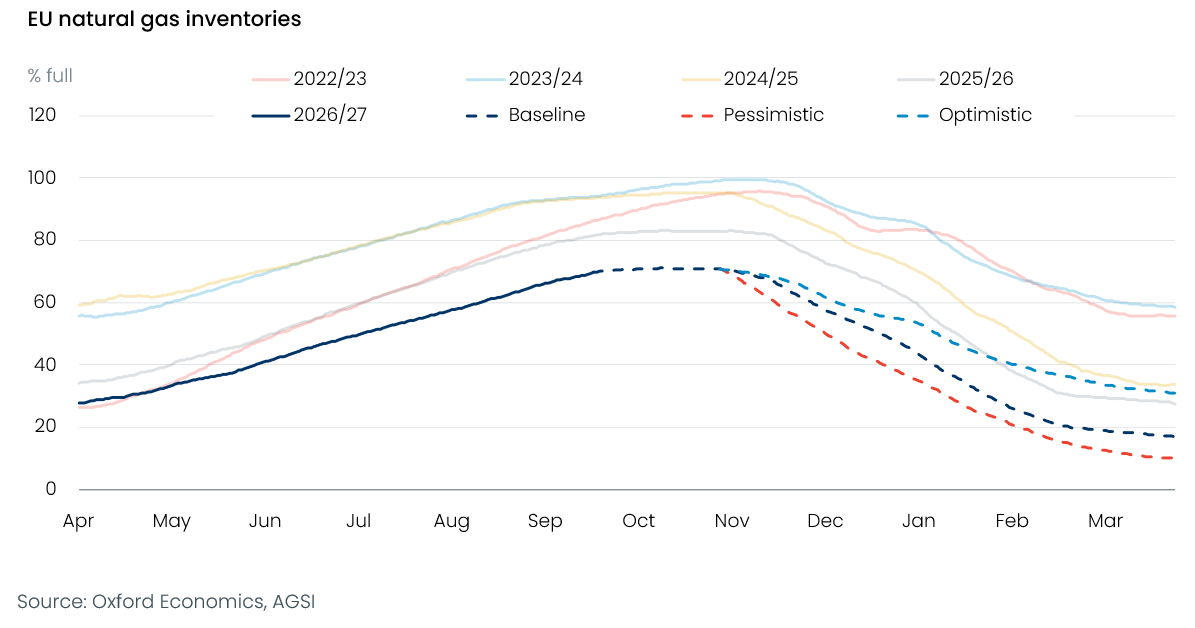 (Winter May Deplete EU Natural Gas Stockpiles) Gold Prices Rise, Investment Demand Remains Strong The impact of Middle East geopolitical shocks on gold was less than market expectations. Rising oil prices reignited inflation concerns, reinforcing market expectations of tighter US monetary policy, pushing up US Treasury yields and the dollar, partially offsetting safe-haven buying of gold. Even so, central bank gold purchases and investor demand continue to support gold prices. We forecast an average annual gold price of approximately $4,515 per ounce in 2026, rising to $4,840 in 2027, and reaching $5,140 in 2028. We expect the Federal Reserve to raise interest rates fewer times than currently anticipated by financial markets, thereby easing upward pressure on US Treasury yields and the dollar. Meanwhile, emerging market central banks will continue to diversify their foreign exchange reserves, sustaining gold demand. The outlook for other precious metals is mixed. High silver prices are driving recycling and substitution demand (especially in the photovoltaic sector); limited mine supply is beneficial for platinum. However, as the market share of internal combustion engine vehicles gradually shrinks, palladium faces structural demand weakening pressure. Copper and aluminum prices experienced a short-term correction before rebounding. With supply disruptions easing and trade distortions gradually disappearing, copper and aluminum prices are expected to decline in early 2027, but will remain near historical highs. Regarding aluminum, production and exports in the Gulf region are recovering, and new capacity in China and Indonesia is making up for previous supply gaps. However, China's capacity is nearing its effective limit, limiting further increases. The copper market situation is different. Although mine output is weak, increased refining capacity and recycled copper supply have resulted in an overall surplus in the global refined copper market. However, uncertainty surrounding US trade policy has led to regional supply imbalances. Due to anticipated import tariffs, approximately 80% of exchange-traded copper inventories are concentrated in the US. If tariff policies become clearer, companies' incentive to stockpile in the US will weaken, easing supply shortages in other regions and thus suppressing copper prices. Understanding the differences in global supply and demand fundamentals and regional trade distortions is crucial for judging short-term market trends. In the medium to long term, structural demand provides support. Grid investment, electrification, and data center construction will drive copper consumption; aluminum will benefit from investment in transportation, aerospace, and power infrastructure. With limited aluminum production capacity expansion and persistent bottlenecks in copper mine production, these demand-driven factors are expected to push copper and aluminum prices higher again in the second half of 2027. Grain stocks buffer geopolitical and climate risks The risk landscape for agricultural products differs. Rising energy and fertilizer costs, disruptions to Black Sea shipping, and severe weather could all push up grain prices, but current stocks are relatively ample, capable of offsetting the impact of shocks. Previous bumper harvests have left sufficient stocks to absorb some supply disruptions; therefore, we expect grain prices to remain largely stable in 2027. Continued attacks on Black Sea ports and shipping disrupt exports and increase freight rates. Meanwhile, the strong El Niño phenomenon may threaten Asian rice production and Australian wheat yields. However, with the recovery of Gulf fertilizer exports and China easing some export restrictions, fertilizer prices have fallen, easing cost pressures on agricultural production materials. The pace of supply recovery determines the speed of price corrections The overall commodity price cycle is nearing its peak, but the adjustment paths in different markets vary significantly. Oil and gas prices will fall as damaged supply recovers; base metals will experience a short-term correction before structural demand and supply constraints become favorable factors again; gold prices are expected to continue rising; and ample inventories will limit the upside potential for grain prices. The biggest uncertainty lies in the speed at which supply returns to normal. If Middle Eastern exports recover faster, energy prices will fall, driving down transportation and production costs across all commodity categories. Conversely, if regional infrastructure is attacked again, prices will remain high, and the correction process will be delayed. For companies with a commodity business, understanding this divergence is crucial. The core challenge is not only predicting when prices will peak, but also distinguishing which pressures are temporary and which will be long-term, and how different supply scenarios will change the market outlook.
This bears similarities to the supply shocks following the COVID-19 pandemic and the Russia-Ukraine conflict: at those times, production, trade, and logistics were disrupted, impacting multiple markets simultaneously. However, the current shock is concentrated in the energy sector, with vastly different prospects for various commodities. Our baseline forecast is that overall commodity prices will gradually decline in 2027 as Middle Eastern exports recover and supply constraints ease. However, the pace of adjustment will depend on the speed of physical supply recovery and whether geopolitical risks subside. (Due to energy supply constraints, the Goldman Sachs Commodity Index is projected to reach its historical peak in the fourth quarter of 2026.) Oil prices will remain above $100 per barrel until mid-2027 . Crude oil remains the core of this commodity price shock. With repeated attacks on Red Sea export infrastructure, coupled with a persistently rising geopolitical risk premium, we currently expect Brent crude to average above $100 per barrel until the second quarter of 2027. The September attack on Saudi Arabia's East-West oil pipeline highlighted the vulnerability of alternative export routes. This pipeline, with a daily capacity of approximately 4 million barrels, helps Saudi crude oil exports bypass the Strait of Hormuz. Although the pipeline has partially resumed operation, the risk of further disruption continues to support oil prices. It is worth noting that as export capacity recovers, the core factor hindering oil prices from returning to normal is increasingly becoming the geopolitical risk premium, rather than a shortage of physical crude oil supply. Even with ample market supply, continued uncertainty in regional security could keep oil prices high. We still expect Brent crude to eventually converge towards its long-term equilibrium price of around $60 per barrel, but this adjustment process is expected to be delayed until 2029, rather than the previously anticipated 2028. The impact extends beyond crude oil. Tight supply in the refined product market, with the European diesel refining spread approaching $100 per barrel, further pushes up transportation and production costs. Rising fuel prices will significantly impact diesel-consuming mining operations, agricultural machinery, and the freight industry, transmitting the energy shock to other commodity markets. Natural gas faces winter supply shortages, highlighting uncertainty. Compared to crude oil, liquefied natural gas (LNG) is more difficult to divert, making the natural gas market highly vulnerable to supply disruptions in the Middle East. Before the conflict, Qatar and the UAE accounted for approximately 20% of global LNG trade; since March, their LNG exports have been effectively blocked by the Strait of Hormuz. As a result, LNG-linked natural gas prices in Europe and Asia have risen by approximately 130% since before the conflict, while Brent crude has increased by 45%. We expect natural gas prices to remain high during the 2026–2027 winter, before declining after global LNG supply expands. However, the market outlook is highly dependent on weather, gas storage levels, and the likelihood of further supply disruptions. Current European natural gas inventories are at their lowest level for this time of year in over a decade. In our baseline scenario, by April 1, 2027, storage levels will be only 17% of capacity, putting significant pressure on the market should winter temperatures fall below expectations. A cold snap, coupled with disruptions to US LNG or Norwegian pipeline supplies, could push prices as high as $35 per million British thermal units (MMBtu). Conversely, if winter is mild and global LNG supply continues to increase, peak winter prices may be capped at around $21 per MMBtu. Nevertheless, Europe's resilience is better than during the 2021–2022 energy crisis. Natural gas demand is down by about one-fifth compared to 2021, and new LNG import facilities have increased supply resilience. These two contrasting scenarios illustrate that natural gas price movements depend not only on Middle Eastern exports but also on Europe's ability to manage winter gas demand and secure alternative sources. (Winter May Deplete EU Natural Gas Stockpiles) Gold Prices Rise, Investment Demand Remains Strong The impact of Middle East geopolitical shocks on gold was less than market expectations. Rising oil prices reignited inflation concerns, reinforcing market expectations of tighter US monetary policy, pushing up US Treasury yields and the dollar, partially offsetting safe-haven buying of gold. Even so, central bank gold purchases and investor demand continue to support gold prices. We forecast an average annual gold price of approximately $4,515 per ounce in 2026, rising to $4,840 in 2027, and reaching $5,140 in 2028. We expect the Federal Reserve to raise interest rates fewer times than currently anticipated by financial markets, thereby easing upward pressure on US Treasury yields and the dollar. Meanwhile, emerging market central banks will continue to diversify their foreign exchange reserves, sustaining gold demand. The outlook for other precious metals is mixed. High silver prices are driving recycling and substitution demand (especially in the photovoltaic sector); limited mine supply is beneficial for platinum. However, as the market share of internal combustion engine vehicles gradually shrinks, palladium faces structural demand weakening pressure. Copper and aluminum prices experienced a short-term correction before rebounding. With supply disruptions easing and trade distortions gradually disappearing, copper and aluminum prices are expected to decline in early 2027, but will remain near historical highs. Regarding aluminum, production and exports in the Gulf region are recovering, and new capacity in China and Indonesia is making up for previous supply gaps. However, China's capacity is nearing its effective limit, limiting further increases. The copper market situation is different. Although mine output is weak, increased refining capacity and recycled copper supply have resulted in an overall surplus in the global refined copper market. However, uncertainty surrounding US trade policy has led to regional supply imbalances. Due to anticipated import tariffs, approximately 80% of exchange-traded copper inventories are concentrated in the US. If tariff policies become clearer, companies' incentive to stockpile in the US will weaken, easing supply shortages in other regions and thus suppressing copper prices. Understanding the differences in global supply and demand fundamentals and regional trade distortions is crucial for judging short-term market trends. In the medium to long term, structural demand provides support. Grid investment, electrification, and data center construction will drive copper consumption; aluminum will benefit from investment in transportation, aerospace, and power infrastructure. With limited aluminum production capacity expansion and persistent bottlenecks in copper mine production, these demand-driven factors are expected to push copper and aluminum prices higher again in the second half of 2027. Grain stocks buffer geopolitical and climate risks The risk landscape for agricultural products differs. Rising energy and fertilizer costs, disruptions to Black Sea shipping, and severe weather could all push up grain prices, but current stocks are relatively ample, capable of offsetting the impact of shocks. Previous bumper harvests have left sufficient stocks to absorb some supply disruptions; therefore, we expect grain prices to remain largely stable in 2027. Continued attacks on Black Sea ports and shipping disrupt exports and increase freight rates. Meanwhile, the strong El Niño phenomenon may threaten Asian rice production and Australian wheat yields. However, with the recovery of Gulf fertilizer exports and China easing some export restrictions, fertilizer prices have fallen, easing cost pressures on agricultural production materials. The pace of supply recovery determines the speed of price corrections The overall commodity price cycle is nearing its peak, but the adjustment paths in different markets vary significantly. Oil and gas prices will fall as damaged supply recovers; base metals will experience a short-term correction before structural demand and supply constraints become favorable factors again; gold prices are expected to continue rising; and ample inventories will limit the upside potential for grain prices. The biggest uncertainty lies in the speed at which supply returns to normal. If Middle Eastern exports recover faster, energy prices will fall, driving down transportation and production costs across all commodity categories. Conversely, if regional infrastructure is attacked again, prices will remain high, and the correction process will be delayed. For companies with a commodity business, understanding this divergence is crucial. The core challenge is not only predicting when prices will peak, but also distinguishing which pressures are temporary and which will be long-term, and how different supply scenarios will change the market outlook.
- Risk Warning and Disclaimer
- The market involves risk, and trading may not be suitable for all investors. This article is for reference only and does not constitute personal investment advice, nor does it take into account certain users’ specific investment objectives, financial situation, or other needs. Any investment decisions made based on this information are at your own risk.