Cooling expectations of a Fed rate hike triggered a technical rebound in silver prices, which then fluctuated and corrected.
2026-10-19 14:20:20
Spot silver traded between $57.50 and $57.70 per ounce in Asian trading on Monday, a slight increase from Friday's close of approximately $57.13. It dipped to a low of $56.72 in the morning before rebounding quickly, with a daily range exceeding $1. COMEX silver also rose, reaching around $57.66 per ounce, with the spot and futures markets moving in tandem. Expectations regarding Federal Reserve policy are the core trigger for this round of silver price rebound. Chairman Warsh clearly stated at the IMF's annual meeting in Bangkok last Friday that he would not make any predictions about interest rate decisions in advance, nor did he reveal the policy inclination for the October policy meeting.  The market's probability of keeping interest rates unchanged at the October 27-28 meeting has risen to 83.9%, a significant increase from 49% a month ago, while the probability of a 25 basis point rate hike is only 16.1%. This shift in expectations has driven down US Treasury yields—the 10-year Treasury yield has fallen from its previous high of around 5.31% to the 5.06%-5.11% range, and the dollar index has fallen back to around 101.80-101.90, significantly reducing the opportunity cost of holding non-interest-bearing assets like silver. However, the tightening cycle is not over. The market still prices in a more than 90% probability that the Fed will raise rates by 25 basis points in December, and sticky inflation remains a potential risk. US September CPI rose 3.7% year-on-year and core CPI rose 2.6%, both exceeding expectations. September PPI rose 1.3% month-on-month, the largest increase since March 2022, with soaring energy prices being the main driver. If continued tensions in the Middle East drive oil prices higher, the urgency for a December rate hike by the Federal Reserve may intensify again, putting new valuation pressure on silver. Middle East geopolitical risks provide safe-haven support for silver. The Iranian Revolutionary Guard stated that an oil tanker struck a mine and exploded in the Strait of Hormuz on Sunday, and the secretary of Iran's Supreme National Security Council warned of retaliatory plans for a new round of attacks against the US and Israel, following a surge in attacks around the Strait of Hormuz in the past 10 days. Meanwhile, concerns about AI financing triggered a sell-off in risk assets, with funds shifting to the bond market, creating a rare combination of "declining risk appetite + declining US Treasury yields + a weaker dollar," from which silver, as a commodity with both financial and industrial attributes, benefits. On the fundamental side, the silver supply and demand situation remains structurally tight. The World Silver Institute predicts a global silver market supply deficit of 46.3 million ounces in 2026, marking the sixth consecutive year of a supply deficit. However, the gap has narrowed compared to last year, mainly due to the accelerated trend of silver reduction in the photovoltaic industry—the advancement of technologies such as silver-plated copper and electroplated copper, coupled with the slowdown in global photovoltaic installation growth. It is estimated that silver consumption in photovoltaics will decline by approximately 19% to 20% year-on-year this year. However, increased demand from emerging fields such as AI data centers, new energy vehicles, and 5G has offset the decline in silver consumption in photovoltaics to some extent. Regarding inventory, COMEX silver inventory is approximately 334 million ounces, and SLV silver ETF holdings increased by 115.14 tons to 15,478.67 tons, indicating continued willingness to buy at lower levels. From a technical perspective, silver is trading below the 50-day and 100-day simple moving averages on the daily chart, with the moving average system diverging downwards, indicating that the large-scale bearish structure has not yet reversed. The price is below the Bollinger Band middle line, the MACD is below the zero line but the green bars are gradually narrowing, and the RSI is around 36, approaching the oversold zone but without a capitulation sell-off, representing a weak recovery signal after the decline. On the 1-hour chart, the price is fluctuating within a small range of 0.236 to 0.382 Fibonacci retracements. Short-term moving averages are intertwined, and the Bollinger Bands are narrowing, indicating intensified competition between bulls and bears. Resistance levels are at $57.70, $58.20-$58.41, and $59.37-$60.00. Support levels are at $56.72-$56.81, $55.38, and $54.77-$55.00. A break above the $58.20-$58.41 resistance zone could see silver prices further challenge $59.37-$60.00; a break below $56.72-$56.81 could lead to a retest of the $55.38 low, or even a move towards $55.00 or lower.
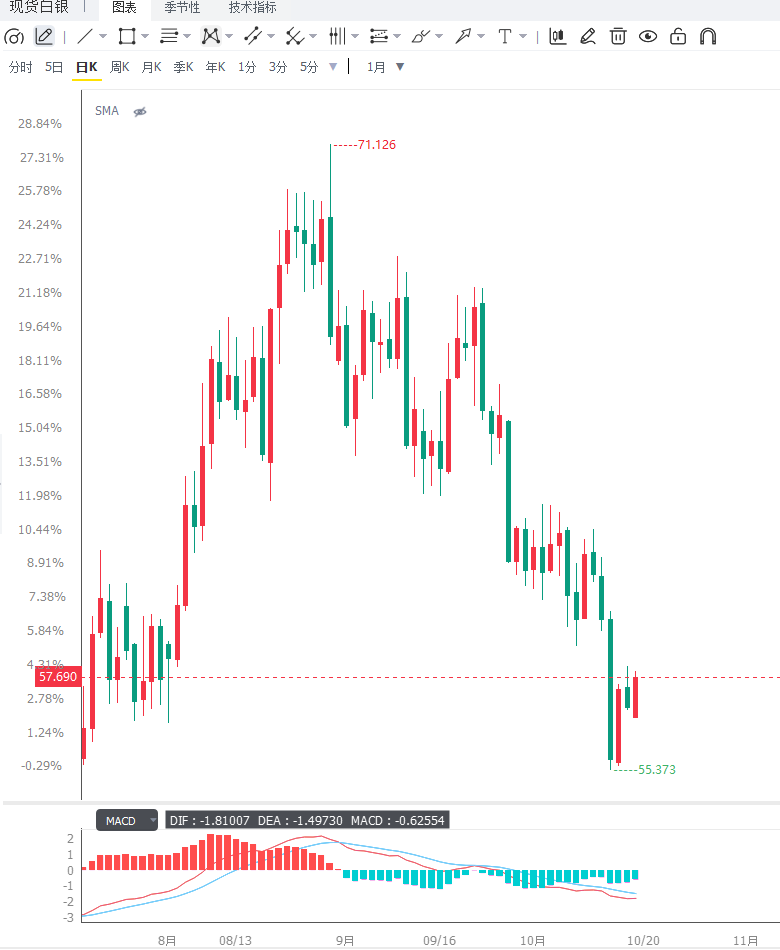 Editor's Summary: Spot silver is currently caught in a short-term tug-of-war between "delayed expectations of a Fed rate hike" and "unchanged large-scale downtrend structure." Warsh's ambiguous statements provided a breathing space for silver, with falling US Treasury yields and geopolitical risks jointly driving a technical rebound. However, daily moving averages are providing significant resistance, and the $58 level remains a strong resistance that will be difficult to overcome in the short term. Going forward, key factors to watch include the Fed's interest rate meeting on October 28th, shipping conditions in the Strait of Hormuz, subsequent US inflation data, and marginal changes in silver demand from the photovoltaic and AI sectors.
The market's probability of keeping interest rates unchanged at the October 27-28 meeting has risen to 83.9%, a significant increase from 49% a month ago, while the probability of a 25 basis point rate hike is only 16.1%. This shift in expectations has driven down US Treasury yields—the 10-year Treasury yield has fallen from its previous high of around 5.31% to the 5.06%-5.11% range, and the dollar index has fallen back to around 101.80-101.90, significantly reducing the opportunity cost of holding non-interest-bearing assets like silver. However, the tightening cycle is not over. The market still prices in a more than 90% probability that the Fed will raise rates by 25 basis points in December, and sticky inflation remains a potential risk. US September CPI rose 3.7% year-on-year and core CPI rose 2.6%, both exceeding expectations. September PPI rose 1.3% month-on-month, the largest increase since March 2022, with soaring energy prices being the main driver. If continued tensions in the Middle East drive oil prices higher, the urgency for a December rate hike by the Federal Reserve may intensify again, putting new valuation pressure on silver. Middle East geopolitical risks provide safe-haven support for silver. The Iranian Revolutionary Guard stated that an oil tanker struck a mine and exploded in the Strait of Hormuz on Sunday, and the secretary of Iran's Supreme National Security Council warned of retaliatory plans for a new round of attacks against the US and Israel, following a surge in attacks around the Strait of Hormuz in the past 10 days. Meanwhile, concerns about AI financing triggered a sell-off in risk assets, with funds shifting to the bond market, creating a rare combination of "declining risk appetite + declining US Treasury yields + a weaker dollar," from which silver, as a commodity with both financial and industrial attributes, benefits. On the fundamental side, the silver supply and demand situation remains structurally tight. The World Silver Institute predicts a global silver market supply deficit of 46.3 million ounces in 2026, marking the sixth consecutive year of a supply deficit. However, the gap has narrowed compared to last year, mainly due to the accelerated trend of silver reduction in the photovoltaic industry—the advancement of technologies such as silver-plated copper and electroplated copper, coupled with the slowdown in global photovoltaic installation growth. It is estimated that silver consumption in photovoltaics will decline by approximately 19% to 20% year-on-year this year. However, increased demand from emerging fields such as AI data centers, new energy vehicles, and 5G has offset the decline in silver consumption in photovoltaics to some extent. Regarding inventory, COMEX silver inventory is approximately 334 million ounces, and SLV silver ETF holdings increased by 115.14 tons to 15,478.67 tons, indicating continued willingness to buy at lower levels. From a technical perspective, silver is trading below the 50-day and 100-day simple moving averages on the daily chart, with the moving average system diverging downwards, indicating that the large-scale bearish structure has not yet reversed. The price is below the Bollinger Band middle line, the MACD is below the zero line but the green bars are gradually narrowing, and the RSI is around 36, approaching the oversold zone but without a capitulation sell-off, representing a weak recovery signal after the decline. On the 1-hour chart, the price is fluctuating within a small range of 0.236 to 0.382 Fibonacci retracements. Short-term moving averages are intertwined, and the Bollinger Bands are narrowing, indicating intensified competition between bulls and bears. Resistance levels are at $57.70, $58.20-$58.41, and $59.37-$60.00. Support levels are at $56.72-$56.81, $55.38, and $54.77-$55.00. A break above the $58.20-$58.41 resistance zone could see silver prices further challenge $59.37-$60.00; a break below $56.72-$56.81 could lead to a retest of the $55.38 low, or even a move towards $55.00 or lower. Editor's Summary: Spot silver is currently caught in a short-term tug-of-war between "delayed expectations of a Fed rate hike" and "unchanged large-scale downtrend structure." Warsh's ambiguous statements provided a breathing space for silver, with falling US Treasury yields and geopolitical risks jointly driving a technical rebound. However, daily moving averages are providing significant resistance, and the $58 level remains a strong resistance that will be difficult to overcome in the short term. Going forward, key factors to watch include the Fed's interest rate meeting on October 28th, shipping conditions in the Strait of Hormuz, subsequent US inflation data, and marginal changes in silver demand from the photovoltaic and AI sectors.
- Risk Warning and Disclaimer
- The market involves risk, and trading may not be suitable for all investors. This article is for reference only and does not constitute personal investment advice, nor does it take into account certain users’ specific investment objectives, financial situation, or other needs. Any investment decisions made based on this information are at your own risk.