The expectation of a Fed rate hike has slowed, and the dollar index continues to fluctuate at high levels.
2026-10-19 14:24:21
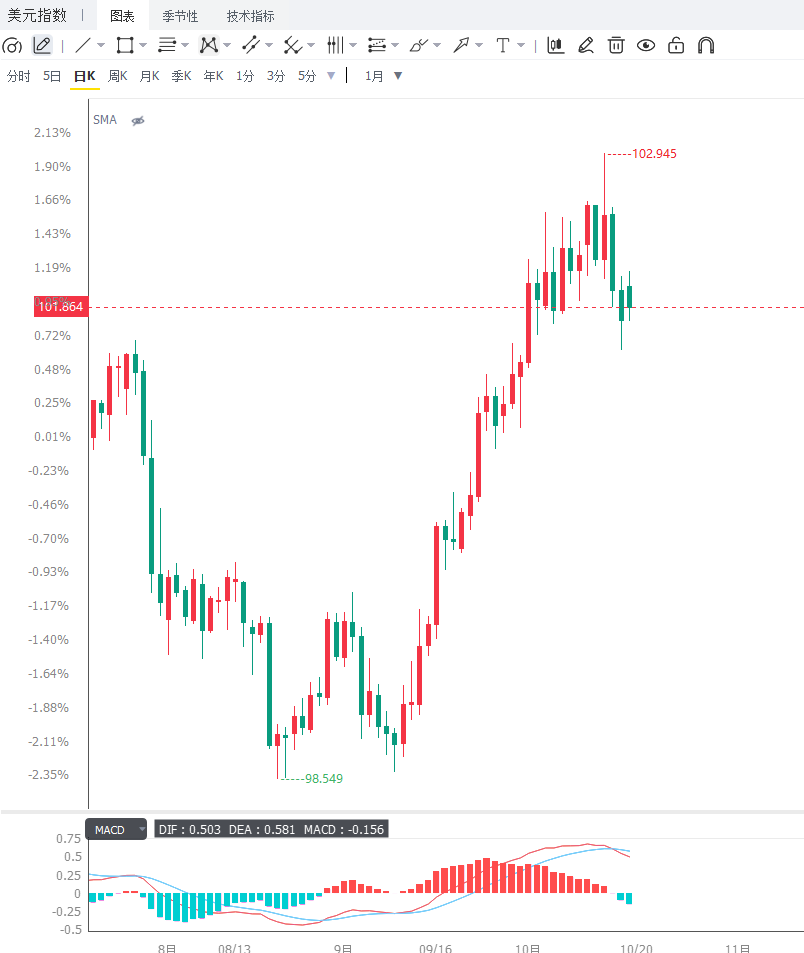
The US dollar index traded between 101.80 and 101.85 in Asian trading on Monday, essentially unchanged from Friday's close of 101.84. It briefly rose to 102.01 in the morning before quickly retreating, with a daily range of approximately 25 points. The dollar exhibited a high-level consolidation pattern amid a confluence of factors, with both bulls and bears remaining cautious. Social unrest in France provided short-term safe-haven support for the dollar. The yield on French 10-year government bonds rose to nearly 4.85%, approaching the more than 20-year high of 5% reached earlier this month, with financing costs now higher than those of countries like Greece and Italy, which were deeply mired in the European debt crisis. As of the second quarter of 2026, France's public debt has reached €3.6 trillion, equivalent to 119% of GDP, with a projected fiscal deficit of 5.4%, far exceeding the EU's 3% limit. The wave of protests has spread to other European countries such as Portugal, Italy, and Spain, reigniting market concerns about the risks of Eurozone sovereign debt. Amid this safe-haven sentiment, the dollar rebounded from a two-week low reached on Friday.  However, the safe-haven appeal of the US dollar is being eroded by financing concerns in the AI sector. Recently, high-yield bonds issued by some AI-related companies have fallen to approximately 80% of their face value, raising questions about the market's ability to absorb financing for AI infrastructure. OCBC strategists point out that AI has become a crucial pillar for US growth, risk assets, yields, and the US dollar, but this support is a double-edged sword—if the investment cycle cools, the same support could reverse, putting pressure on the dollar even in a safe-haven environment. When the shock is centered on the US, the safe-haven demand for US Treasuries will push yields down, while weak US asset returns will reduce the relative attractiveness of the dollar, forming a rare combination of "increased risk aversion + declining US Treasury yields + weakening dollar." Regarding Federal Reserve policy expectations, Chairman Warsh's "no-prediction" statement at the IMF Bangkok annual meeting last Friday continues to resonate. The market's probability of maintaining the current interest rate at the October 28th meeting has risen to 83.9%, while the probability of a 25 basis point rate hike is only 16.1%. However, expectations for an interest rate hike at the December meeting remain strong—the probability of a 25 basis point hike is 77.3%, and the probability of a 50 basis point hike is 14.5%. This means that the tightening cycle has not ended, but only the timing of implementation has been postponed, and the US dollar as a whole still enjoys medium- to long-term support. From a technical perspective, the US dollar index is trading above the 20-day exponential moving average on the daily chart, maintaining a short-term bullish structural bias. The RSI is around 57, above the 50 neutral line, indicating that the upward momentum continues rather than being overbought. The resistance levels above are 102.01, 102.40 to 102.50, and 103.00. The support levels below are 101.65, 101.40, and 101.00. If it breaks below 101.65, the short-term bullish structure may be weakened, and the US dollar may further retrace to the 101.40 to 101.00 area; if it regains a foothold above 102.00, it may challenge the 102.40 to 102.50 resistance zone again.
 Editor's Summary: The US dollar index is currently caught in a short-term tug-of-war between "support from French turmoil and Middle East geopolitical safe-haven demand" and "AI financing concerns weakening the dollar's luster." Warsh's ambiguous statements have suppressed the dollar's upward momentum, but the risk of a December rate hike remains, and the dollar as a whole still enjoys medium- to long-term support. The key events to watch going forward are the Fed's interest rate decision on October 28th, the French bond market, AI sector debt performance, and US retail sales and PPI data.
However, the safe-haven appeal of the US dollar is being eroded by financing concerns in the AI sector. Recently, high-yield bonds issued by some AI-related companies have fallen to approximately 80% of their face value, raising questions about the market's ability to absorb financing for AI infrastructure. OCBC strategists point out that AI has become a crucial pillar for US growth, risk assets, yields, and the US dollar, but this support is a double-edged sword—if the investment cycle cools, the same support could reverse, putting pressure on the dollar even in a safe-haven environment. When the shock is centered on the US, the safe-haven demand for US Treasuries will push yields down, while weak US asset returns will reduce the relative attractiveness of the dollar, forming a rare combination of "increased risk aversion + declining US Treasury yields + weakening dollar." Regarding Federal Reserve policy expectations, Chairman Warsh's "no-prediction" statement at the IMF Bangkok annual meeting last Friday continues to resonate. The market's probability of maintaining the current interest rate at the October 28th meeting has risen to 83.9%, while the probability of a 25 basis point rate hike is only 16.1%. However, expectations for an interest rate hike at the December meeting remain strong—the probability of a 25 basis point hike is 77.3%, and the probability of a 50 basis point hike is 14.5%. This means that the tightening cycle has not ended, but only the timing of implementation has been postponed, and the US dollar as a whole still enjoys medium- to long-term support. From a technical perspective, the US dollar index is trading above the 20-day exponential moving average on the daily chart, maintaining a short-term bullish structural bias. The RSI is around 57, above the 50 neutral line, indicating that the upward momentum continues rather than being overbought. The resistance levels above are 102.01, 102.40 to 102.50, and 103.00. The support levels below are 101.65, 101.40, and 101.00. If it breaks below 101.65, the short-term bullish structure may be weakened, and the US dollar may further retrace to the 101.40 to 101.00 area; if it regains a foothold above 102.00, it may challenge the 102.40 to 102.50 resistance zone again. Editor's Summary: The US dollar index is currently caught in a short-term tug-of-war between "support from French turmoil and Middle East geopolitical safe-haven demand" and "AI financing concerns weakening the dollar's luster." Warsh's ambiguous statements have suppressed the dollar's upward momentum, but the risk of a December rate hike remains, and the dollar as a whole still enjoys medium- to long-term support. The key events to watch going forward are the Fed's interest rate decision on October 28th, the French bond market, AI sector debt performance, and US retail sales and PPI data.
- Risk Warning and Disclaimer
- The market involves risk, and trading may not be suitable for all investors. This article is for reference only and does not constitute personal investment advice, nor does it take into account certain users’ specific investment objectives, financial situation, or other needs. Any investment decisions made based on this information are at your own risk.