The pound continued its rebound against the dollar as expectations of a Bank of England rate hike rose and the dollar weakened.
2026-10-20 15:22:20
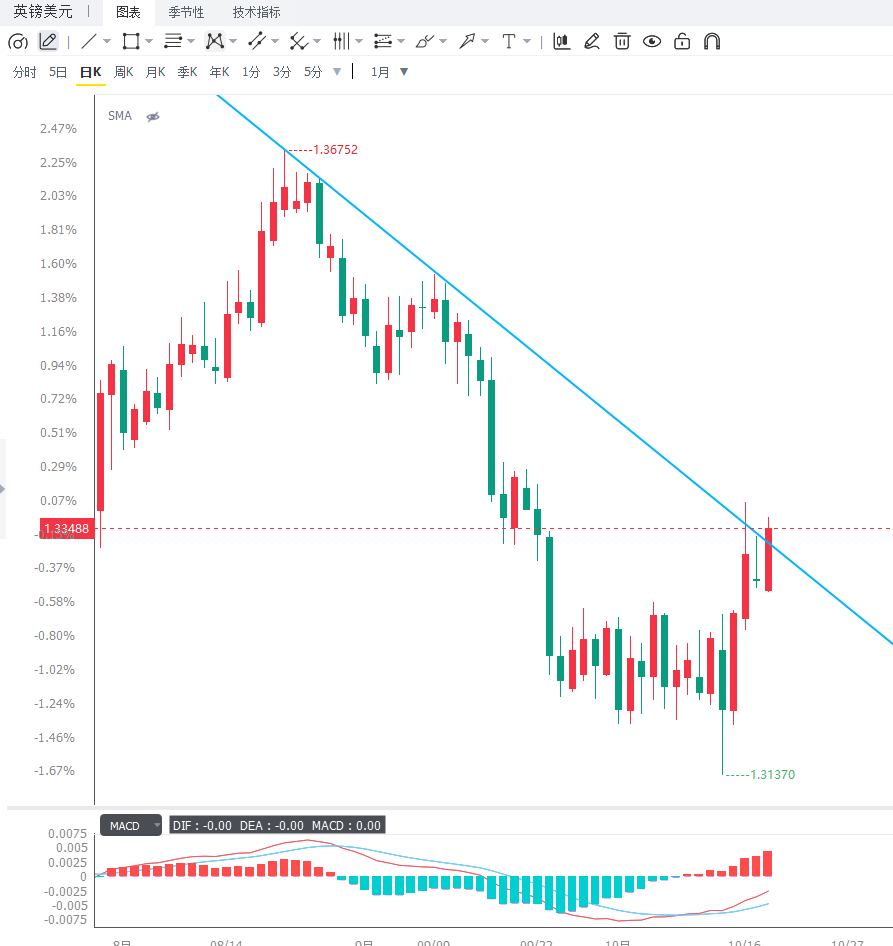
On Tuesday during Asian trading hours, the pound traded around 1.3350 against the dollar, rebounding slightly from the previous trading day's close and continuing its consolidation and recovery trend since last week. This round of upward movement was not driven by the pound's strong fundamentals, but rather by a temporary pullback in the dollar ahead of the interest rate meeting, coupled with a moderate increase in expectations of a Bank of England rate hike. These two factors combined to drive the short-term recovery in the exchange rate.  The logic surrounding the US dollar is relatively clear. Last week, Federal Reserve Chairman Warsh expressed optimism about the resilience of the US economy but explicitly refused to provide specific guidance on the timing and likelihood of future interest rate adjustments, emphasizing that he would "not predict the outcome of the meeting." According to the CME Group's FedWatch tool, the federal funds futures market is currently pricing in an 82.8% probability that the Fed will keep interest rates unchanged in October, while pricing in a December rate hike remains above 80%. This combination of "uncertain direction and delayed timing" caused the dollar index to continue its weak trend at the beginning of the week, trading around 101.80. Warsh's speech received a score of 5.6/10, slightly below the historical benchmark of 6.1/10; he stated that he was "too traumatized by the global financial crisis," highlighting his continued vigilance regarding financial stability. However, the Fed sentiment index remains stable at a high level of 127.51, well above the neutral benchmark of 100, indicating that the overall policy narrative remains hawkish. This means the dollar's pullback is more of a technical correction than a trend reversal—once year-end tightening expectations resurface, the dollar's interest rate advantage could return, putting downward pressure on the pound. Support for the pound comes from dual expectations of monetary and fiscal policy. Interest rate futures indicate the market is currently pricing in four 25-basis-point rate hikes by the Bank of England before July 2027, with the first action potentially occurring as early as November. While this expectation doesn't constitute an aggressive tightening path, it's sufficient to give the pound a relative interest rate advantage given the general wait-and-see attitude of major central banks worldwide. Meanwhile, investors are focusing on next week's UK budget. Several large asset management institutions are positioning themselves in advance, betting that fiscal discipline will support UK government bonds; if Chancellor John Healy confirms to the market that public spending and government borrowing will be strictly controlled, demand for UK bonds is expected to gain further momentum, thus boosting the pound through the yield-exchange rate transmission chain. Conversely, if the budget is interpreted as excessive expansion, long-term interest rates and the pound may come under pressure simultaneously, representing the biggest one-sided risk facing the pound this week. From a global market perspective, the current movement of the pound is also constrained by the relative strength of other assets. The euro has lagged behind due to large-scale protests in many parts of France, with the spread between French and German bond yields widening to approximately 147 basis points, a high since the European debt crisis. This divergence suggests that the pound's rebound is, to some extent, a passive appreciation driven by a weakening euro and a retreating dollar, lacking sufficient initiative. Furthermore, the sticky inflation backdrop of a 3.7% year-on-year CPI and a 6.3% year-on-year PPI in the US in September, along with the upcoming ADP employment, housing starts, and building permits data, will indirectly influence the pound's movement through the dollar channel. Given that the October homebuilder confidence index has fallen to around 29, the lowest level since mid-2012, further weakening housing data could reinforce expectations of an economic slowdown and amplify the pound's short-term gains. On the daily chart, the pound/dollar pair shows a mildly bearish short-term tone, trading below the 50-day exponential moving average (approximately 1.3349), but above the 9-day EMA (approximately 1.3277). Short-term moving averages have not yet formed a clear bullish alignment. The RSI (14) is at 51.26, close to the neutral zone, indicating the market is in a consolidation phase rather than a trend breakout. Meanwhile, the stable state of the FXS Fed Sentiment Index has failed to provide a clear bullish catalyst. The primary resistance is at the 50-day EMA of approximately 1.3349. A daily close above this level is needed to alleviate the current bearish bias and open up space for a more sustained recovery. The next key levels to watch are the 1.3400 level and the previous support at 1.3450. Support is initially seen at the 9-day EMA of approximately 1.3277. A break below this short-term support could allow sellers to regain control and continue the recent pullback. Deeper support lies around 1.3220 and 1.3180. On the 4-hour chart, the exchange rate is consolidating in a narrow range between 1.3280 and 1.3340. Short-term moving averages are converging, the MACD histogram is close to the zero line, and the fast and slow lines are repeatedly intertwined, indicating neutral momentum. If the price retraces to 1.3280-1.3290 and finds support, there is still a chance for a short-term upward move towards the 1.3349-1.3370 resistance zone. However, if the price breaks below 1.3277 with significant volume, it may seek support at 1.3220 or even 1.3180.
 Editor's Summary: The core logic for the GBP/USD exchange rate in the short term lies in the resonance between a "phased pullback in the US dollar" and "moderately rising expectations of a Bank of England rate hike." However, the sustainability of this resonance depends on the quality of next week's UK budget. If Chancellor Healy demonstrates sufficient fiscal discipline, demand for UK bonds and the pound are expected to benefit simultaneously, and the exchange rate may attempt to challenge the 1.3349-1.3400 resistance zone. If the budget leans towards expansion, pressure on long-term interest rates may quickly offset the support from rate hike expectations, causing the exchange rate to return to below 1.3277 for consolidation. In the medium term, as long as the Fed sentiment index remains above 127 and the expectation of tightening in December is not disproven, the dollar's pullback is more like a technical correction, and the pound's upside potential will be significantly suppressed.
The logic surrounding the US dollar is relatively clear. Last week, Federal Reserve Chairman Warsh expressed optimism about the resilience of the US economy but explicitly refused to provide specific guidance on the timing and likelihood of future interest rate adjustments, emphasizing that he would "not predict the outcome of the meeting." According to the CME Group's FedWatch tool, the federal funds futures market is currently pricing in an 82.8% probability that the Fed will keep interest rates unchanged in October, while pricing in a December rate hike remains above 80%. This combination of "uncertain direction and delayed timing" caused the dollar index to continue its weak trend at the beginning of the week, trading around 101.80. Warsh's speech received a score of 5.6/10, slightly below the historical benchmark of 6.1/10; he stated that he was "too traumatized by the global financial crisis," highlighting his continued vigilance regarding financial stability. However, the Fed sentiment index remains stable at a high level of 127.51, well above the neutral benchmark of 100, indicating that the overall policy narrative remains hawkish. This means the dollar's pullback is more of a technical correction than a trend reversal—once year-end tightening expectations resurface, the dollar's interest rate advantage could return, putting downward pressure on the pound. Support for the pound comes from dual expectations of monetary and fiscal policy. Interest rate futures indicate the market is currently pricing in four 25-basis-point rate hikes by the Bank of England before July 2027, with the first action potentially occurring as early as November. While this expectation doesn't constitute an aggressive tightening path, it's sufficient to give the pound a relative interest rate advantage given the general wait-and-see attitude of major central banks worldwide. Meanwhile, investors are focusing on next week's UK budget. Several large asset management institutions are positioning themselves in advance, betting that fiscal discipline will support UK government bonds; if Chancellor John Healy confirms to the market that public spending and government borrowing will be strictly controlled, demand for UK bonds is expected to gain further momentum, thus boosting the pound through the yield-exchange rate transmission chain. Conversely, if the budget is interpreted as excessive expansion, long-term interest rates and the pound may come under pressure simultaneously, representing the biggest one-sided risk facing the pound this week. From a global market perspective, the current movement of the pound is also constrained by the relative strength of other assets. The euro has lagged behind due to large-scale protests in many parts of France, with the spread between French and German bond yields widening to approximately 147 basis points, a high since the European debt crisis. This divergence suggests that the pound's rebound is, to some extent, a passive appreciation driven by a weakening euro and a retreating dollar, lacking sufficient initiative. Furthermore, the sticky inflation backdrop of a 3.7% year-on-year CPI and a 6.3% year-on-year PPI in the US in September, along with the upcoming ADP employment, housing starts, and building permits data, will indirectly influence the pound's movement through the dollar channel. Given that the October homebuilder confidence index has fallen to around 29, the lowest level since mid-2012, further weakening housing data could reinforce expectations of an economic slowdown and amplify the pound's short-term gains. On the daily chart, the pound/dollar pair shows a mildly bearish short-term tone, trading below the 50-day exponential moving average (approximately 1.3349), but above the 9-day EMA (approximately 1.3277). Short-term moving averages have not yet formed a clear bullish alignment. The RSI (14) is at 51.26, close to the neutral zone, indicating the market is in a consolidation phase rather than a trend breakout. Meanwhile, the stable state of the FXS Fed Sentiment Index has failed to provide a clear bullish catalyst. The primary resistance is at the 50-day EMA of approximately 1.3349. A daily close above this level is needed to alleviate the current bearish bias and open up space for a more sustained recovery. The next key levels to watch are the 1.3400 level and the previous support at 1.3450. Support is initially seen at the 9-day EMA of approximately 1.3277. A break below this short-term support could allow sellers to regain control and continue the recent pullback. Deeper support lies around 1.3220 and 1.3180. On the 4-hour chart, the exchange rate is consolidating in a narrow range between 1.3280 and 1.3340. Short-term moving averages are converging, the MACD histogram is close to the zero line, and the fast and slow lines are repeatedly intertwined, indicating neutral momentum. If the price retraces to 1.3280-1.3290 and finds support, there is still a chance for a short-term upward move towards the 1.3349-1.3370 resistance zone. However, if the price breaks below 1.3277 with significant volume, it may seek support at 1.3220 or even 1.3180. Editor's Summary: The core logic for the GBP/USD exchange rate in the short term lies in the resonance between a "phased pullback in the US dollar" and "moderately rising expectations of a Bank of England rate hike." However, the sustainability of this resonance depends on the quality of next week's UK budget. If Chancellor Healy demonstrates sufficient fiscal discipline, demand for UK bonds and the pound are expected to benefit simultaneously, and the exchange rate may attempt to challenge the 1.3349-1.3400 resistance zone. If the budget leans towards expansion, pressure on long-term interest rates may quickly offset the support from rate hike expectations, causing the exchange rate to return to below 1.3277 for consolidation. In the medium term, as long as the Fed sentiment index remains above 127 and the expectation of tightening in December is not disproven, the dollar's pullback is more like a technical correction, and the pound's upside potential will be significantly suppressed.
- Risk Warning and Disclaimer
- The market involves risk, and trading may not be suitable for all investors. This article is for reference only and does not constitute personal investment advice, nor does it take into account certain users’ specific investment objectives, financial situation, or other needs. Any investment decisions made based on this information are at your own risk.