Sticky inflation and the approaching interest rate meeting dampened upward momentum, with the US dollar index consolidating near its high of 101.80.
2026-10-20 15:26:20
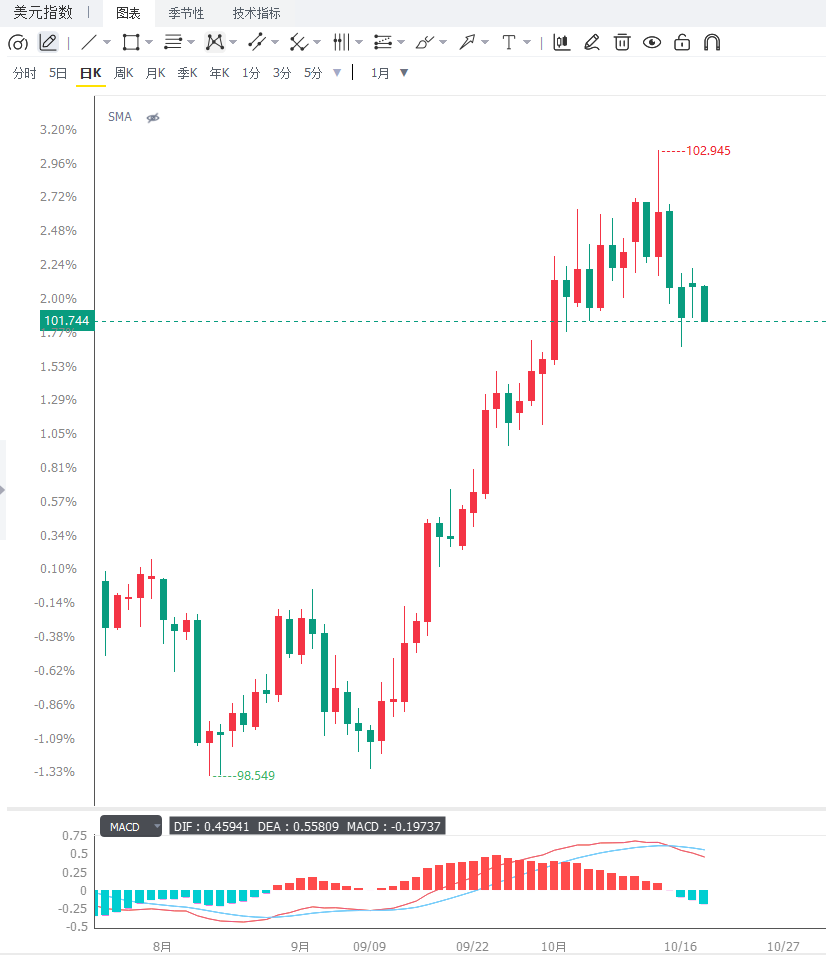
On Tuesday morning in Europe, the US dollar index traded around 101.80, slightly retreating from the previous trading day's New York close, and under pressure below the 102 level. With the Federal Reserve's interest rate meeting approaching next week, market trading has become noticeably more cautious, with bullish sentiment weakening. However, the overall bullish structure remains intact, and the exchange rate is exhibiting typical characteristics of "consolidation at high levels, awaiting a catalyst."  Last week's inflation data provided the direct backdrop for the current high-level fluctuations in the US dollar. Data from the US Bureau of Labor Statistics showed that the September CPI rose 3.7% year-on-year, higher than market expectations; wholesale prices climbed 6.3% year-on-year, the largest increase since 2022. This data further confirms the stickiness of inflation and makes the judgment that "the tightening cycle has ended" seem premature. However, Federal Reserve Chairman Warsh's remarks last week were cautious. He explicitly stated that he "would not predict the outcome of the meeting" and emphasized that "I believe it is inappropriate to say now what I might do at the remainder of the year." This data-dependent communication style prompted the market to quickly price in an unchanged interest rate in October at approximately 82.8%. In other words, while inflation is relatively high, the timing of implementation may be postponed, which is the core reason why the dollar has recently struggled to rise further but has also failed to fall significantly. Warsh's speech received a score of 5.6/10, slightly below the historical benchmark of 6.1/10, indicating that his communication style was more moderate than usual. In his speech, he acknowledged that he was "deeply wounded by the global financial crisis," highlighting his continued vigilance regarding financial stability. He also emphasized the surge in investment and structural growth driven by "good policies," and viewed artificial intelligence as a recent demand-side variable and a tool to strengthen monetary policy analysis. He also planned to hold a special hearing on AI. More noteworthy is that the Fed's sentiment index remained high at 127.51, well above the neutral benchmark of 100. This means that despite a slightly softer tone, the overall policy narrative remains firmly hawkish. For the dollar, this is a combination of "lack of short-term catalysts but continued medium-term support": the interest rate advantage has not been weakened, but upward momentum needs new data to activate it. The divergent performance of non-US currencies is also shaping the relative strength of the dollar. G10 currencies performed unevenly, with the euro under pressure due to large-scale protests in many parts of France, and the Franco-German bond yield spread widening to approximately 147 basis points, a high since the 2011-2012 European debt crisis. This divergence means that the fluctuations in the dollar index are more driven by relative changes in the constituent currencies than by trend-based buying and selling of the dollar itself. Analysts also pointed out that the market may be reluctant to excessively short the dollar before the end-of-month interest rate meeting, but the weakening support from yields will make the dollar more vulnerable to further weakening – this judgment highlights the biggest risk currently facing the dollar: not a shift in fundamentals, but the fragility of its portfolio structure. From a global market perspective, the current high-level consolidation of the dollar is essentially the result of the combined forces of "inflation stickiness, policy caution, and AI capital inflows." On the one hand, high interest rates and AI-related industrial capital continue to provide medium- to long-term support for the dollar; on the other hand, the prices of high-yield bonds of some AI-related companies have fallen to about 80% of their face value, and the widening credit spreads have raised questions about the market's ability to absorb infrastructure financing. Once the investment cycle cools down, a combination of "increased risk aversion, declining US Treasury yields, and a weaker dollar" may emerge, which will be the main tail risk facing the dollar. In addition, geopolitical variables such as French fiscal uncertainty and shipping disruptions in the Middle East will also indirectly affect the short-term direction of the dollar through risk appetite channels. On the data front, the US ADP employment report, housing starts, and building permits report will be released later today. Given that the homebuilder confidence index fell to about 29 in October, the lowest level since mid-2012, if housing data weakens further, it may strengthen expectations of an economic slowdown and put short-term pressure on the US dollar; conversely, if employment data is unexpectedly resilient, it may push the US dollar to retest the resistance above 102. On the daily chart, the US dollar index is running above the 100-day simple moving average and the lower Bollinger Band, and the short-term bias is still bullish, with the demand zone structure below intact; however, the index has entered the upper half of the recent fluctuation envelope, and the middle Bollinger Band at about 101.85 constitutes immediate resistance. The RSI (14) is at 55.8, above the 50 neutral line and not overbought, indicating that the upward momentum is moderate rather than excessive, which is a typical "supported but lacking breakout momentum" pattern. Stronger resistance lies at the upper Bollinger Band around 102.75, an area prone to profit-taking. Support is initially seen at the lower Bollinger Band around 100.95, with a deeper support level near the 100-day moving average around 100.50. As long as this support cluster holds, the overall rebound structure remains intact. On the 4-hour chart, the index is consolidating narrowly between 101.50 and 102.10. Short-term moving averages are converging, and the MACD histogram is close to the zero line, indicating neutral momentum. An upward breakout requires a firm hold above 101.85 with significant volume; otherwise, a pullback to 101.50 or even 101.20 is likely. A downward breakout requires a decisive breach of 100.95. Until then, the market is expected to remain range-bound.
 Editor's Summary: The core contradiction for the US dollar index in the short term lies in the tug-of-war between "sticky inflation and hawkish narratives providing medium-term support" and "the expectation of no change in October weakening short-term momentum." Warsh's decision not to predict the meeting's stance returns pricing power to data, meaning that before next week's FOMC meeting, the dollar is likely to continue its high-level consolidation between 100.95 and 102.75. A unilateral breakout would require support from ADP employment, housing data, or unexpected information at the level of the meeting minutes. In the medium term, as long as the FXS Fed Sentiment Index remains above 127 and the December tightening expectation is not completely disproven, the dollar's pullback is more of a technical correction than a trend reversal. However, if AI-related credit spreads continue to widen and US Treasury yields experience a systemic decline, the dollar's interest rate differential will be weakened, and the risk of a rapid pullback to 100.50 or even lower should be noted.
Last week's inflation data provided the direct backdrop for the current high-level fluctuations in the US dollar. Data from the US Bureau of Labor Statistics showed that the September CPI rose 3.7% year-on-year, higher than market expectations; wholesale prices climbed 6.3% year-on-year, the largest increase since 2022. This data further confirms the stickiness of inflation and makes the judgment that "the tightening cycle has ended" seem premature. However, Federal Reserve Chairman Warsh's remarks last week were cautious. He explicitly stated that he "would not predict the outcome of the meeting" and emphasized that "I believe it is inappropriate to say now what I might do at the remainder of the year." This data-dependent communication style prompted the market to quickly price in an unchanged interest rate in October at approximately 82.8%. In other words, while inflation is relatively high, the timing of implementation may be postponed, which is the core reason why the dollar has recently struggled to rise further but has also failed to fall significantly. Warsh's speech received a score of 5.6/10, slightly below the historical benchmark of 6.1/10, indicating that his communication style was more moderate than usual. In his speech, he acknowledged that he was "deeply wounded by the global financial crisis," highlighting his continued vigilance regarding financial stability. He also emphasized the surge in investment and structural growth driven by "good policies," and viewed artificial intelligence as a recent demand-side variable and a tool to strengthen monetary policy analysis. He also planned to hold a special hearing on AI. More noteworthy is that the Fed's sentiment index remained high at 127.51, well above the neutral benchmark of 100. This means that despite a slightly softer tone, the overall policy narrative remains firmly hawkish. For the dollar, this is a combination of "lack of short-term catalysts but continued medium-term support": the interest rate advantage has not been weakened, but upward momentum needs new data to activate it. The divergent performance of non-US currencies is also shaping the relative strength of the dollar. G10 currencies performed unevenly, with the euro under pressure due to large-scale protests in many parts of France, and the Franco-German bond yield spread widening to approximately 147 basis points, a high since the 2011-2012 European debt crisis. This divergence means that the fluctuations in the dollar index are more driven by relative changes in the constituent currencies than by trend-based buying and selling of the dollar itself. Analysts also pointed out that the market may be reluctant to excessively short the dollar before the end-of-month interest rate meeting, but the weakening support from yields will make the dollar more vulnerable to further weakening – this judgment highlights the biggest risk currently facing the dollar: not a shift in fundamentals, but the fragility of its portfolio structure. From a global market perspective, the current high-level consolidation of the dollar is essentially the result of the combined forces of "inflation stickiness, policy caution, and AI capital inflows." On the one hand, high interest rates and AI-related industrial capital continue to provide medium- to long-term support for the dollar; on the other hand, the prices of high-yield bonds of some AI-related companies have fallen to about 80% of their face value, and the widening credit spreads have raised questions about the market's ability to absorb infrastructure financing. Once the investment cycle cools down, a combination of "increased risk aversion, declining US Treasury yields, and a weaker dollar" may emerge, which will be the main tail risk facing the dollar. In addition, geopolitical variables such as French fiscal uncertainty and shipping disruptions in the Middle East will also indirectly affect the short-term direction of the dollar through risk appetite channels. On the data front, the US ADP employment report, housing starts, and building permits report will be released later today. Given that the homebuilder confidence index fell to about 29 in October, the lowest level since mid-2012, if housing data weakens further, it may strengthen expectations of an economic slowdown and put short-term pressure on the US dollar; conversely, if employment data is unexpectedly resilient, it may push the US dollar to retest the resistance above 102. On the daily chart, the US dollar index is running above the 100-day simple moving average and the lower Bollinger Band, and the short-term bias is still bullish, with the demand zone structure below intact; however, the index has entered the upper half of the recent fluctuation envelope, and the middle Bollinger Band at about 101.85 constitutes immediate resistance. The RSI (14) is at 55.8, above the 50 neutral line and not overbought, indicating that the upward momentum is moderate rather than excessive, which is a typical "supported but lacking breakout momentum" pattern. Stronger resistance lies at the upper Bollinger Band around 102.75, an area prone to profit-taking. Support is initially seen at the lower Bollinger Band around 100.95, with a deeper support level near the 100-day moving average around 100.50. As long as this support cluster holds, the overall rebound structure remains intact. On the 4-hour chart, the index is consolidating narrowly between 101.50 and 102.10. Short-term moving averages are converging, and the MACD histogram is close to the zero line, indicating neutral momentum. An upward breakout requires a firm hold above 101.85 with significant volume; otherwise, a pullback to 101.50 or even 101.20 is likely. A downward breakout requires a decisive breach of 100.95. Until then, the market is expected to remain range-bound. Editor's Summary: The core contradiction for the US dollar index in the short term lies in the tug-of-war between "sticky inflation and hawkish narratives providing medium-term support" and "the expectation of no change in October weakening short-term momentum." Warsh's decision not to predict the meeting's stance returns pricing power to data, meaning that before next week's FOMC meeting, the dollar is likely to continue its high-level consolidation between 100.95 and 102.75. A unilateral breakout would require support from ADP employment, housing data, or unexpected information at the level of the meeting minutes. In the medium term, as long as the FXS Fed Sentiment Index remains above 127 and the December tightening expectation is not completely disproven, the dollar's pullback is more of a technical correction than a trend reversal. However, if AI-related credit spreads continue to widen and US Treasury yields experience a systemic decline, the dollar's interest rate differential will be weakened, and the risk of a rapid pullback to 100.50 or even lower should be noted.
- Risk Warning and Disclaimer
- The market involves risk, and trading may not be suitable for all investors. This article is for reference only and does not constitute personal investment advice, nor does it take into account certain users’ specific investment objectives, financial situation, or other needs. Any investment decisions made based on this information are at your own risk.