The Fed's hawkish expectations supported the dollar, and the USD/CAD pair traded in a range.
2026-10-21 14:36:24
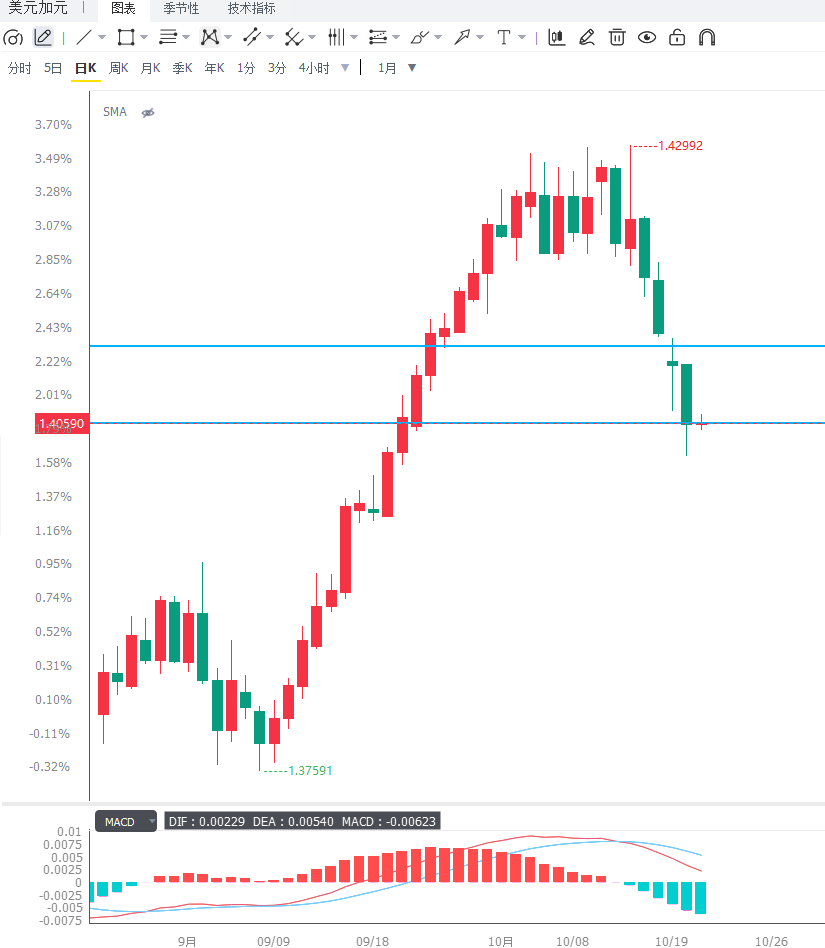
On Wednesday during Asian trading hours, the USD/CAD pair stabilized around 1.4060 after four consecutive days of declines, with the downward trend somewhat contained but the rebound lacking strength. The core contradiction in the current exchange rate lies in the fact that soaring oil prices simultaneously provide support for both the USD and CAD – on the one hand, inflation and safe-haven demand benefit the USD, while on the other hand, improved trade terms benefit the CAD. These two factors offset each other, resulting in a typical tug-of-war pattern with a "ceiling" and a "floor."  From the supply side, risks have accumulated significantly. In the past two weeks, at least 18 merchant ships have been attacked in the Strait of Hormuz. The conflict between Saudi Arabia, the Iranian-backed Houthi rebels in Yemen, and Russia and Ukraine has escalated simultaneously, with each side launching attacks and targeted strikes against energy infrastructure. Under these multiple shocks, crude oil prices have risen by more than 10% this month. However, the supply side is also releasing hedging signals: oil flows in the Middle East have largely recovered to about 80% of pre-conflict levels, and energy infrastructure has shown resilience exceeding market expectations. This means that the current oil price increase is driven more by "disruption expectations" than by "actual shortages." Once logistical data continues to improve, the premium could be retraced just as quickly—this is both immediate support and a potential reversal risk for the Canadian dollar, which is highly dependent on oil price fluctuations. Diplomatic news has further amplified market volatility. Pakistani Army Chief of Staff Asim Munir met with senior Iranian diplomatic and military officials in Tehran to discuss bilateral relations and the progress of negotiations with Washington. The diplomats involved in the discussion later clarified that efforts to end the conflict are still underway and explicitly denied rumors that a "final agreement is imminent." This intermediate state of "negotiations in progress, agreement not yet finalized" is precisely the scenario most difficult for the market to price: it is neither sufficient to disprove the risk of supply disruptions nor to provide a clear path to easing them, leading to a tug-of-war in oil prices after the news is released, often resulting in an initial surge followed by a pullback. For the USD/CAD pair, this impulsive volatility amplifies the risk of false breakouts in both directions, making it unwise to chase highs or lows in the absence of confirmation signals. In terms of monetary policy, the divergence in the paths taken by the US and Canada constitutes the medium-term main theme for the exchange rate. Federal Reserve Chairman Warsh explicitly stated that he would not "predict" interest rate decisions and did not provide a clear signal regarding the October meeting; his speech scored 5.6/10 on the FXS Speechtracker, slightly below the historical average of 6.1/10, and he described himself as "too traumatized by the global financial crisis," highlighting a cautious tendency when emphasizing structural growth, surging investment, and artificial intelligence as a demand-side variable. Meanwhile, the FXS Fed Sentiment Index remained high at 127.51, indicating that the overall policy narrative remains firmly in the hawkish range. This combination of a "soft tone and hawkish stance" leaves the US dollar lacking directional catalysts, yet it hasn't lost its bottom support. In contrast, the Bank of Canada has less room to maneuver in response to inflation amid high oil prices. If energy costs continue to be passed on to core prices, its policy pace may be forced to accelerate—a potential change that needs to be closely monitored in the coming weeks and is not yet fully priced in by the market. From a global market perspective, the current USD/CAD fluctuations are essentially a superposition of two independent logics: on one hand, the proactive support for the US dollar provided by the hawkish narrative and safe-haven demand from the US; on the other hand, the passive strengthening of the Canadian dollar through trade terms and fiscal channels due to rising oil prices. Since the Canadian dollar is generally more elastic to oil prices than the US dollar, the USD/CAD is often more likely to be pressured downwards during periods of rapid oil price increases; only when the premium is given back or risk appetite plummets will the safe-haven attribute of the US dollar regain dominance. In addition, the increased freight and insurance costs caused by the disruption of shipping in the Middle East will exacerbate global trade concerns and indirectly put pressure on the currencies of export-oriented economies like Canada. This environment is initially favorable for the Canadian dollar, but if it evolves into a situation where growth slows and interest rates coexist, its pricing logic will face a more complex test. On the daily chart, the USD/CAD pair is trading below the 50-day exponential moving average and the 9-day EMA. The short-term moving averages are in a bearish alignment, and the rebound continues to be suppressed by the aforementioned resistance levels. The medium-term bearish structure has not yet been repaired. The RSI (14) is around 42.7, below the 50 neutral line and not yet in the oversold zone, indicating that the upward momentum is weakening and there is room for further bottoming out. This is a typical weak consolidation pattern. The upside resistance levels to watch are the 50-day EMA around 1.4075, the 9-day EMA around 1.4140, and the psychological level of 1.4200. Only a decisive break above 1.4075 on the daily chart can alleviate the current bearish bias. A key resistance level further up is the horizontal resistance line at 1.4794; this level will be a major test if the bulls attempt to restart their upward trend. On the downside, the first support level to watch is the previous support at 1.3980, followed by 1.3920 and 1.3850. 1.3980 is a crucial support level in the near term; a break below this level could open up further downside potential. On the 4-hour chart, the exchange rate has been consolidating slowly along the short-term moving average after falling back from around 1.4100. The MACD histogram is close to the zero axis, with the fast and slow lines repeatedly intertwined, indicating neutral momentum. Currently, the price is fluctuating narrowly between 1.4040 and 1.4080. If it breaks below 1.4000 with significant volume, it may seek support at 1.3980 or even 1.3920. An upward breakout requires confirmation from oil price movements and signals from the Federal Reserve. Until then, a range-bound trading strategy is advisable, avoiding chasing highs and lows.
 Editor's Summary: The core contradiction in the short-term USD/CAD exchange rate lies in the dual pull of rising oil prices on the US dollar (inflation and safe-haven demand) and the Canadian dollar (terms of trade). This, coupled with the Fed's hawkish narrative and moving average resistance, suggests the exchange rate is more likely to fluctuate within the 1.3980-1.4075 range. Three key variables need to be monitored: first, the navigability of the Strait of Hormuz and the frequency of attacks, which directly determine the duration of the oil price premium and the Canadian dollar's responsiveness; second, the actual progress of US-Iran negotiations, any substantial signs of easing tensions could trigger a rapid retracement of the premium and reverse the Canadian dollar's relative advantage; and third, whether Middle Eastern oil flows can continue to approach pre-war levels, which is crucial evidence of whether the market is driven by "expectations" or "substantial shortages." In the medium term, until 1.4075 is effectively recovered, the exchange rate will maintain a weak and volatile pattern. Confirmation of the trend direction still awaits the final clarification of the geopolitical situation and the policy paths of the central banks of the US and Canada.
From the supply side, risks have accumulated significantly. In the past two weeks, at least 18 merchant ships have been attacked in the Strait of Hormuz. The conflict between Saudi Arabia, the Iranian-backed Houthi rebels in Yemen, and Russia and Ukraine has escalated simultaneously, with each side launching attacks and targeted strikes against energy infrastructure. Under these multiple shocks, crude oil prices have risen by more than 10% this month. However, the supply side is also releasing hedging signals: oil flows in the Middle East have largely recovered to about 80% of pre-conflict levels, and energy infrastructure has shown resilience exceeding market expectations. This means that the current oil price increase is driven more by "disruption expectations" than by "actual shortages." Once logistical data continues to improve, the premium could be retraced just as quickly—this is both immediate support and a potential reversal risk for the Canadian dollar, which is highly dependent on oil price fluctuations. Diplomatic news has further amplified market volatility. Pakistani Army Chief of Staff Asim Munir met with senior Iranian diplomatic and military officials in Tehran to discuss bilateral relations and the progress of negotiations with Washington. The diplomats involved in the discussion later clarified that efforts to end the conflict are still underway and explicitly denied rumors that a "final agreement is imminent." This intermediate state of "negotiations in progress, agreement not yet finalized" is precisely the scenario most difficult for the market to price: it is neither sufficient to disprove the risk of supply disruptions nor to provide a clear path to easing them, leading to a tug-of-war in oil prices after the news is released, often resulting in an initial surge followed by a pullback. For the USD/CAD pair, this impulsive volatility amplifies the risk of false breakouts in both directions, making it unwise to chase highs or lows in the absence of confirmation signals. In terms of monetary policy, the divergence in the paths taken by the US and Canada constitutes the medium-term main theme for the exchange rate. Federal Reserve Chairman Warsh explicitly stated that he would not "predict" interest rate decisions and did not provide a clear signal regarding the October meeting; his speech scored 5.6/10 on the FXS Speechtracker, slightly below the historical average of 6.1/10, and he described himself as "too traumatized by the global financial crisis," highlighting a cautious tendency when emphasizing structural growth, surging investment, and artificial intelligence as a demand-side variable. Meanwhile, the FXS Fed Sentiment Index remained high at 127.51, indicating that the overall policy narrative remains firmly in the hawkish range. This combination of a "soft tone and hawkish stance" leaves the US dollar lacking directional catalysts, yet it hasn't lost its bottom support. In contrast, the Bank of Canada has less room to maneuver in response to inflation amid high oil prices. If energy costs continue to be passed on to core prices, its policy pace may be forced to accelerate—a potential change that needs to be closely monitored in the coming weeks and is not yet fully priced in by the market. From a global market perspective, the current USD/CAD fluctuations are essentially a superposition of two independent logics: on one hand, the proactive support for the US dollar provided by the hawkish narrative and safe-haven demand from the US; on the other hand, the passive strengthening of the Canadian dollar through trade terms and fiscal channels due to rising oil prices. Since the Canadian dollar is generally more elastic to oil prices than the US dollar, the USD/CAD is often more likely to be pressured downwards during periods of rapid oil price increases; only when the premium is given back or risk appetite plummets will the safe-haven attribute of the US dollar regain dominance. In addition, the increased freight and insurance costs caused by the disruption of shipping in the Middle East will exacerbate global trade concerns and indirectly put pressure on the currencies of export-oriented economies like Canada. This environment is initially favorable for the Canadian dollar, but if it evolves into a situation where growth slows and interest rates coexist, its pricing logic will face a more complex test. On the daily chart, the USD/CAD pair is trading below the 50-day exponential moving average and the 9-day EMA. The short-term moving averages are in a bearish alignment, and the rebound continues to be suppressed by the aforementioned resistance levels. The medium-term bearish structure has not yet been repaired. The RSI (14) is around 42.7, below the 50 neutral line and not yet in the oversold zone, indicating that the upward momentum is weakening and there is room for further bottoming out. This is a typical weak consolidation pattern. The upside resistance levels to watch are the 50-day EMA around 1.4075, the 9-day EMA around 1.4140, and the psychological level of 1.4200. Only a decisive break above 1.4075 on the daily chart can alleviate the current bearish bias. A key resistance level further up is the horizontal resistance line at 1.4794; this level will be a major test if the bulls attempt to restart their upward trend. On the downside, the first support level to watch is the previous support at 1.3980, followed by 1.3920 and 1.3850. 1.3980 is a crucial support level in the near term; a break below this level could open up further downside potential. On the 4-hour chart, the exchange rate has been consolidating slowly along the short-term moving average after falling back from around 1.4100. The MACD histogram is close to the zero axis, with the fast and slow lines repeatedly intertwined, indicating neutral momentum. Currently, the price is fluctuating narrowly between 1.4040 and 1.4080. If it breaks below 1.4000 with significant volume, it may seek support at 1.3980 or even 1.3920. An upward breakout requires confirmation from oil price movements and signals from the Federal Reserve. Until then, a range-bound trading strategy is advisable, avoiding chasing highs and lows. Editor's Summary: The core contradiction in the short-term USD/CAD exchange rate lies in the dual pull of rising oil prices on the US dollar (inflation and safe-haven demand) and the Canadian dollar (terms of trade). This, coupled with the Fed's hawkish narrative and moving average resistance, suggests the exchange rate is more likely to fluctuate within the 1.3980-1.4075 range. Three key variables need to be monitored: first, the navigability of the Strait of Hormuz and the frequency of attacks, which directly determine the duration of the oil price premium and the Canadian dollar's responsiveness; second, the actual progress of US-Iran negotiations, any substantial signs of easing tensions could trigger a rapid retracement of the premium and reverse the Canadian dollar's relative advantage; and third, whether Middle Eastern oil flows can continue to approach pre-war levels, which is crucial evidence of whether the market is driven by "expectations" or "substantial shortages." In the medium term, until 1.4075 is effectively recovered, the exchange rate will maintain a weak and volatile pattern. Confirmation of the trend direction still awaits the final clarification of the geopolitical situation and the policy paths of the central banks of the US and Canada.
- Risk Warning and Disclaimer
- The market involves risk, and trading may not be suitable for all investors. This article is for reference only and does not constitute personal investment advice, nor does it take into account certain users’ specific investment objectives, financial situation, or other needs. Any investment decisions made based on this information are at your own risk.