Gold Outlook: Spot gold continues to see a tug-of-war between bulls and bears, with support levels holding once again.
2026-10-22 02:08:23
Spot gold rebounded from its lows after falling for the fourth consecutive day, but bulls failed to mount a significant push for a clear upward trend after the US spot market opened. Gold prices have once again stabilized above the key support range of $4070-$4110 per ounce, a level that has been tested multiple times in recent weeks. As long as this support area holds, bulls still have a chance to push gold prices back into their previous upward trend. For most of this year, gold has been in a long-term consolidation and periodic weakening pattern. Since its January high, gold prices have retreated by approximately 26%. With selling momentum clearly weakening in recent weeks, there is a potential for a rebound, but a decisive positive signal to reverse the trend is still lacking. Whether a turnaround will occur remains to be seen.  What factors are preventing gold prices from breaking out of a one-sided trend? The macroeconomic theme of inflation is pulling gold prices in two opposite directions. Theoretically, sustained high inflation increases demand for gold as a store of value; however, if inflation is too sticky, forcing central banks to maintain a hawkish stance, rising real and nominal yields will marginally weaken gold's attractiveness. This contradiction between bullish and bearish factors is becoming increasingly crucial. The latest inflation data from the US and UK, coupled with high oil prices, has reignited market concerns that interest rates may remain at restrictive levels for much longer than previously expected, with bond yields reacting accordingly. The yield on 10-year US Treasury bonds remains above 5%, and although it has fallen somewhat in recent trading days, the current high level still significantly suppresses gold prices. This also explains why, even with long-term factors such as inflation and currency devaluation, a gold price rebound is difficult to sustain. Gold itself does not generate interest income; when government bonds can provide investors with substantial returns, the opportunity cost of holding gold becomes undeniable. Central bank gold purchases provide long-term bottom support . However, there is another type of market demand that is not sensitive to short-term yield fluctuations. Central banks around the world continue to purchase gold, especially the People's Bank of China, providing important structural support for the gold market. As the year draws to a close, there are almost no signs that official gold demand will recede. Continued central bank buying could change the market logic behind this round of correction. If investors expect official gold purchases to remain high, they will be more willing to buy on dips through ETFs, spot markets, and futures markets. In other words, even if the short-term macroeconomic environment is bearish, central bank gold purchases are expected to provide a bottoming buffer for gold prices. Gold prices still need to confirm the exhaustion of bearish momentum. However, from a current technical perspective, the overall signal remains bearish. Last week, gold prices continued their downward trend, with only two weeks of gains in the past eight weeks. From a momentum perspective, it is not suitable to predict the bottom at this stage. However, the key support level of $4075-$4100/ounce has been repeatedly held, leading the market to speculate that gold prices may be approaching a bottom range. This support zone is the starting point of the upward trend in early August. However, this rebound has not yet changed the overall technical pattern; there is a downward trend line connecting recent highs. A decisive break above this trendline would signal a decline in downward momentum; however, this alone is insufficient to confirm the formation of a sustainable bottom.
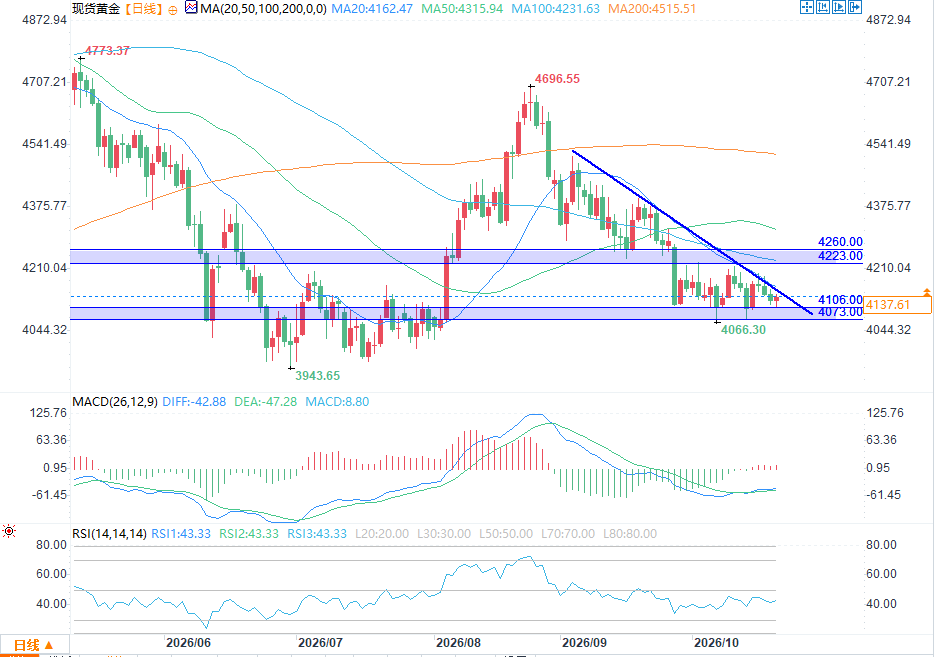 (Spot gold daily chart source: FX678) Gold prices need to reclaim the $4223-$4260/oz resistance zone. A sustained break above this resistance would be a stronger signal, indicating that the current correction is likely nearing its end and the bulls have regained control of the market. Gold Outlook: Short-term downside risks remain, but long-term fundamentals are bullish . Until the aforementioned breakout signal appears, caution is still advised, and the possibility of further price declines cannot be ruled out. If oil prices remain high and US Treasury yields rise again, a weakening gold price remains a realistic scenario. Despite short-term pressure, the long-term fundamentals for gold remain positive. Central bank gold purchases, concerns about currency devaluation, and the diversified allocation value of gold assets will not disappear due to this price correction.
What factors are preventing gold prices from breaking out of a one-sided trend? The macroeconomic theme of inflation is pulling gold prices in two opposite directions. Theoretically, sustained high inflation increases demand for gold as a store of value; however, if inflation is too sticky, forcing central banks to maintain a hawkish stance, rising real and nominal yields will marginally weaken gold's attractiveness. This contradiction between bullish and bearish factors is becoming increasingly crucial. The latest inflation data from the US and UK, coupled with high oil prices, has reignited market concerns that interest rates may remain at restrictive levels for much longer than previously expected, with bond yields reacting accordingly. The yield on 10-year US Treasury bonds remains above 5%, and although it has fallen somewhat in recent trading days, the current high level still significantly suppresses gold prices. This also explains why, even with long-term factors such as inflation and currency devaluation, a gold price rebound is difficult to sustain. Gold itself does not generate interest income; when government bonds can provide investors with substantial returns, the opportunity cost of holding gold becomes undeniable. Central bank gold purchases provide long-term bottom support . However, there is another type of market demand that is not sensitive to short-term yield fluctuations. Central banks around the world continue to purchase gold, especially the People's Bank of China, providing important structural support for the gold market. As the year draws to a close, there are almost no signs that official gold demand will recede. Continued central bank buying could change the market logic behind this round of correction. If investors expect official gold purchases to remain high, they will be more willing to buy on dips through ETFs, spot markets, and futures markets. In other words, even if the short-term macroeconomic environment is bearish, central bank gold purchases are expected to provide a bottoming buffer for gold prices. Gold prices still need to confirm the exhaustion of bearish momentum. However, from a current technical perspective, the overall signal remains bearish. Last week, gold prices continued their downward trend, with only two weeks of gains in the past eight weeks. From a momentum perspective, it is not suitable to predict the bottom at this stage. However, the key support level of $4075-$4100/ounce has been repeatedly held, leading the market to speculate that gold prices may be approaching a bottom range. This support zone is the starting point of the upward trend in early August. However, this rebound has not yet changed the overall technical pattern; there is a downward trend line connecting recent highs. A decisive break above this trendline would signal a decline in downward momentum; however, this alone is insufficient to confirm the formation of a sustainable bottom. (Spot gold daily chart source: FX678) Gold prices need to reclaim the $4223-$4260/oz resistance zone. A sustained break above this resistance would be a stronger signal, indicating that the current correction is likely nearing its end and the bulls have regained control of the market. Gold Outlook: Short-term downside risks remain, but long-term fundamentals are bullish . Until the aforementioned breakout signal appears, caution is still advised, and the possibility of further price declines cannot be ruled out. If oil prices remain high and US Treasury yields rise again, a weakening gold price remains a realistic scenario. Despite short-term pressure, the long-term fundamentals for gold remain positive. Central bank gold purchases, concerns about currency devaluation, and the diversified allocation value of gold assets will not disappear due to this price correction.
- Risk Warning and Disclaimer
- The market involves risk, and trading may not be suitable for all investors. This article is for reference only and does not constitute personal investment advice, nor does it take into account certain users’ specific investment objectives, financial situation, or other needs. Any investment decisions made based on this information are at your own risk.