The rebound in oil prices boosted the Canadian dollar, widening the growth gap between the Canadian and US dollar currencies, causing the US dollar to fall for the sixth consecutive day against the Canadian dollar.
2026-10-22 14:40:23
The US dollar continued its decline against the Canadian dollar during Thursday's Asian session, trading around 1.4040, marking its sixth consecutive day of losses. The current core contradiction in the exchange rate lies in the interplay between the immediate support provided to the Canadian dollar through rising oil prices via trade terms and the medium-term downward pressure stemming from the widening gap in North American fundamentals revealed by the IMF. This creates a tug-of-war pattern where the exchange rate can fall, but not rapidly.  From the perspective of the Canadian dollar, the rebound in energy prices has provided the most direct support. The Houthi attack on Saudi Aramco's Shebay oil field has exacerbated geopolitical tensions in the Middle East and triggered market concerns about energy supply disruptions. Meanwhile, Ukraine launched a large-scale attack this week on key Russian oil infrastructure, clearly aimed at blocking Moscow's ability to expand diesel exports under the recently reached agreement. This simultaneous pressure from two fronts makes it difficult for the risk premium in the crude oil market to systematically subside in the short term. As a typical commodity currency, the Canadian dollar is generally more elastic to oil prices than the US dollar; during periods of rapid oil price increases, the USD/CAD exchange rate tends to be more pressured downwards. This is also a key driver behind the current six-day losing streak in the exchange rate. However, it is worth noting that this premium driven by "disruption expectations" could be quickly reversed if logistical data improves—for the Canadian dollar, which is highly dependent on oil price fluctuations, this represents both immediate support and a potential risk of reversal. Iranian Foreign Minister Araqchi stated on Wednesday that the United States must lift its naval blockade and demonstrate a genuine commitment to a peaceful resolution to the conflict; Tehran is prepared to resume negotiations if it sees conclusive evidence of genuine efforts by the US to achieve a just and lasting end to the conflict. This intermediate state of "negotiations left open, agreement not yet finalized" is precisely the scenario most difficult for the market to price: it is neither sufficient to disprove the risk of supply disruptions nor to provide a clear path to easing them, leading to a tug-of-war in oil prices after the news is released, often resulting in an initial surge followed by a pullback. For the USD/CAD pair, this impulsive volatility amplifies the risk of false breakouts in both directions, and investors should avoid chasing highs and lows in the absence of confirmation signals. However, the medium- to long-term fundamental outlook is not favorable for the Canadian dollar. Market analysis shows that the latest IMF forecasts highlight the deteriorating relative outlook for Canada, noting that "with the IMF raising its growth forecast for the US this year to 2.5% (still 2.1% in 2027), the North American growth gap is widening." The bank points out that "the chart on the right shows the Bloomberg consensus relative growth forecast for 2027, but the IMF's assessment (Canada growing 1.2% next year, compared to 2.1% for the US) is more unfavorable for Canada," reinforcing the judgment of weakening momentum in Canada. Meanwhile, the bank observed that "the left chart shows the relationship between the two-year interest rate spread and the USD/CAD exchange rate," emphasizing that relative front-end yields continue to frame the performance of the Canadian dollar against the US dollar. In other words, although oil prices have supported the Canadian dollar in the short term, the two more enduring pricing clues—growth expectations and interest rate differentials—both point towards the US dollar. This means that the current decline is more of an event-driven technical correction than a trend reversal; once the oil premium falls, the exchange rate is likely to quickly return to an interest rate differential-driven trajectory. On the monetary policy front, Federal Reserve Chairman Warsh avoided providing guidance on the timing and necessity of future interest rate hikes last week, leaving the market uncertain before next week's meeting. This combination of "uncertain direction and delayed timing" allows the US dollar's interest rate advantage to continue while avoiding a risk-averse reversal triggered by excessive hawkishness. For USD/CAD, this is an environment of "support for the US dollar and catalysts for the Canadian dollar": the Fed's year-end tightening path has not been disproven, providing bottom support for the index; however, the lack of incremental hawkish catalysts in the short term makes the rebound lack smoothness. Furthermore, the Bank of Canada has less room to maneuver in response to inflation amid high oil prices. If energy costs continue to be passed on to core prices, its policy pace may be forced to accelerate—a potential change that needs to be closely monitored in the coming weeks and is not yet fully priced into by the market. From a global market perspective, the current USD/CAD fluctuations are essentially a combination of three independent factors: on one hand, rising oil prices passively strengthen the Canadian dollar through trade terms and fiscal channels; on the other hand, the US dollar is actively supported by the US-Canada growth differential and the two-year interest rate differential; and on the other hand, the indirect suppression of global trade sentiment by rising freight and insurance costs caused by Middle East shipping disruptions. This environment is initially favorable for the Canadian dollar, but if it evolves into a situation of both slowing growth and high interest rates, its pricing logic will face more complex challenges. It is worth noting that Middle Eastern oil flows have largely recovered to about 80% of pre-war levels, and Saudi Arabia's oil exports in August increased by 7.9% month-on-month to the highest level since March. The resilience on the supply side is offsetting geopolitical premiums—this is core evidence to verify whether it is "expectation-driven" or "substantial shortage," and will also determine the duration of the Canadian dollar's current advantage. On the daily chart, the USD/CAD pair is trading below the 50-day exponential moving average (approximately 1.4075) and the 9-day EMA (approximately 1.4140). The short-term moving averages are in a bearish alignment, and the rebound continues to be suppressed by the aforementioned resistance levels. The medium-term bearish structure has not yet been repaired. The RSI (14) is around 42.7, below the 50 neutral line and not yet in the oversold zone, indicating that the upward momentum is weakening and there is room for further bottoming out, which is a typical weak consolidation pattern. The upper resistance levels to watch are the 50-day EMA (approximately 1.4075), the 9-day EMA (approximately 1.4140), and the psychological level of 1.4200. Only if the daily body effectively stands above 1.4075 can the current bearish tendency be alleviated. The key barrier above is the horizontal resistance line at 1.4794. The lower support levels to watch are first the previous platform at 1.3980, then 1.3920 and 1.3850. Among them, 1.3980 is the key defense level in the near term. If it is effectively broken, it may open up a deeper downside space. On the 4-hour chart, after falling from around 1.4080, the exchange rate has been consolidating slowly along the short-term moving average. The MACD histogram is close to the zero line, with the fast and slow lines repeatedly intertwined, indicating weak momentum. Currently, the price is fluctuating narrowly between 1.4030 and 1.4060. If it breaks below 1.4000 with significant volume, it may seek support at 1.3980 or even 1.3920.
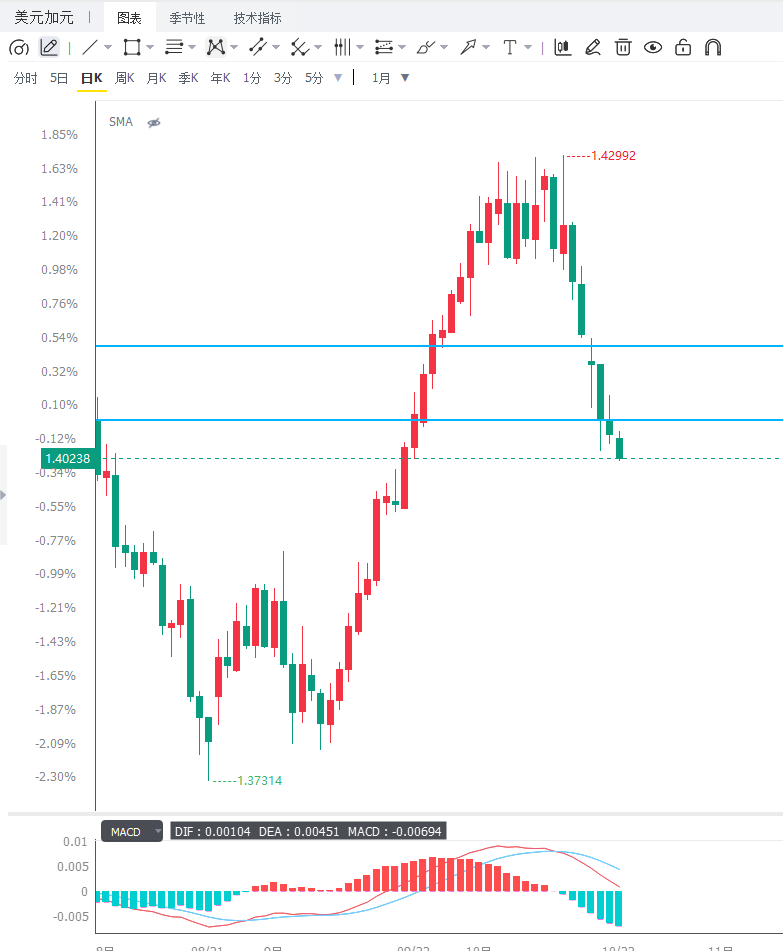 Editor's Summary: The core contradiction in the short-term USD/CAD exchange rate lies in the immediate boost to the Canadian dollar from rising oil prices, which is offset by the medium-term support for the US dollar from the widening US-Canada growth differential and the widening two-year interest rate differential. This suggests that the exchange rate is more likely to fluctuate repeatedly within the 1.3980-1.4075 range. Three variables need to be closely monitored going forward: first, the extent of damage to the Shebay oil field and its recovery progress, as well as the passage of traffic in the Strait of Hormuz, which directly determine the duration of the oil price premium and the Canadian dollar's elasticity; second, the frequency of Ukraine's attacks on Russian energy facilities and the actual progress of US-Iran negotiations, any substantial signs of easing tensions could trigger a rapid retracement of the premium and reverse the Canadian dollar's relative advantage; and third, the subsequent revisions to the IMF and Bloomberg consensus on North American growth, and changes in the Bank of Canada's policy pace in response to energy cost transmission. In the medium term, before 1.4075 is effectively recovered, the exchange rate will maintain a weak and volatile pattern. Confirmation of the trend direction still awaits the final clarification of the geopolitical situation and the policy paths of the central banks of the US and Canada.
From the perspective of the Canadian dollar, the rebound in energy prices has provided the most direct support. The Houthi attack on Saudi Aramco's Shebay oil field has exacerbated geopolitical tensions in the Middle East and triggered market concerns about energy supply disruptions. Meanwhile, Ukraine launched a large-scale attack this week on key Russian oil infrastructure, clearly aimed at blocking Moscow's ability to expand diesel exports under the recently reached agreement. This simultaneous pressure from two fronts makes it difficult for the risk premium in the crude oil market to systematically subside in the short term. As a typical commodity currency, the Canadian dollar is generally more elastic to oil prices than the US dollar; during periods of rapid oil price increases, the USD/CAD exchange rate tends to be more pressured downwards. This is also a key driver behind the current six-day losing streak in the exchange rate. However, it is worth noting that this premium driven by "disruption expectations" could be quickly reversed if logistical data improves—for the Canadian dollar, which is highly dependent on oil price fluctuations, this represents both immediate support and a potential risk of reversal. Iranian Foreign Minister Araqchi stated on Wednesday that the United States must lift its naval blockade and demonstrate a genuine commitment to a peaceful resolution to the conflict; Tehran is prepared to resume negotiations if it sees conclusive evidence of genuine efforts by the US to achieve a just and lasting end to the conflict. This intermediate state of "negotiations left open, agreement not yet finalized" is precisely the scenario most difficult for the market to price: it is neither sufficient to disprove the risk of supply disruptions nor to provide a clear path to easing them, leading to a tug-of-war in oil prices after the news is released, often resulting in an initial surge followed by a pullback. For the USD/CAD pair, this impulsive volatility amplifies the risk of false breakouts in both directions, and investors should avoid chasing highs and lows in the absence of confirmation signals. However, the medium- to long-term fundamental outlook is not favorable for the Canadian dollar. Market analysis shows that the latest IMF forecasts highlight the deteriorating relative outlook for Canada, noting that "with the IMF raising its growth forecast for the US this year to 2.5% (still 2.1% in 2027), the North American growth gap is widening." The bank points out that "the chart on the right shows the Bloomberg consensus relative growth forecast for 2027, but the IMF's assessment (Canada growing 1.2% next year, compared to 2.1% for the US) is more unfavorable for Canada," reinforcing the judgment of weakening momentum in Canada. Meanwhile, the bank observed that "the left chart shows the relationship between the two-year interest rate spread and the USD/CAD exchange rate," emphasizing that relative front-end yields continue to frame the performance of the Canadian dollar against the US dollar. In other words, although oil prices have supported the Canadian dollar in the short term, the two more enduring pricing clues—growth expectations and interest rate differentials—both point towards the US dollar. This means that the current decline is more of an event-driven technical correction than a trend reversal; once the oil premium falls, the exchange rate is likely to quickly return to an interest rate differential-driven trajectory. On the monetary policy front, Federal Reserve Chairman Warsh avoided providing guidance on the timing and necessity of future interest rate hikes last week, leaving the market uncertain before next week's meeting. This combination of "uncertain direction and delayed timing" allows the US dollar's interest rate advantage to continue while avoiding a risk-averse reversal triggered by excessive hawkishness. For USD/CAD, this is an environment of "support for the US dollar and catalysts for the Canadian dollar": the Fed's year-end tightening path has not been disproven, providing bottom support for the index; however, the lack of incremental hawkish catalysts in the short term makes the rebound lack smoothness. Furthermore, the Bank of Canada has less room to maneuver in response to inflation amid high oil prices. If energy costs continue to be passed on to core prices, its policy pace may be forced to accelerate—a potential change that needs to be closely monitored in the coming weeks and is not yet fully priced into by the market. From a global market perspective, the current USD/CAD fluctuations are essentially a combination of three independent factors: on one hand, rising oil prices passively strengthen the Canadian dollar through trade terms and fiscal channels; on the other hand, the US dollar is actively supported by the US-Canada growth differential and the two-year interest rate differential; and on the other hand, the indirect suppression of global trade sentiment by rising freight and insurance costs caused by Middle East shipping disruptions. This environment is initially favorable for the Canadian dollar, but if it evolves into a situation of both slowing growth and high interest rates, its pricing logic will face more complex challenges. It is worth noting that Middle Eastern oil flows have largely recovered to about 80% of pre-war levels, and Saudi Arabia's oil exports in August increased by 7.9% month-on-month to the highest level since March. The resilience on the supply side is offsetting geopolitical premiums—this is core evidence to verify whether it is "expectation-driven" or "substantial shortage," and will also determine the duration of the Canadian dollar's current advantage. On the daily chart, the USD/CAD pair is trading below the 50-day exponential moving average (approximately 1.4075) and the 9-day EMA (approximately 1.4140). The short-term moving averages are in a bearish alignment, and the rebound continues to be suppressed by the aforementioned resistance levels. The medium-term bearish structure has not yet been repaired. The RSI (14) is around 42.7, below the 50 neutral line and not yet in the oversold zone, indicating that the upward momentum is weakening and there is room for further bottoming out, which is a typical weak consolidation pattern. The upper resistance levels to watch are the 50-day EMA (approximately 1.4075), the 9-day EMA (approximately 1.4140), and the psychological level of 1.4200. Only if the daily body effectively stands above 1.4075 can the current bearish tendency be alleviated. The key barrier above is the horizontal resistance line at 1.4794. The lower support levels to watch are first the previous platform at 1.3980, then 1.3920 and 1.3850. Among them, 1.3980 is the key defense level in the near term. If it is effectively broken, it may open up a deeper downside space. On the 4-hour chart, after falling from around 1.4080, the exchange rate has been consolidating slowly along the short-term moving average. The MACD histogram is close to the zero line, with the fast and slow lines repeatedly intertwined, indicating weak momentum. Currently, the price is fluctuating narrowly between 1.4030 and 1.4060. If it breaks below 1.4000 with significant volume, it may seek support at 1.3980 or even 1.3920. Editor's Summary: The core contradiction in the short-term USD/CAD exchange rate lies in the immediate boost to the Canadian dollar from rising oil prices, which is offset by the medium-term support for the US dollar from the widening US-Canada growth differential and the widening two-year interest rate differential. This suggests that the exchange rate is more likely to fluctuate repeatedly within the 1.3980-1.4075 range. Three variables need to be closely monitored going forward: first, the extent of damage to the Shebay oil field and its recovery progress, as well as the passage of traffic in the Strait of Hormuz, which directly determine the duration of the oil price premium and the Canadian dollar's elasticity; second, the frequency of Ukraine's attacks on Russian energy facilities and the actual progress of US-Iran negotiations, any substantial signs of easing tensions could trigger a rapid retracement of the premium and reverse the Canadian dollar's relative advantage; and third, the subsequent revisions to the IMF and Bloomberg consensus on North American growth, and changes in the Bank of Canada's policy pace in response to energy cost transmission. In the medium term, before 1.4075 is effectively recovered, the exchange rate will maintain a weak and volatile pattern. Confirmation of the trend direction still awaits the final clarification of the geopolitical situation and the policy paths of the central banks of the US and Canada.
- Risk Warning and Disclaimer
- The market involves risk, and trading may not be suitable for all investors. This article is for reference only and does not constitute personal investment advice, nor does it take into account certain users’ specific investment objectives, financial situation, or other needs. Any investment decisions made based on this information are at your own risk.