Commodities are caught between panic in the AI market and escalating energy risks.
2026-10-22 19:32:21
The global commodities market is becoming increasingly polarized. Investors are facing declining risk appetite, renewed geopolitical conflicts, and the need to unwind large, crowded speculative positions. Concerns about the prospects of AI investments are weighing on copper and industrial metals; escalating tensions in the Middle East are pushing crude oil prices to a five-month high. Meanwhile, despite continued strong demand for gold ETFs, gold prices remain weak; and agricultural commodity prices have seen a sharp reversal, influenced by harvest pressures and speculative liquidation.  Concerns about the AI market are shaking the bullish logic for copper prices. The Nasdaq index recently plummeted by more than 500 points, and the market is increasingly questioning whether the AI investment boom can be sustained. Its negative impact is no longer limited to the technology stock sector.
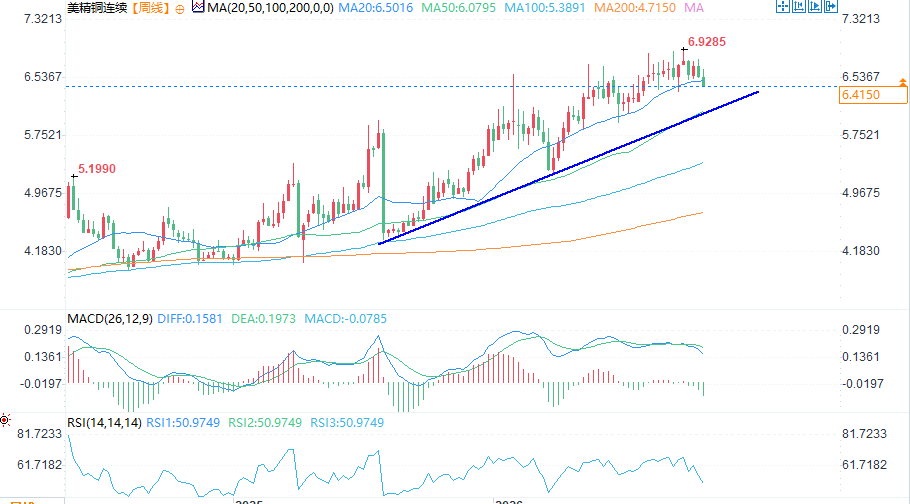 (COME Copper Weekly Chart Source: EasyForex) High-grade copper prices fell 2.4%, breaking below the recent support level of $6.50 per pound, currently mired in dual uncertainties. On the one hand, investors are uncertain whether the US will impose tariffs on refined copper, and the stockpiling behavior spurred by previous tariff expectations was a significant support for copper prices; on the other hand, the market is concerned about a slowdown in investment in artificial intelligence and data centers, which are important sources of expected future copper demand growth. However, weakening investor sentiment does not equate to a deterioration in physical fundamentals. Electrification construction, grid expansion, and limited copper mine supply continue to benefit copper prices, and most of the globally observable exchange inventories are concentrated in the US. Therefore, the current price weakness is more a return to rationality from previously high expectations than a substantial decline in real demand. Crude oil bucked the trend and rose, with risk aversion strengthening . While many commodities sensitive to economic growth were under pressure, crude oil showed a completely opposite trend. Affected by the escalation of the Middle East conflict and the possibility of further US military action, the market is concerned about another disruption to crude oil supply, and Brent crude oil broke through $112 per barrel, reaching a five-month high. While crude oil shipments from the Middle East have recovered somewhat, the global crude oil market remains highly fragile. The risks of attacks on shipping lines, high freight rates, and damage to critical energy infrastructure continue to threaten supply chains; the refined oil market (especially diesel) is experiencing tight supply, and any further disruptions would amplify the impact. The European natural gas market is similarly fraught with uncertainty, with storage inventories at relatively low levels, meaning Europe will be heavily reliant on continuous imports throughout the winter. If prolonged severe weather coupled with further disruptions to liquefied natural gas (LNG) transport could cause the current price of around €90/MWh (equivalent to $29.50/MMBtu) to surge again. This casts a shadow over the entire financial market. Rising energy prices continue to put pressure on stock and bond markets, and a renewed inflationary shock would limit central banks' room for monetary easing. After years of inflation exceeding target levels, investors can no longer simply assume that weakening economic growth expectations will automatically lead to lower financing costs. Therefore, even if high oil prices ultimately suppress economic activity and energy demand, energy products remain an important tool for portfolio diversification in hedging against geopolitical and inflationary risks. Gold: A Battle Between Speculative Selling and Strategic Buying Gold prices have failed to strengthen despite rising risk aversion, becoming a major market focus. While US Treasury yields have fallen, the dollar has weakened slightly, and geopolitical uncertainty continues to escalate, spot gold has encountered resistance below $4,100 for the third time this month.
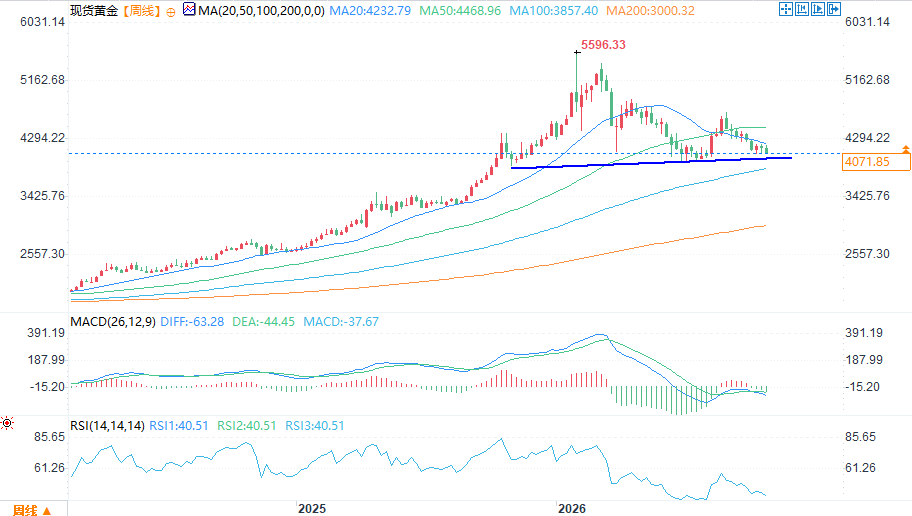 (COME Gold Weekly Chart Source: EasyForex) The underlying reason lies in the significant divergence in the behavior of different investment groups: short-term traders focusing on macroeconomics closely monitor interest rate expectations, exchange rate trends, and technical indicators; while long-term investors continue to buy gold through ETFs to hedge against risks of fiscal instability, geopolitical conflicts, and currency devaluation. The soaring financing costs of the French government confirm the logic of long-term gold allocation. The yield on French 10-year government bonds broke through 5% for the first time in 24 years, widening the spread with German bonds to nearly 170 basis points, indicating growing market concerns about the sustainability of French fiscal policy. Currently, speculative selling still outweighs strategic buying, and the holdings data clearly reflect the divergence between the two types of investors. Since August 25th, hedge funds, commodity trading advisors, and other asset management accounts have reduced their net long positions in gold by 4 million ounces; while Bloomberg statistics show that gold ETF holdings have increased by 2.3 million ounces. The continued inflow of funds into ETFs despite the decline in gold prices indicates that the long-term investment logic for gold has not failed. Once this wave of speculative liquidation subsides, long-term buying may once again dominate gold price movements. Agricultural Products: Risks of Position Reduction Combined with Weather Concerns Over the past six weeks, agricultural product prices, represented by grains, have experienced a sharp correction. The Bloomberg Grain Index has fallen by 14%, almost erasing all of the surge in August. Expectations of improved supply due to a bumper harvest triggered large-scale speculative position liquidation. Net long positions in asset management accounts for the six major grain and soybean futures contracts have fallen from a historical high of over 1 million contracts to around 750,000 contracts in the latest reporting week. This correction fully demonstrates how position arbitrage amplifies fundamental volatility: falling prices further induce long position liquidation, creating downward pressure. However, even with recent price weakness, the long-term supply outlook still harbors multiple risks. The ongoing situation in Iran, the Russia-Ukraine conflict, the potential arrival of a super El Niño phenomenon, and the possible reintroduction of grain export restrictions could all disrupt agricultural production and trade. Although current ample supply is suppressing prices, the dual threats of geopolitical conflict and extreme weather mean that agricultural product prices could still experience further sharp fluctuations or even rebounds. Commodities Remain a Powerful Investment Hedging Tool The divergent trends within the commodity market reflect an increasingly complex investment environment. Economic growth concerns are weighing on industrial metals and agricultural products; geopolitical conflicts are supporting energy prices; and gold is supported by long-term strategic buying. Importantly, commodities can hedge against risks that traditional investment portfolios struggle to withstand. Supply-driven inflation in the energy sector can simultaneously harm stocks and bonds; geopolitical conflicts, extreme weather, and trade restrictions can expose multiple commodity sectors to upside price risks. Therefore, the logic of tactical commodity allocation remains valid, although the prospects for various sub-sectors are becoming increasingly divergent. We recommend a broad-based commodity portfolio, with a focus on markets where demand is rising while supply remains constrained. These markets are expected to experience structural price increases, leading to substantial investment returns. Total returns from commodity futures include not only the price fluctuations of the underlying asset but also the rollover gains and losses from contract expiration and the interest income generated from margin deposits. In a spot premium market (where the futures price is lower than the near-term contract), assuming the curve shape remains unchanged, as futures prices converge towards spot prices, rolling over can yield positive roll-over gains. Conversely, a spot discount structure will result in negative roll-over gains. Therefore, persistent supply tightness can bring investors a double benefit: even if spot prices remain largely flat, they can still potentially reap gains from both price increases and positive roll-over gains.
Concerns about the AI market are shaking the bullish logic for copper prices. The Nasdaq index recently plummeted by more than 500 points, and the market is increasingly questioning whether the AI investment boom can be sustained. Its negative impact is no longer limited to the technology stock sector. (COME Copper Weekly Chart Source: EasyForex) High-grade copper prices fell 2.4%, breaking below the recent support level of $6.50 per pound, currently mired in dual uncertainties. On the one hand, investors are uncertain whether the US will impose tariffs on refined copper, and the stockpiling behavior spurred by previous tariff expectations was a significant support for copper prices; on the other hand, the market is concerned about a slowdown in investment in artificial intelligence and data centers, which are important sources of expected future copper demand growth. However, weakening investor sentiment does not equate to a deterioration in physical fundamentals. Electrification construction, grid expansion, and limited copper mine supply continue to benefit copper prices, and most of the globally observable exchange inventories are concentrated in the US. Therefore, the current price weakness is more a return to rationality from previously high expectations than a substantial decline in real demand. Crude oil bucked the trend and rose, with risk aversion strengthening . While many commodities sensitive to economic growth were under pressure, crude oil showed a completely opposite trend. Affected by the escalation of the Middle East conflict and the possibility of further US military action, the market is concerned about another disruption to crude oil supply, and Brent crude oil broke through $112 per barrel, reaching a five-month high. While crude oil shipments from the Middle East have recovered somewhat, the global crude oil market remains highly fragile. The risks of attacks on shipping lines, high freight rates, and damage to critical energy infrastructure continue to threaten supply chains; the refined oil market (especially diesel) is experiencing tight supply, and any further disruptions would amplify the impact. The European natural gas market is similarly fraught with uncertainty, with storage inventories at relatively low levels, meaning Europe will be heavily reliant on continuous imports throughout the winter. If prolonged severe weather coupled with further disruptions to liquefied natural gas (LNG) transport could cause the current price of around €90/MWh (equivalent to $29.50/MMBtu) to surge again. This casts a shadow over the entire financial market. Rising energy prices continue to put pressure on stock and bond markets, and a renewed inflationary shock would limit central banks' room for monetary easing. After years of inflation exceeding target levels, investors can no longer simply assume that weakening economic growth expectations will automatically lead to lower financing costs. Therefore, even if high oil prices ultimately suppress economic activity and energy demand, energy products remain an important tool for portfolio diversification in hedging against geopolitical and inflationary risks. Gold: A Battle Between Speculative Selling and Strategic Buying Gold prices have failed to strengthen despite rising risk aversion, becoming a major market focus. While US Treasury yields have fallen, the dollar has weakened slightly, and geopolitical uncertainty continues to escalate, spot gold has encountered resistance below $4,100 for the third time this month. (COME Gold Weekly Chart Source: EasyForex) The underlying reason lies in the significant divergence in the behavior of different investment groups: short-term traders focusing on macroeconomics closely monitor interest rate expectations, exchange rate trends, and technical indicators; while long-term investors continue to buy gold through ETFs to hedge against risks of fiscal instability, geopolitical conflicts, and currency devaluation. The soaring financing costs of the French government confirm the logic of long-term gold allocation. The yield on French 10-year government bonds broke through 5% for the first time in 24 years, widening the spread with German bonds to nearly 170 basis points, indicating growing market concerns about the sustainability of French fiscal policy. Currently, speculative selling still outweighs strategic buying, and the holdings data clearly reflect the divergence between the two types of investors. Since August 25th, hedge funds, commodity trading advisors, and other asset management accounts have reduced their net long positions in gold by 4 million ounces; while Bloomberg statistics show that gold ETF holdings have increased by 2.3 million ounces. The continued inflow of funds into ETFs despite the decline in gold prices indicates that the long-term investment logic for gold has not failed. Once this wave of speculative liquidation subsides, long-term buying may once again dominate gold price movements. Agricultural Products: Risks of Position Reduction Combined with Weather Concerns Over the past six weeks, agricultural product prices, represented by grains, have experienced a sharp correction. The Bloomberg Grain Index has fallen by 14%, almost erasing all of the surge in August. Expectations of improved supply due to a bumper harvest triggered large-scale speculative position liquidation. Net long positions in asset management accounts for the six major grain and soybean futures contracts have fallen from a historical high of over 1 million contracts to around 750,000 contracts in the latest reporting week. This correction fully demonstrates how position arbitrage amplifies fundamental volatility: falling prices further induce long position liquidation, creating downward pressure. However, even with recent price weakness, the long-term supply outlook still harbors multiple risks. The ongoing situation in Iran, the Russia-Ukraine conflict, the potential arrival of a super El Niño phenomenon, and the possible reintroduction of grain export restrictions could all disrupt agricultural production and trade. Although current ample supply is suppressing prices, the dual threats of geopolitical conflict and extreme weather mean that agricultural product prices could still experience further sharp fluctuations or even rebounds. Commodities Remain a Powerful Investment Hedging Tool The divergent trends within the commodity market reflect an increasingly complex investment environment. Economic growth concerns are weighing on industrial metals and agricultural products; geopolitical conflicts are supporting energy prices; and gold is supported by long-term strategic buying. Importantly, commodities can hedge against risks that traditional investment portfolios struggle to withstand. Supply-driven inflation in the energy sector can simultaneously harm stocks and bonds; geopolitical conflicts, extreme weather, and trade restrictions can expose multiple commodity sectors to upside price risks. Therefore, the logic of tactical commodity allocation remains valid, although the prospects for various sub-sectors are becoming increasingly divergent. We recommend a broad-based commodity portfolio, with a focus on markets where demand is rising while supply remains constrained. These markets are expected to experience structural price increases, leading to substantial investment returns. Total returns from commodity futures include not only the price fluctuations of the underlying asset but also the rollover gains and losses from contract expiration and the interest income generated from margin deposits. In a spot premium market (where the futures price is lower than the near-term contract), assuming the curve shape remains unchanged, as futures prices converge towards spot prices, rolling over can yield positive roll-over gains. Conversely, a spot discount structure will result in negative roll-over gains. Therefore, persistent supply tightness can bring investors a double benefit: even if spot prices remain largely flat, they can still potentially reap gains from both price increases and positive roll-over gains.
- Risk Warning and Disclaimer
- The market involves risk, and trading may not be suitable for all investors. This article is for reference only and does not constitute personal investment advice, nor does it take into account certain users’ specific investment objectives, financial situation, or other needs. Any investment decisions made based on this information are at your own risk.