The decline in US Treasury yields may be masking deeper concerns behind the AI boom.
2026-10-23 17:44:22
Let's take a step back and review some of the key drivers in the market this week. The US-Iran conflict continues to escalate, and geopolitical tensions remain high. This has once again provided support for oil prices—WTI crude oil broke through $100, while Brent crude oil reached $114, its highest level since May of last year. This sounds like a familiar scenario for the bond market, doesn't it? Higher oil prices mean increased inflationary pressures, which should theoretically push up US Treasury yields. However, this was not the case this week.  Conversely, US Treasury yields plummeted, with the 10-year yield briefly dipping below 5% overnight and hovering around that level. But hold on—shouldn't falling yields provide some respite for the stock market? You might think so, especially since soaring Treasury yields have been a major culprit in suppressing the stock market over the past two months. However, the stock market suffered a severe blow this week, particularly the AI sector. So, what's going on? One explanation is that investors may be starting to worry about US economic growth rather than inflation again. But given that this narrative has been largely ignored by the market, and the extent of the impact on AI stocks, I believe there may be a completely different underlying issue. Let's get straight to the point and start with CoreWeave. In the AI field, it's not a household name. However, CoreWeave may be the "first domino" that triggered industry-wide concerns about debt financing. See the chart below, which shows the changes in costs incurred to hedge against default risks of major AI-related companies over the past year—the changes in CDS (Credit Default Swap) spreads.
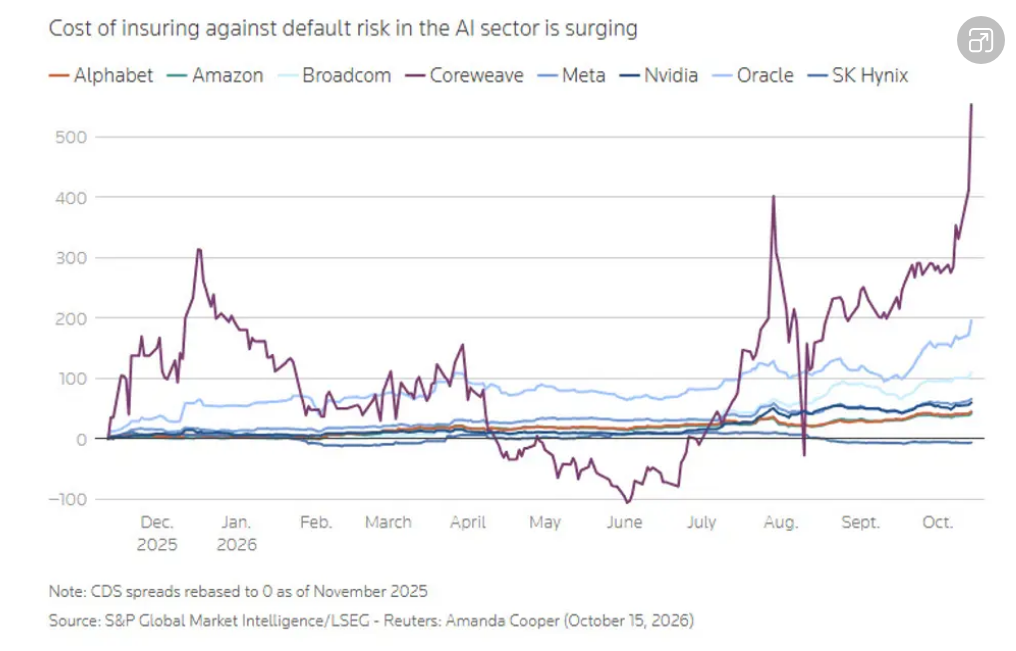 This chart might seem complex at first glance, but the message behind it is quite straightforward: investors are becoming increasingly nervous about lending money to companies caught up in the AI boom. CoreWeave stands out in this regard, with its CDS spread widening by over 500 basis points during the observation period. But what does this actually mean? A simple way to understand it is to think of a CDS as a form of insurance, purchased by investors to protect against the risk that a company might default on its debts. A five-year CDS provides protection for up to five years, and the spread reflects the cost of obtaining this protection. For clarity, 100 basis points equates to 1% per annum. Last week, when CoreWeave's actual five-year CDS spread surged to over 1000 basis points, this was equivalent to paying approximately $100,000 per year to insure $1 million in debt. This is undoubtedly an astonishingly high premium, solely for the purpose of protecting against potential default risk. While CoreWeave is clearly the most prominent case, the chart also shows that this concern is not limited to any single company. Oracle's five-year CDS has climbed to nearly 300 basis points, while Meta and Nvidia's CDS are approaching 100 basis points. Oracle, for example, is being traded as junk credit due to its aggressive reliance on debt financing to support its infrastructure loans. Meanwhile, Meta's five-year CDS is nearing its historical peak, which helps us understand the current situation more intuitively. That said, I don't believe these companies should be grouped into the same risk category. Compared to CoreWeave, Meta and Nvidia clearly have much stronger financial strength and liquidity. However, it's evident that investors are beginning to question a larger issue. This brings us back to the question the market has been repeatedly asking over the past year: Who will foot the bill for this massive AI infrastructure boom? And how long will it take for these huge investments to generate sufficient returns? CoreWeave relies heavily on debt to finance its data center and computing infrastructure; Oracle is also investing heavily in its AI expansion; and Meta is injecting billions of dollars into its infrastructure. As for Nvidia, its fate is closely tied to this spending cycle. The biggest concern here is that if financing becomes more expensive, or AI investment slows, the consequences could ripple through companies that are interdependent in terms of revenue, financing, and growth. So, what does all this have to do with the bond market and US Treasury yields? Given this background, investors are increasingly uncomfortable holding riskier corporate bonds and stocks. So, what options remain in this market that offer both safety and decent returns? The answer is simple—government bonds. Thus, as buying pours in, Treasury prices are pushed up, and yields fall. But here's a key point: even as US Treasury yields decline, corporate borrowing costs can still rise when investors demand higher premiums for credit risk. In other words, safe money is becoming cheaper, while risky money is becoming more expensive. This may be why tech stocks aren't celebrating the significant drop in US Treasury yields. Investors are likely more concerned about financing risks and future profitability than the immediate benefits of lower government borrowing costs. In conclusion, credit concerns about AI are not necessarily the only reason for the rise in Treasury yields. However, it could be a useful element in explaining this week's market movements. It's important to understand that with inflation risks still lingering and oil prices high, declining US Treasury yields don't necessarily indicate an improving economy. It might simply mean that investors are starting to worry that something else might collapse first.
Conversely, US Treasury yields plummeted, with the 10-year yield briefly dipping below 5% overnight and hovering around that level. But hold on—shouldn't falling yields provide some respite for the stock market? You might think so, especially since soaring Treasury yields have been a major culprit in suppressing the stock market over the past two months. However, the stock market suffered a severe blow this week, particularly the AI sector. So, what's going on? One explanation is that investors may be starting to worry about US economic growth rather than inflation again. But given that this narrative has been largely ignored by the market, and the extent of the impact on AI stocks, I believe there may be a completely different underlying issue. Let's get straight to the point and start with CoreWeave. In the AI field, it's not a household name. However, CoreWeave may be the "first domino" that triggered industry-wide concerns about debt financing. See the chart below, which shows the changes in costs incurred to hedge against default risks of major AI-related companies over the past year—the changes in CDS (Credit Default Swap) spreads. This chart might seem complex at first glance, but the message behind it is quite straightforward: investors are becoming increasingly nervous about lending money to companies caught up in the AI boom. CoreWeave stands out in this regard, with its CDS spread widening by over 500 basis points during the observation period. But what does this actually mean? A simple way to understand it is to think of a CDS as a form of insurance, purchased by investors to protect against the risk that a company might default on its debts. A five-year CDS provides protection for up to five years, and the spread reflects the cost of obtaining this protection. For clarity, 100 basis points equates to 1% per annum. Last week, when CoreWeave's actual five-year CDS spread surged to over 1000 basis points, this was equivalent to paying approximately $100,000 per year to insure $1 million in debt. This is undoubtedly an astonishingly high premium, solely for the purpose of protecting against potential default risk. While CoreWeave is clearly the most prominent case, the chart also shows that this concern is not limited to any single company. Oracle's five-year CDS has climbed to nearly 300 basis points, while Meta and Nvidia's CDS are approaching 100 basis points. Oracle, for example, is being traded as junk credit due to its aggressive reliance on debt financing to support its infrastructure loans. Meanwhile, Meta's five-year CDS is nearing its historical peak, which helps us understand the current situation more intuitively. That said, I don't believe these companies should be grouped into the same risk category. Compared to CoreWeave, Meta and Nvidia clearly have much stronger financial strength and liquidity. However, it's evident that investors are beginning to question a larger issue. This brings us back to the question the market has been repeatedly asking over the past year: Who will foot the bill for this massive AI infrastructure boom? And how long will it take for these huge investments to generate sufficient returns? CoreWeave relies heavily on debt to finance its data center and computing infrastructure; Oracle is also investing heavily in its AI expansion; and Meta is injecting billions of dollars into its infrastructure. As for Nvidia, its fate is closely tied to this spending cycle. The biggest concern here is that if financing becomes more expensive, or AI investment slows, the consequences could ripple through companies that are interdependent in terms of revenue, financing, and growth. So, what does all this have to do with the bond market and US Treasury yields? Given this background, investors are increasingly uncomfortable holding riskier corporate bonds and stocks. So, what options remain in this market that offer both safety and decent returns? The answer is simple—government bonds. Thus, as buying pours in, Treasury prices are pushed up, and yields fall. But here's a key point: even as US Treasury yields decline, corporate borrowing costs can still rise when investors demand higher premiums for credit risk. In other words, safe money is becoming cheaper, while risky money is becoming more expensive. This may be why tech stocks aren't celebrating the significant drop in US Treasury yields. Investors are likely more concerned about financing risks and future profitability than the immediate benefits of lower government borrowing costs. In conclusion, credit concerns about AI are not necessarily the only reason for the rise in Treasury yields. However, it could be a useful element in explaining this week's market movements. It's important to understand that with inflation risks still lingering and oil prices high, declining US Treasury yields don't necessarily indicate an improving economy. It might simply mean that investors are starting to worry that something else might collapse first.
- Risk Warning and Disclaimer
- The market involves risk, and trading may not be suitable for all investors. This article is for reference only and does not constitute personal investment advice, nor does it take into account certain users’ specific investment objectives, financial situation, or other needs. Any investment decisions made based on this information are at your own risk.