What does the global debt crisis look like?
2026-10-24 01:02:21
The question I've been asked most in recent days is: "Why is France being hit so hard now?" Ultimately, the market believes that fiscally strapped France will greatly benefit from the drop in oil prices following the signing of the Memorandum of Understanding (MoU) between the US and Iran in June. That same month, foreign investors sold off French government bonds at an all-time high, and this very position is now undergoing a dramatic, "stampede" clearing. The good news is that this clearing won't go on indefinitely. The bad news is that it can cause considerable damage in the process. Contagion is already occurring to other highly indebted countries in the Eurozone, and the situation is likely to worsen further before the European Central Bank (ECB) intervenes as I previously predicted.  This article summarizes what we have seen in the global bond markets as the crisis in France intensifies. We are seeing three distinct phenomena: (i) contagion to other highly indebted countries in the Eurozone—including Italy and Spain; (ii) an escape to the safe haven of the United States—meaning that, in a critical moment, markets will still flock to US Treasuries as the situation worsens; and (iii) the continuation of the reliable outperformance of low-debted safe haven countries such as Germany, Sweden, and Switzerland this year.
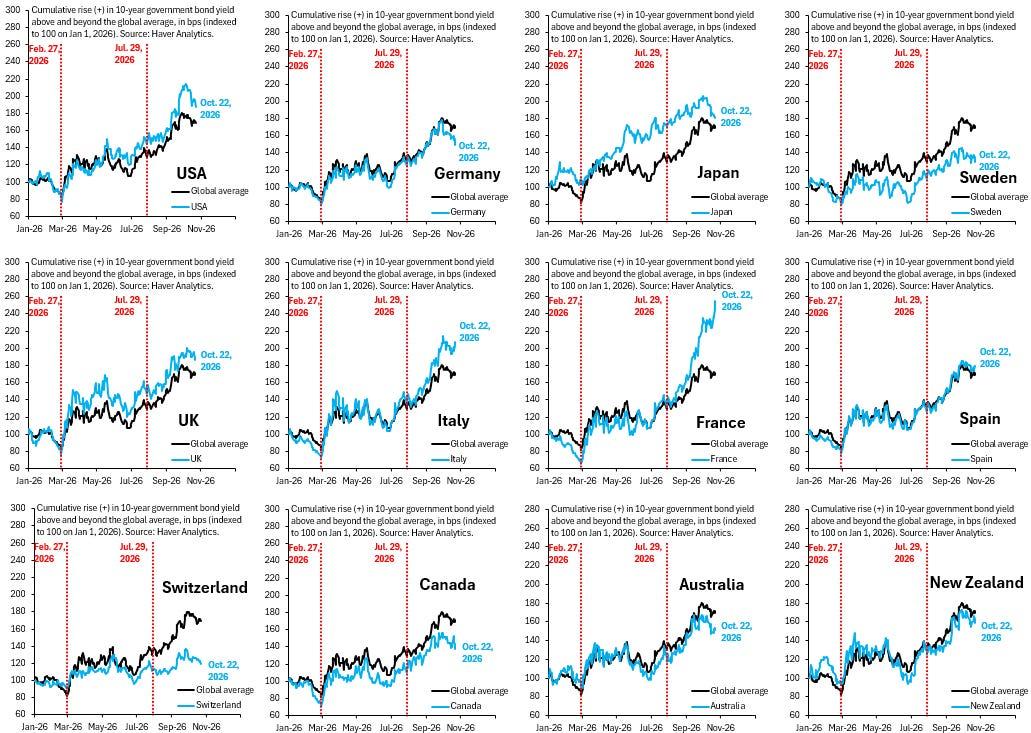 (The blue line in the chart above shows the evolution of 10-year government bond yields so far this year. I indexed them to 100 with January 1, 2026 as the baseline and calculated the cumulative basis point increase from that day to yesterday. If you were at 200 yesterday, that means your 10-year yield has risen by 100 basis points since the beginning of 2026. The black line in each chart has the same meaning: it's the equal-weighted average of all these daily yield changes. I've accumulated this to show who's outperforming and who's underperforming the average.) Clearly, the French 10-year yield has seen a dramatic surge, standing out like a glaring thorn. But beyond that, countries can be broadly divided into three groups: Victims of the outbreak : The blue line for these countries rose above the black line as the situation in France escalated. This is mainly Italy, but Spain also appears vulnerable. Countries fleeing to safe havens : The blue line for these countries is above the black line—meaning the market doesn't approve of their fiscal policies, but they received inflows of funds fleeing to safe havens as the sell-off in French bonds intensified. This is mainly the US, although Japan also appears to have benefited from the unwinding of yen carry trades. Safe Haven Countries : These countries' blue line has consistently remained below the black line, and the gap between the two has steadily widened this year. These are low-debt countries like Germany, Sweden, and Switzerland, though Canada and Australia also share this characteristic. There is no reason to believe that France's debt crisis will continue indefinitely. What is happening is a dramatic clearing of positions accumulated after the June oil price drop and the expectation of continued low prices. The most obvious "circuit breaker" for this sell-off is the drop in oil prices—something the US could achieve by increasing its interception of Iranian Islamic Revolutionary Guard Corps (IRGC) gunboats in the Strait of Hormuz. But equally true is that this global debt crisis has transcended France itself. Japan experienced a debt crisis in January, followed by a steepening of the US yield curve in August after the July 29th Fed meeting. We are in a global game of whack-a-mole, and the only certainty is that highly indebted governments will play the same tricks as in "The Game of Highly Indebted Nations," attempting to artificially suppress shadow yields on their national bonds.
This article summarizes what we have seen in the global bond markets as the crisis in France intensifies. We are seeing three distinct phenomena: (i) contagion to other highly indebted countries in the Eurozone—including Italy and Spain; (ii) an escape to the safe haven of the United States—meaning that, in a critical moment, markets will still flock to US Treasuries as the situation worsens; and (iii) the continuation of the reliable outperformance of low-debted safe haven countries such as Germany, Sweden, and Switzerland this year. (The blue line in the chart above shows the evolution of 10-year government bond yields so far this year. I indexed them to 100 with January 1, 2026 as the baseline and calculated the cumulative basis point increase from that day to yesterday. If you were at 200 yesterday, that means your 10-year yield has risen by 100 basis points since the beginning of 2026. The black line in each chart has the same meaning: it's the equal-weighted average of all these daily yield changes. I've accumulated this to show who's outperforming and who's underperforming the average.) Clearly, the French 10-year yield has seen a dramatic surge, standing out like a glaring thorn. But beyond that, countries can be broadly divided into three groups: Victims of the outbreak : The blue line for these countries rose above the black line as the situation in France escalated. This is mainly Italy, but Spain also appears vulnerable. Countries fleeing to safe havens : The blue line for these countries is above the black line—meaning the market doesn't approve of their fiscal policies, but they received inflows of funds fleeing to safe havens as the sell-off in French bonds intensified. This is mainly the US, although Japan also appears to have benefited from the unwinding of yen carry trades. Safe Haven Countries : These countries' blue line has consistently remained below the black line, and the gap between the two has steadily widened this year. These are low-debt countries like Germany, Sweden, and Switzerland, though Canada and Australia also share this characteristic. There is no reason to believe that France's debt crisis will continue indefinitely. What is happening is a dramatic clearing of positions accumulated after the June oil price drop and the expectation of continued low prices. The most obvious "circuit breaker" for this sell-off is the drop in oil prices—something the US could achieve by increasing its interception of Iranian Islamic Revolutionary Guard Corps (IRGC) gunboats in the Strait of Hormuz. But equally true is that this global debt crisis has transcended France itself. Japan experienced a debt crisis in January, followed by a steepening of the US yield curve in August after the July 29th Fed meeting. We are in a global game of whack-a-mole, and the only certainty is that highly indebted governments will play the same tricks as in "The Game of Highly Indebted Nations," attempting to artificially suppress shadow yields on their national bonds.
- Risk Warning and Disclaimer
- The market involves risk, and trading may not be suitable for all investors. This article is for reference only and does not constitute personal investment advice, nor does it take into account certain users’ specific investment objectives, financial situation, or other needs. Any investment decisions made based on this information are at your own risk.