The 157 level is a tug-of-war! A triple whammy from the Fed, GDP, and the Bank of Japan – will the USD/JPY pair see a turning point this week?
2026-10-26 13:52:24
The USD/JPY pair traded slightly higher in Asian trading on Monday (October 26), currently hovering around 157.00, still in its lowest range since late September. Short sellers may be reluctant to make large bets ahead of key central bank events and data releases this week. The market is focused on the Federal Reserve decision on Wednesday, US Q3 GDP and PCE price index on Thursday, and the Bank of Japan's policy update on Friday. 
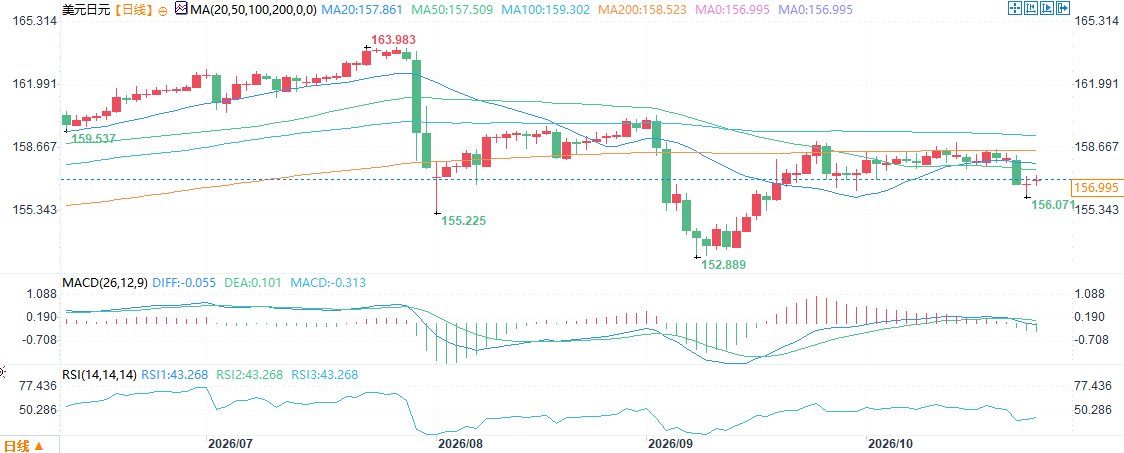 (USD/JPY daily chart, source: EasyForex) At 13:49 Beijing time, USD/JPY was trading at 157.08/09.
Event Calendar: Federal Reserve decision, US data, and Bank of Japan meeting in quick succession.
This week is packed with macroeconomic events. The Federal Reserve will conclude its two-day policy meeting and announce its interest rate decision on Wednesday. Market focus will be on the accompanying policy statement, as well as Chairman Kevin Warsh's remarks and forward guidance at the post-meeting press conference. Following this, Thursday will see the release of the preliminary US Q3 GDP figure and the PCE price index. These two data points will directly influence market expectations regarding the Fed's future policy path and could become a significant catalyst for the dollar's movement. On Friday, market attention will shift to the Bank of Japan's policy update, whose decision and communication are expected to further dominate the short-term direction of the USD/JPY exchange rate, creating a dense interplay of transatlantic and Asia-Pacific policy signals.Policy divergence: The Fed sees no urgency to raise rates, while the Bank of Japan governor signals hawkish sentiment.
Recent statements from Federal Reserve officials suggest there is no immediate urgency for an interest rate hike at the upcoming meeting. Meanwhile, U.S. Treasury yields have retreated from multi-year highs, weakening the dollar's rebound momentum since hitting a three-week low last Thursday. In contrast, the yen has been supported by more hawkish comments from Bank of Japan Governor Kazuo Ueda last week—who pointed out that underlying inflation is approaching the 2% target, thus reinforcing the rationale for a near-term rate hike. This divergence in policy stances may continue to exert downward pressure on the dollar against the yen. However, persistent geopolitical uncertainty may limit further declines in the safe-haven dollar, keeping the exchange rate tug-of-war between policy expectations and risk premiums.Geopolitics and Pricing: Middle East risk premium remains; probability of a Fed rate hike in December is approximately 80%.
Regarding the Middle East situation, US President Trump has ruled out immediate military action against Iran, but the risks have not dissipated. The Iranian-backed Houthi rebels in Yemen threatened on Sunday to continue attacks on King Khalid Airport in Riyadh, Saudi Arabia. Coupled with the stalled US-Iran negotiations, the geopolitical risk premium remains firmly in place. Meanwhile, traders are still pricing in an approximately 80% probability of another Fed rate hike in December. This high probability pricing helps curb excessive shorting of the dollar, thus limiting the downside potential of the USD/JPY pair. Before further shorting, the market needs to remain cautious about the dual uncertainties of geopolitical and policy expectations.Institutional Views
Goldman Sachs strategist Karen Reichgott Fishman significantly lowered her 12-month USD/JPY target to 150 from 165, while adjusting her 3-month and 6-month targets to 158 and 155 respectively. The bank believes that the Bank of Japan's accelerated pace of interest rate hikes and the increased likelihood of domestic capital flowing back to Japanese assets are driving a structural strengthening of the yen. The domestic policy environment that has long suppressed the yen is shifting, and undervaluation factors are beginning to take effect. Although Japanese investors are still buying large amounts of overseas assets, posing a challenge to the speed of repatriation, Goldman Sachs maintains a bullish stance on the yen, believing that changes in policy and capital flows will gradually support its appreciation. Westpac predicts that USD/JPY will fall to 156 in December 2026 and further decline to 151 in December 2027. The bank believes that Japanese inflation data is still testing the necessity of further interest rate hikes, while the expectation that US interest rates will remain unchanged throughout 2027 means that the yen's strength does not depend on rapid interest rate cuts by the Federal Reserve. Westpac views this as a path for a gradual recovery in the yen, echoing Goldman Sachs' 12-month target of 150. While short-term volatility remains influenced by policy meetings and risk sentiment, the bank remains bullish on the yen's appreciation against the dollar in the medium to long term.Summarize
This week is packed with events: Wednesday features the Fed's decision and Warsh's remarks; Thursday brings the US Q3 GDP and PCE price index; and Friday sees the Bank of Japan's policy update. Policy divergence forms the core logic – Fed officials hinted at no urgency to raise rates, and falling US Treasury yields from multi-year highs pressured the dollar, while hawkish comments from Ueda and Kazuo strengthened the case for an imminent BOJ rate hike, creating headwinds for the USD/JPY exchange rate. However, the Middle East geopolitical risk premium remains, and the market is pricing in an approximately 80% probability of a Fed rate hike in December, limiting further declines in the exchange rate. Short-term direction depends on the relative signals from this week's central bank events and data. (USD/JPY daily chart, source: EasyForex) At 13:49 Beijing time, USD/JPY was trading at 157.08/09.
- Risk Warning and Disclaimer
- The market involves risk, and trading may not be suitable for all investors. This article is for reference only and does not constitute personal investment advice, nor does it take into account certain users’ specific investment objectives, financial situation, or other needs. Any investment decisions made based on this information are at your own risk.