Why has the Federal Reserve's quantitative easing gone awry?
2026-10-27 00:56:22
Today, anxieties about fiscal policy are commonplace, but the reality is far more complex than it appears. Policymakers, like ordinary people, are driven by incentives: the market generally believes the US Treasury market won't completely collapse because the Federal Reserve will intervene to support yields should the situation worsen. The most typical example is the surge in US Treasury yields in March 2020 at the beginning of the COVID-19 outbreak. The official narrative is that global market turmoil caused basis trading to collapse, forcing the Federal Reserve to intervene and stabilize yields. But there's another interpretation: the market pushed up yields because it anticipated large-scale government deficit spending, making the rise in yields inherently reasonable.  The Federal Reserve's emergency intervention and subsequent quantitative easing (QE) program were essentially designed to create space for fiscal expansion. But looking ahead, if this mechanism continues to operate, what incentive will policymakers have to manage the budget? We should have learned from the COVID-19 pandemic that the world is full of uncertainty and fiscal budgets should be prudent. However, reality has not been so. In the post-pandemic era, proponents of Modern Monetary Theory (MMT) have been loudly proclaiming that "deficits are insignificant." Central banks around the world have been the driving force behind loose fiscal policies, and the Federal Reserve is no exception.
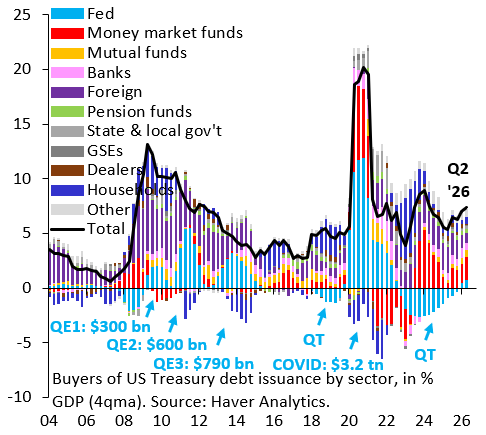 The black line in the chart represents the net increase in US debt issuance, which can be roughly understood as the fiscal deficit. The different colored bars represent buyers of US Treasury bonds; I'm focusing on the light blue bars, which represent the Federal Reserve's net purchases of US Treasury bonds. I've marked the Fed's multiple rounds of quantitative easing (QE) with arrows, revealing two prominent characteristics: First, each round of QE was larger than the previous one, with the easing during the pandemic far exceeding previous levels; second, when the Fed begins quantitative easing (QT), its balance sheet never returns to its pre-easing state, and the large amount of purchased US Treasury bonds remains permanently on the balance sheet, continuously rolling over. This contradicts the original design intent of QE when it was first introduced in 2009. At that time, QE was simply an extension of counter-cyclical monetary policy after interest rates hit the zero lower bound. The original plan was that after the global financial crisis (and the same after the pandemic), the US Treasury bonds held by the Fed should quickly mature and exit the balance sheet; however, these bonds have been "stored" on the balance sheet for a long time. No wonder some call it monetized financing. In my view, this is precisely why US Treasury yields are artificially suppressed: the so-called implicit yield—the yield that the market would have formed without these Fed operations—is far higher than what we see now. This directly impacts the fiscal situation: First, since yields are artificially suppressed and the true implicit yield is significantly higher, the US fiscal situation is far worse than it appears. Therefore, the view that "yields are low, debt is not a problem" ignores the crucial supporting role played by the Fed. Second, imagine if the AI bubble bursts, causing a 40% stock market crash and a significant slowdown in US economic activity. Now that QE has become the norm, the Fed will inevitably use it again to deal with crises. This operation will pave the way for fiscal stimulus, and politicians will not bear the cost of years of huge deficits following the pandemic. The core issue in streamlining fiscal policy lies with the Fed. If the Fed intervenes again to support yields when the next shock arrives, it will only further reinforce the negative incentives for politicians, leading to a continued deterioration of the fiscal situation.
The Federal Reserve's emergency intervention and subsequent quantitative easing (QE) program were essentially designed to create space for fiscal expansion. But looking ahead, if this mechanism continues to operate, what incentive will policymakers have to manage the budget? We should have learned from the COVID-19 pandemic that the world is full of uncertainty and fiscal budgets should be prudent. However, reality has not been so. In the post-pandemic era, proponents of Modern Monetary Theory (MMT) have been loudly proclaiming that "deficits are insignificant." Central banks around the world have been the driving force behind loose fiscal policies, and the Federal Reserve is no exception. The black line in the chart represents the net increase in US debt issuance, which can be roughly understood as the fiscal deficit. The different colored bars represent buyers of US Treasury bonds; I'm focusing on the light blue bars, which represent the Federal Reserve's net purchases of US Treasury bonds. I've marked the Fed's multiple rounds of quantitative easing (QE) with arrows, revealing two prominent characteristics: First, each round of QE was larger than the previous one, with the easing during the pandemic far exceeding previous levels; second, when the Fed begins quantitative easing (QT), its balance sheet never returns to its pre-easing state, and the large amount of purchased US Treasury bonds remains permanently on the balance sheet, continuously rolling over. This contradicts the original design intent of QE when it was first introduced in 2009. At that time, QE was simply an extension of counter-cyclical monetary policy after interest rates hit the zero lower bound. The original plan was that after the global financial crisis (and the same after the pandemic), the US Treasury bonds held by the Fed should quickly mature and exit the balance sheet; however, these bonds have been "stored" on the balance sheet for a long time. No wonder some call it monetized financing. In my view, this is precisely why US Treasury yields are artificially suppressed: the so-called implicit yield—the yield that the market would have formed without these Fed operations—is far higher than what we see now. This directly impacts the fiscal situation: First, since yields are artificially suppressed and the true implicit yield is significantly higher, the US fiscal situation is far worse than it appears. Therefore, the view that "yields are low, debt is not a problem" ignores the crucial supporting role played by the Fed. Second, imagine if the AI bubble bursts, causing a 40% stock market crash and a significant slowdown in US economic activity. Now that QE has become the norm, the Fed will inevitably use it again to deal with crises. This operation will pave the way for fiscal stimulus, and politicians will not bear the cost of years of huge deficits following the pandemic. The core issue in streamlining fiscal policy lies with the Fed. If the Fed intervenes again to support yields when the next shock arrives, it will only further reinforce the negative incentives for politicians, leading to a continued deterioration of the fiscal situation.
- Risk Warning and Disclaimer
- The market involves risk, and trading may not be suitable for all investors. This article is for reference only and does not constitute personal investment advice, nor does it take into account certain users’ specific investment objectives, financial situation, or other needs. Any investment decisions made based on this information are at your own risk.