October 27th Financial Breakfast: Gold prices rebounded above $4,000 ahead of the Fed decision; oil prices still face supply risks; Brent crude hit a near six-month high.
2026-10-27 07:32:27
On Monday (October 27, Beijing time) in early Asian trading, spot gold was trading around $4,012.12 per ounce. Gold prices rebounded from a more than three-month low on Monday, returning above the $4,000 per ounce mark, supported by a pullback in oil prices and some bargain hunting. Trading is likely to be light ahead of the Fed decision and remain around $4,000. US crude oil was trading around $101.39 per barrel. Oil prices closed lower on Monday, but Brent crude touched a near six-month high during the session. The market is hoping for an easing of tensions in the Middle East, but continued attacks on major oil-producing Saudi Arabia and shipping have kept investors on edge. 
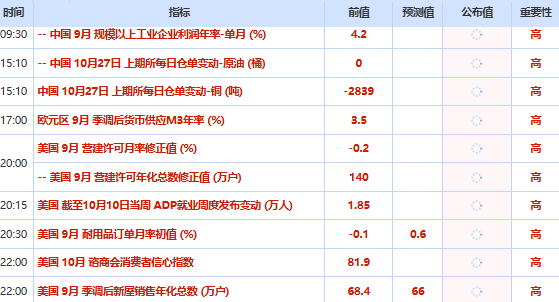
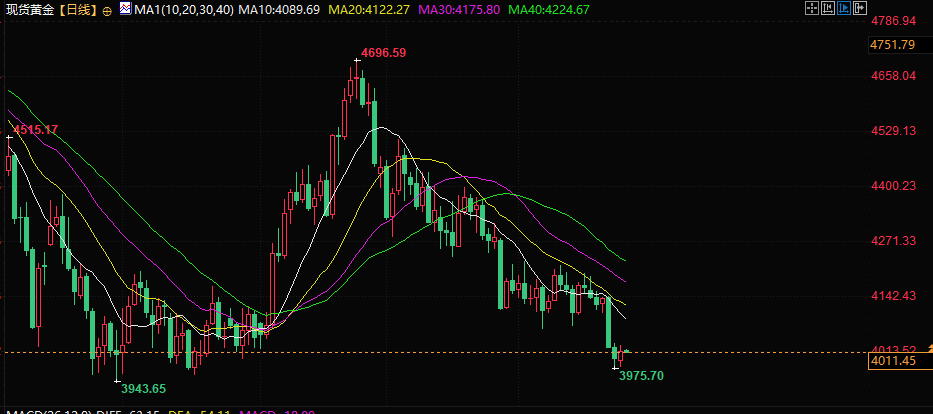 The Federal Reserve is scheduled to announce its interest rate decision on Wednesday. The market widely expects a pause after a September rate hike, with CME FedWatch showing an 80% probability of a December rate hike. Investors are also awaiting Thursday's US PCE data and focusing on the November 3rd midterm elections. Spot silver hit a near one-year low of $52.98 per ounce on Monday, while palladium rose 0.5% to $1049.09. Norilsk Nickel, the world's largest palladium producer and a major refined nickel producer, stated that its planned large-scale furnace overhaul could lead to a decline in key metal production in 2027-2028.
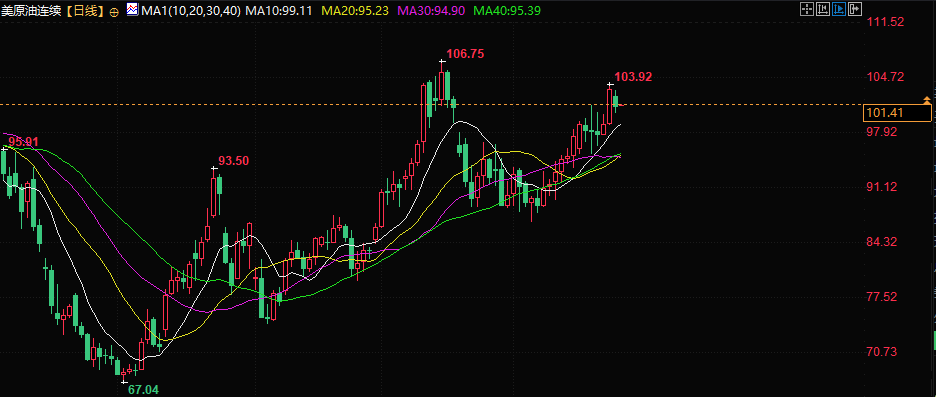 The pro-Iranian Houthi rebels in Yemen claimed responsibility for attacks on Saudi Arabia's east-west oil pipeline pumping station and Riyadh airport over the weekend. Saudi Arabia has not yet immediately confirmed this. The Saudi-led coalition in Yemen claimed on Monday that it had destroyed three drones targeting Riyadh and southern Saudi Arabia. A Qatari mediation delegation traveled to Tehran on Sunday, while Saudi Arabia, Turkey, and Pakistan met with Iranian officials in Tehran on Monday. The effects of the war with Iran, which began on February 28, continue, with businesses struggling to cope with disruptions to commercial shipping in the Strait of Hormuz and the Bab el-Mandeb Strait. Data from the Washington Institute shows that October was the month with the most attacks on merchant ships in the Strait of Hormuz and surrounding waters. Russian refineries will increase diesel production in October due to a supply agreement reached between the Kremlin and the United States and the Russian government's approval of export quotas. IEA Administrator Fatih Birol reiterated supply concerns, predicting that the global energy market will not recover to pre-war levels until 2027. The U.S. Department of Energy reported that U.S. strategic petroleum reserves fell to 282.6 million barrels of crude oil last week, the lowest level since October 1982.
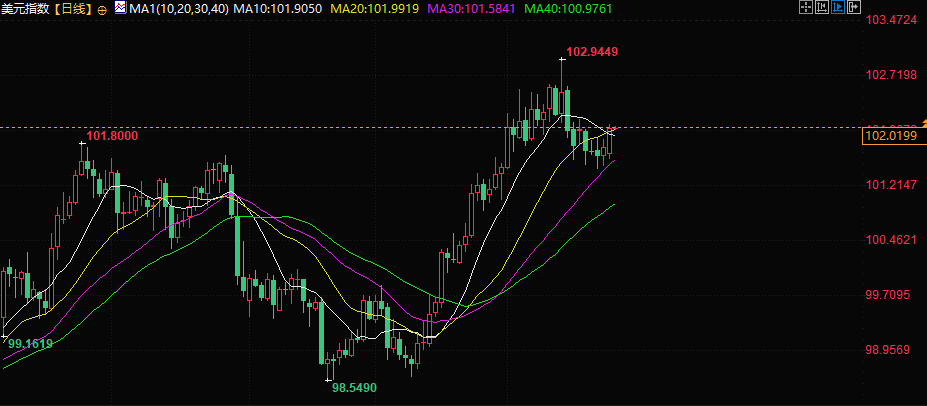 The euro fell 0.24% against the dollar on Monday, closing at 1.1173. Last week's sell-off of French government bonds pushed the country's debt risk premium to its highest level since the 2011 sovereign debt crisis, reigniting concerns about renewed financial pressure in the eurozone and weighing on the euro. However, a rise in French OAT prices on Monday and Moody's decision not to downgrade France's sovereign credit rating last week eased pressure on the French government. Kit Juckes, global head of foreign exchange strategy at Societe Generale, said that the fundamental issues affecting the euro have not changed, and interest rate differentials have narrowed, but the euro remains vulnerable due to a poor economic growth outlook and persistently high energy prices. The Brazilian real plunged after President Lula's unexpected election victory. Following Lula's historic victory over Senator Flavio Bolsonaro on Sunday, securing his fourth presidential term, the real fell 8.5% to 5.4 reais against the dollar. Bolsonaro, who led in the first round but lost by more than 4 million votes in the second, refused to concede and stated he would demand the election results be declared invalid, shaking Brazilian financial markets that had bet on his victory. In a report, Goldman Sachs analysts Teresa Alves et al. stated that the risk of prolonged questioning of the election results negatively impacts market sentiment. More fundamentally, the real and other Brazilian assets should be priced into a higher level of fiscal risk premium, especially given the significant easing of fiscal policy in recent weeks. Their previous assessment of a more negative fiscal outcome at USD/REN 5.40 is consistent with the fiscal risk premium level priced into the market in September 2024, while 5.80 is consistent with a higher level of fiscal risk premium, similar to the level in December 2024.
Key Focus Today
stock market
U.S. stocks closed higher on Monday, with the S&P 500 rising 0.70% to 7677.03, the Nasdaq Composite gaining 0.83% to 26169.38, and the Dow Jones Industrial Average climbing 0.28% to 52361.76. Anthropic filed for a U.S. IPO, disclosing huge losses and booming revenue growth, boosting market confidence in AI-related stocks. Despite a slowdown in the fall IPO schedule due to market volatility, the company is proceeding with its listing. More than a third of the S&P 500 companies, including Alphabet, Microsoft, and Amazon, will report earnings this week, with the market focused on whether their massive AI investments will translate into growth. Semiconductor stocks fueled the rally, with the Philadelphia Semiconductor Index rising about 3% on the day, though still down nearly 12% this month. Meta plans to raise up to $95 billion through equity financing to support AI data centers and other infrastructure, helping CoreWeave recover early losses. Lumentum and Coherent were among the best-performing stocks in the S&P 500, with the technology sector leading the gains. Tesla's stock price hit a more than three-month high after Barclays upgraded its rating from "neutral" to "overweight." The Federal Reserve is expected to keep interest rates unchanged on Wednesday, with CME data showing only a 12.7% probability of a rate hike. Economic growth and inflation data will also be released on Thursday. Investors are also preparing for the November 3 midterm elections.Gold Market
Spot gold rose 0.48% on Monday to close at $4,016.97 per ounce, rebounding from a more than three-month low. A pullback in crude oil prices provided support for gold, while bargain hunters entered the market. Trading is likely to be light ahead of the Fed decision and remain around $4,000. The Federal Reserve is scheduled to announce its interest rate decision on Wednesday. The market widely expects a pause after a September rate hike, with CME FedWatch showing an 80% probability of a December rate hike. Investors are also awaiting Thursday's US PCE data and focusing on the November 3rd midterm elections. Spot silver hit a near one-year low of $52.98 per ounce on Monday, while palladium rose 0.5% to $1049.09. Norilsk Nickel, the world's largest palladium producer and a major refined nickel producer, stated that its planned large-scale furnace overhaul could lead to a decline in key metal production in 2027-2028.oil market
Oil prices fell on Monday, with WTI crude down 2.12% to settle at $101.25 a barrel and Brent crude down 1.4% to settle at $115.17 a barrel. However, prices touched near six-month highs during the session, as the market hoped for easing tensions in the Middle East. But continued attacks on major oil-producing Saudi Arabia and shipping routes kept investors on edge. The pro-Iranian Houthi rebels in Yemen claimed responsibility for attacks on Saudi Arabia's east-west oil pipeline pumping station and Riyadh airport over the weekend. Saudi Arabia has not yet immediately confirmed this. The Saudi-led coalition in Yemen claimed on Monday that it had destroyed three drones targeting Riyadh and southern Saudi Arabia. A Qatari mediation delegation traveled to Tehran on Sunday, while Saudi Arabia, Turkey, and Pakistan met with Iranian officials in Tehran on Monday. The effects of the war with Iran, which began on February 28, continue, with businesses struggling to cope with disruptions to commercial shipping in the Strait of Hormuz and the Bab el-Mandeb Strait. Data from the Washington Institute shows that October was the month with the most attacks on merchant ships in the Strait of Hormuz and surrounding waters. Russian refineries will increase diesel production in October due to a supply agreement reached between the Kremlin and the United States and the Russian government's approval of export quotas. IEA Administrator Fatih Birol reiterated supply concerns, predicting that the global energy market will not recover to pre-war levels until 2027. The U.S. Department of Energy reported that U.S. strategic petroleum reserves fell to 282.6 million barrels of crude oil last week, the lowest level since October 1982.Foreign exchange market
The dollar index rose 0.26% on Monday to close at 102.02. Despite headwinds such as rising inflation, US economic data showed resilience and provided support for the dollar. Five major central banks will announce their policy decisions later this week. Despite inflationary pressures, the Federal Reserve, the European Central Bank, and the Bank of Japan are expected to keep interest rates unchanged, while the central banks of New Zealand and Canada are expected to raise rates this week. The euro fell 0.24% against the dollar on Monday, closing at 1.1173. Last week's sell-off of French government bonds pushed the country's debt risk premium to its highest level since the 2011 sovereign debt crisis, reigniting concerns about renewed financial pressure in the eurozone and weighing on the euro. However, a rise in French OAT prices on Monday and Moody's decision not to downgrade France's sovereign credit rating last week eased pressure on the French government. Kit Juckes, global head of foreign exchange strategy at Societe Generale, said that the fundamental issues affecting the euro have not changed, and interest rate differentials have narrowed, but the euro remains vulnerable due to a poor economic growth outlook and persistently high energy prices. The Brazilian real plunged after President Lula's unexpected election victory. Following Lula's historic victory over Senator Flavio Bolsonaro on Sunday, securing his fourth presidential term, the real fell 8.5% to 5.4 reais against the dollar. Bolsonaro, who led in the first round but lost by more than 4 million votes in the second, refused to concede and stated he would demand the election results be declared invalid, shaking Brazilian financial markets that had bet on his victory. In a report, Goldman Sachs analysts Teresa Alves et al. stated that the risk of prolonged questioning of the election results negatively impacts market sentiment. More fundamentally, the real and other Brazilian assets should be priced into a higher level of fiscal risk premium, especially given the significant easing of fiscal policy in recent weeks. Their previous assessment of a more negative fiscal outcome at USD/REN 5.40 is consistent with the fiscal risk premium level priced into the market in September 2024, while 5.80 is consistent with a higher level of fiscal risk premium, similar to the level in December 2024.International News
Report: Mediators Push for US-Iran Agreement on 5-Day Concessions, Reopening Straits in Exchange for Lifting Maritime Blockade Amid widespread concerns that the US and Israel might soon launch a new attack on Iran, senior representatives from Saudi Arabia, Turkey, and Pakistan met with Iranian officials in Tehran on Monday. This visit is the latest in a series of intensive diplomatic efforts by regional mediators. Gulf officials stated that Monday's talks aimed to support the efforts of the Qatari and Pakistani mediators, urging Iran to demonstrate sufficient flexibility to reach a diplomatic solution with the United States. Two diplomats stated that Qatari mediators have been pushing for an agreement between the US and Iran in which both sides would make a series of concessions within five days. Under a proposed arrangement of concessions, Iran would reopen the Strait of Hormuz, allowing commercial vessels to pass, while the US would lift its maritime blockade of Iranian ports. The main obstacle to reaching an agreement lies in determining when each side will make concessions. They added that mediators have been pushing Iran to make concessions on its nuclear program in the early stages of an agreement's implementation. Brazilian Stock Market Triggers Circuit Breaker for First Time in Over Six Years On October 26, local time, Brazil's financial markets experienced sharp fluctuations, with major stock indices plummeting, triggering a circuit breaker on the Brazilian Stock Exchange. This marks the first time the Brazilian stock market has triggered a circuit breaker since March 2020. That morning, the Ibovespa index, Brazil's main stock index, fell 10% from the previous trading day's close, triggering the circuit breaker and suspending trading in stocks and related assets for 30 minutes. After trading resumed, the index continued to decline, with intraday losses exceeding 17% at one point. Affected by market volatility, the Brazilian foreign exchange market also experienced significant fluctuations. The exchange rate between the US dollar and the Brazilian real rose to approximately 5.6 reais to 1 US dollar at one point during the day. Simultaneously, Brazil announced the cancellation of the auction of fixed-rate government bonds and inflation-linked bonds scheduled for this week. It is understood that Brazil's stock market circuit breaker mechanism was established in 1997 to alleviate sharp market fluctuations by temporarily suspending trading. This mechanism was previously activated during the 1997 Asian financial crisis and the 2008 global financial crisis. The last time the circuit breaker was triggered was in March 2020, when the Brazilian stock market triggered it six times in one month due to the impact of the COVID-19 pandemic. Including this time, the Brazilian stock market has triggered the circuit breaker mechanism 24 times. (CCTV News) With the Israeli election approaching, public opinion is deeply divided on key issues. On October 27, Israel will hold a new parliamentary election, the first general election since the outbreak of a new round of conflict between Israel and Palestine on October 7, 2023. After a long period of regional conflict, the Israeli people are facing deep divisions and divisions on issues such as national security and political direction. In interviews with CCTV reporters, some Israeli voters said that how to deal with security threats and whether to continue supporting incumbent Prime Minister Netanyahu are "multiple-choice questions" facing them. Meanwhile, some rational neutral voters are calling for unity among different classes and ethnic groups in the country to be the top priority, rather than security issues. Many ordinary people have also clearly expressed their extreme weariness with polarized politics and endless conflict, and their desire for real change. (CCTV International News) US Officials Reveal US Military Ready for Another Large-Scale Strikes Against Iran The US military is prepared for a new round of large-scale strikes against Iran, with President Trump likely to issue the order after the US midterm elections in November. CNN, citing US officials, reported that current US forces deployed in the Middle East are sufficient to carry out the new strike mission against Iran, and the US military could launch a large-scale operation within 96 hours of Trump's order. Compared to previous strikes against radar and missile launchers, the scope of the new operation may be expanded. US Central Command and Pentagon officials are compiling a list of proposed targets, including Iranian energy infrastructure, military sites, and nuclear facilities. The report, citing current and former US officials, stated that Trump issuing the order is only a "matter of time." He may issue the order before the end of the year, most likely after the US midterm elections. (CCTV News) Russia Says Resumption of Talks Does Not Mean Restriction of Military Action Against Ukraine Russian Presidential Press Secretary Peskov stated on the 26th that the decision to resume trilateral talks between Russia, the US, and Ukraine does not mean restrictions on military action. At a press conference that day, Peskov said that the Russian armed forces were continuing special military operations, launching intensive and sustained strikes against Ukrainian military-industrial complexes, military and paramilitary targets. Peskov said that many details regarding resolving the Russia-Ukraine conflict remained to be negotiated, and Russia would not disclose these details. According to Russian media reports on the 25th, Russian presidential aide Ushakov stated that Russia was willing to resume trilateral negotiations with the US and Ukraine after November 4th. Ushakov said that the proposed trilateral talks were preliminary contact at the expert level and should not be viewed with excessive optimism. Significant efforts from all parties are still needed before a peace agreement is reached on the Ukrainian issue. Regarding the Oreshki humanitarian operation, Peskov believed it would set a precedent for similar agreements on providing aid to civilians in other regions. He called on Ukraine to fulfill the agreements reached regarding the Oreshki humanitarian operation. (Xinhua) US Threatens to Relaunch "Epic Fury," Saudi Arabia, Turkey, and Pakistan Gather in Tehran to Discuss Security and Autonomy In late February of this year, the United States launched a military strike against Iran codenamed "Epic Fury." Eight months later, US President Trump brought up the action again, threatening another small-scale "epic rage" against Iran. Just as the risk of war between the US and Iran was rising again, senior officials from Saudi Arabia, Turkey, and Pakistan—the three Mecca Agreement countries—gathered in Tehran, the Iranian capital, to try to find "ways to ease tensions, strengthen regional security, and promote regional stability." (CCTV) The probability of the Federal Reserve raising interest rates this week is 10.5%, and the probability of at least one more rate hike this year is 82.3%. According to CME's "FedWatch": the probability of the Federal Reserve keeping interest rates unchanged this week is 89.5%, and the probability of a cumulative rate hike of 25 basis points is 10.5%. The probability of the Federal Reserve keeping interest rates unchanged by December is 17.7%, the probability of a cumulative rate hike of 25 basis points is 73.9%, and the probability of a cumulative rate hike of 50 basis points is 8.4%.Domestic News
China plans to add 34 new leading-level smart factories. On the 26th, the Ministry of Industry and Information Technology issued a notice announcing the list of factories proposed for the 2026 leading-level smart factory cultivation project. Among them are 34 factories, including Xiaomi Auto Technology Co., Ltd.'s AI-driven agile manufacturing super smart factory for high-end new energy vehicles. Smart factories are the main carriers of intelligent manufacturing and the main battleground for the digital transformation and intelligent upgrading of the manufacturing industry. Currently, China is carrying out tiered cultivation of smart factories at four levels: basic, advanced, excellent, and leading. Leading-level smart factories explore future manufacturing models, lead intelligent transformation, and create globally leading development benchmarks. As of the end of September, China had cumulatively built more than 13,000 advanced-level and more than 500 excellent-level smart factories, and cultivated 15 leading-level smart factories. (Xinhua News Agency)- Risk Warning and Disclaimer
- The market involves risk, and trading may not be suitable for all investors. This article is for reference only and does not constitute personal investment advice, nor does it take into account certain users’ specific investment objectives, financial situation, or other needs. Any investment decisions made based on this information are at your own risk.