Institutions: Supply recovery may not necessarily suppress prices; Brent crude is expected to reach nearly $110 by the end of the year.
2026-10-28 08:24:23
Brent crude futures fell about 4% in Asian trading on Wednesday (September 28), currently trading below $110 per barrel. UBS expects Brent crude to remain around $110 per barrel by the end of the year and has raised its 2027 price forecast, citing depleted inventories, record freight rates, and a recovery in Chinese demand as these factors will keep oil prices high as Middle Eastern supplies recover from this year's disruptions. The bank raised its March 2027 Brent forecast to $95 per barrel from $90, its June forecast to $90 per barrel from $85, and its September forecast to $85 per barrel from $80. 
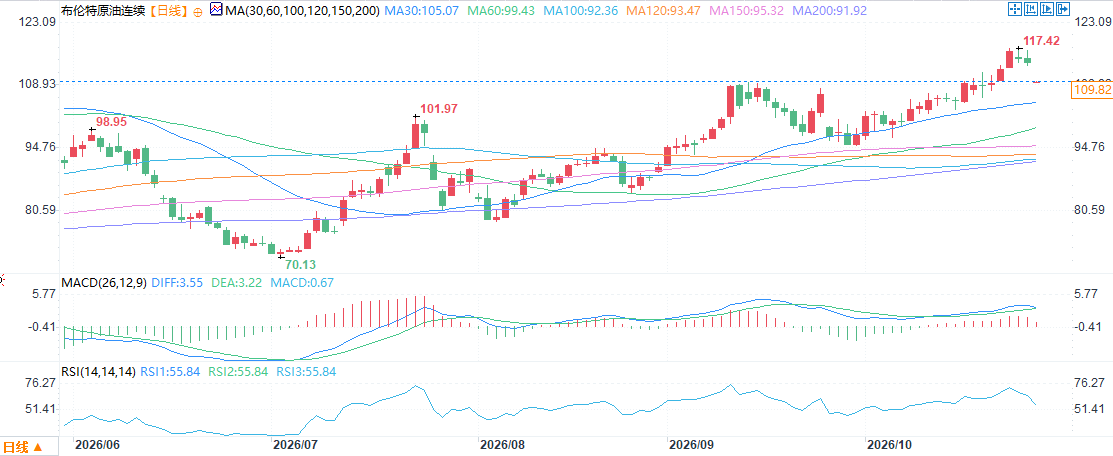 (Brent crude oil futures daily chart, source: EasyTrade) At 8:17 Beijing time, Brent crude oil futures were trading at $109.87 per barrel.
Inventories and Reserves: Global inventories have declined significantly, and the release of strategic reserves has been largely completed.
UBS stated that global inventories have declined significantly, and the committed release of strategic petroleum reserves has now been largely completed, removing the buffer that previously helped cushion supply losses. The market's supply shortage could further deplete commercial inventories, which the bank believes should support prices.Supply recovery: Hormuz and bypass pipeline flows approach 18.8 million barrels per day
Middle East shipments have recovered significantly from the severe disruptions earlier this year. UBS, citing Petro-Logistics data, estimates that combined crude oil flows through the Strait of Hormuz and via bypass pipelines exceeded 17.3 million barrels per day in September, and approached 18.8 million barrels per day in the first three weeks of October, compared to an average of 19.9 million barrels per day in January and February before the conflict.Maritime safety: At least 30 ships were attacked in October, setting a new monthly record; high freight rates are squeezing shipping capacity.
However, this recovery has been accompanied by a sharp deterioration in maritime security. At least 30 attacks on ships were reported in and around the Strait of Hormuz in October, the highest monthly total on record, driving up freight rates and limiting tanker availability. UBS stated that this means the oil balance now depends not only on how many barrels are produced, but also on whether there is sufficient and affordable shipping capacity to transport oil to where it is needed. Freight rates determine the cost of delivering crude oil, and tight shipping capacity could reshape regional trade flows and refinery economics.Asian buying: Imports rebound sharply from lows, removing a key buffer.
Asian buying was the final factor UBS highlighted. Imports have rebounded sharply from their unusually low levels earlier this year, removing a significant buffer for global markets. UBS analyst Giovanni Staunovo stated that uncertainty remains high in the bank's forecasts, reflecting the unpredictable course of the Middle East conflict and the pace of recovery in Gulf production and global oil demand.Summarize
UBS expects Brent crude to remain around $110/barrel by the end of the year, and has raised its forecasts for March, June, and September 2027 to $95/barrel, $90/barrel, and $85/barrel, respectively. The bank believes the oil market tension has shifted from production to logistics: global inventories have fallen sharply, strategic reserves have been largely released, and while flow through the Hormuz and bypass pipelines has recovered to nearly 18.8 million barrels per day, at least 30 attacks on ships in October set a monthly record, pushing up freight rates and squeezing tanker capacity; the recovery in Asian imports has removed a key buffer. Supply recovery may not necessarily lead to a price decline, and the market is more sensitive to new disturbances around the Hormuz. The persistently high oil prices have kept inflationary pressures in place before the Fed's decision, with Asian freight-sensitive refineries and importers having the greatest risk exposure. UBS analysts say forecast uncertainty remains high, depending on the progress of the Middle East conflict and the speed of supply and demand recovery. (Brent crude oil futures daily chart, source: EasyTrade) At 8:17 Beijing time, Brent crude oil futures were trading at $109.87 per barrel.
- Risk Warning and Disclaimer
- The market involves risk, and trading may not be suitable for all investors. This article is for reference only and does not constitute personal investment advice, nor does it take into account certain users’ specific investment objectives, financial situation, or other needs. Any investment decisions made based on this information are at your own risk.