Gold Trading Alert: The Fed held rates steady, weakening the dollar, while oil prices reignited inflationary pressures; focus on US GDP and PCE.
2026-10-29 08:00:23
On Wednesday (October 28), spot gold rose 0.2% to close at $4,068.96 per ounce, seemingly indicating a slight bullish trend. However, in early Asian trading on Thursday (October 29), spot gold weakened slightly to around $4,055, a drop of about 0.35%. Supported by the decline in the dollar index after the Fed held rates steady, gold is caught between two opposing forces: renewed oil price increases, persistent inflation concerns, and high expectations for a December rate hike. The short-term direction is unclear. Today's trading session will see the release of US Q3 GDP data and September PCE data. Market expectations are relatively optimistic, which may put downward pressure on gold prices before the data release. However, investors should also pay attention to further market interpretations of the Fed's decision. 
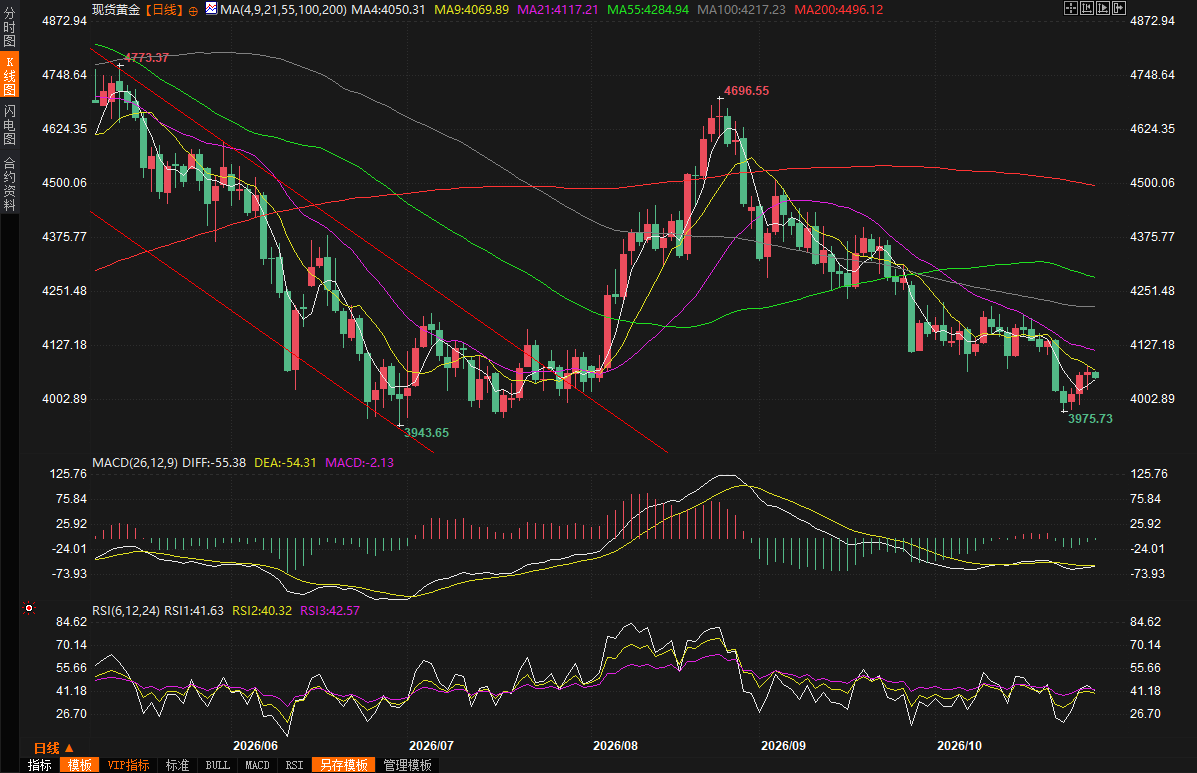 (Spot gold daily chart, source: FX678) At 07:57 Beijing time, spot gold is currently trading at $4056.55 per ounce.
I. The Subtle Signals of the Federal Reserve's "Holding Rates Steady"
As widely expected, the Federal Reserve on Wednesday maintained its target range for the benchmark interest rate at 3.75%-4.00%, deciding by a 10-2 vote to postpone any adjustments to borrowing costs until after next week's U.S. midterm elections, awaiting more data on inflation trends. The dissenting votes came from Fed Governor Cook and Cleveland Fed President Hammark, both of whom advocated for a 25-basis-point rate hike. Cook is facing pressure from President Trump to remove him from office, while Hammark has consistently held a hawkish stance, making this "holding unchanged" decision less monolithic and more indicative of significant internal division. The policy statement itself was not dovish. The Fed acknowledged that inflation "remains high," while upgrading its assessment of the economy from "solid" expansion at the September meeting to "strong," noting robust investment performance and job growth in line with the pace of labor force growth. The statement also indicated that "accumulating more information will help the Committee determine the appropriate policy stance to ensure that inflation returns in time to the Committee's 2 percent objective," and emphasized that "the Committee will achieve price stability." This wording represents a significant shift from the September meeting, carrying a hint of forward guidance, a approach Fed Chairman Warsh had previously expressed a desire to avoid. In other words, the Fed is telling the market: the pause is not the end, it's just waiting for data. What truly repriced the market was Warsh's statement at the press conference. He didn't offer guidance on the monetary policy outlook but acknowledged that the Fed hasn't achieved price stability, stating, "We are working on it." He also stated that he doesn't approve of "prejudging the meeting's outcome," noting that "a lot can happen, so I can't share my personal thoughts on what will happen when this committee meets again in six weeks." The market interpreted this as slightly neutral to dovish, causing the dollar index to fall and providing support for gold prices. However, Warsh did not commit to stopping rate hikes, and long-term US Treasury yields continued to rise, effectively limiting gold's upside potential.II. A weaker dollar provides support for gold prices, while long-term government bond yields exert downward pressure.
The US dollar was a key driver behind Wednesday's gold price gains. While the immediate reaction to the Fed's decision was mild, the dollar weakened after Warsh began his press conference. The dollar index, which measures the dollar's strength against a basket of six major currencies, fell 0.24% to close at 102.11, after earlier hitting 102.48, a near two-week high. Marc Chandler, chief market strategist at Bannockburn Global Forex, said the dollar had weakened since before the FOMC meeting due to a steeper yield curve. For gold, a weaker dollar means it becomes cheaper for holders of other currencies, providing short-term support. But the dollar's weakness isn't the whole story. US long-term Treasury yields rose on Wednesday, with the 10-year yield climbing 4.3 basis points to 5.036%, its highest level since last Thursday; the 30-year yield rose 5.8 basis points to 5.363%, also its highest level since last Thursday. The two-year Treasury yield fell 2.5 basis points to 4.712%, after rising earlier in the session but retreating towards the close. The spread between the two-year and 10-year Treasury yields, widely regarded as an indicator of economic expectations, widened to 32 basis points, compared to about 25 basis points at the close on Tuesday. The steepening yield curve indicates that the market is simultaneously pricing in a slight cooling of short-term rate hike bets while also worrying about long-term inflation and fiscal risks. This creates a complex impact on gold: lower short-term interest rate expectations are beneficial for gold prices, but rising long-term yields increase the opportunity cost of holding non-yielding gold. Independent precious metals trader Tai Wong's commentary aptly summarizes this dilemma. He stated that long-term US Treasury yields are rising, and the market is not entirely satisfied with Warsh's explanation of maintaining interest rates; rising interest rates will put some pressure on gold. He believes that precious metals will not experience a significant sell-off, but the upside potential may be limited. This statement almost perfectly encapsulates Wednesday's gold price performance: a weaker dollar supported the lower limit, while long-term bond yields capped the upper limit. The 10-year TIPS break-even yield was 2.376%, indicating that the market expects an average annual inflation rate of approximately 2.4% over the next 10 years; the 5-year TIPS break-even yield was 2.495%, up from 2.469% on October 27. Inflation expectations are not completely out of control, but they are also far from returning to levels that would reassure the Federal Reserve.III. Oil prices resume their upward trend, and inflation concerns become an "invisible ceiling" for gold.
If the Federal Reserve and the US dollar are the immediate variables for gold, then oil prices are the "invisible ceiling" above it. On Wednesday, influenced by the attack on a Saudi Arabian oil refinery, market concerns about supply risks stemming from the Middle East conflict reignited. Brent crude oil futures for December delivery rose $1.44, or 1%, to settle at $115.32 per barrel; US crude oil futures rose $2.88, or 3%, to settle at $102.78 per barrel. This surge pushed Brent crude back into overbought territory for the fourth time in five trading days. The Houthi rebels claimed on Tuesday that they had hit Saudi Arabia's largest oil refinery with missiles, intensifying their attacks on the world's second-largest oil producer after the United States; the Yemeni government also claimed that the Houthis attacked Aden airport on Wednesday. Geopolitical risks combined with supply disruptions have made oil prices a core variable in inflation trading once again. The impact of rising oil prices on gold is not simply a matter of "benefiting inflation and safe haven." When energy costs are high, especially the prices of key inputs such as diesel, inflation concerns rise rapidly, thereby strengthening expectations of central bank interest rate hikes. Rising inflation may force central banks to raise interest rates, which weakens the appeal of non-yielding gold. Kelly Brown, CEO of deposit management firm Ampersand, bluntly stated, "Maintaining interest rates doesn't mean we can breathe a sigh of relief," implying that the Federal Reserve is telling ordinary people and businesses to continue waiting; with inflation still at 3.7% and oil prices above $100 a barrel, businesses cannot expect borrowing costs to fall quickly. The fact that U.S. inflation has failed to reach the Fed's 2% target for five and a half years has worried some officials that businesses and households are gradually getting used to faster price increases and may plan accordingly, making inflation even harder to control. Inventory data also supports oil prices. The U.S. Energy Information Administration said Wednesday that energy companies drew 1.9 million barrels of crude oil from inventories in the week ending October 23, while analysts had expected an increase of 15,000 barrels. Sources said this is roughly in line with the American Petroleum Institute's report of a 2 million barrel decrease in inventories on Tuesday. In addition, three sources familiar with the matter said that China has released its fourth batch of export quotas for gasoline, diesel, and jet fuel this year, a rare supplementary amount that brings the total quota for 2026 to the same level as in 2025. Looking ahead, the market is awaiting the industry meeting on Sunday, and sources say the OPEC+ alliance is expected to maintain its December oil production target. For gold, the stronger oil prices, the harder it is for inflation concerns to subside, the higher the threshold for the Federal Reserve to shift to easing, and the more difficult it is to fully unlock the upside potential for gold prices.IV. The probability of a December rate hike remains high; PCE data could be the next trigger.
Following the Federal Reserve's decision to hold rates steady, the market hasn't completely ruled out a rate hike. The CME FedWatch tool shows traders now expect a 78% probability of a December rate hike, down from 88% before the announcement. A December rate hike remains the mainstream expectation, with a high probability. Financial markets are still digesting expectations of two more rate hikes in the coming months, although confidence has slightly decreased compared to before Warsh's speech on Wednesday. Market expectations indicate an approximately 80% chance of a rate hike at the Fed's December 8-9 meeting, with a possible second hike by March. This makes Thursday's US personal consumption expenditure (PCE) inflation data the next catalyst. Traders are currently awaiting Thursday's PCE inflation data for further insight into monetary policy direction. The PCE is the Fed's preferred inflation indicator; stronger-than-expected data could reignite bets on a December rate hike, supporting Treasury yields and the dollar, while putting pressure on gold. Conversely, weaker-than-expected data could provide a short-term respite for gold prices, with a weakening dollar and cooling rate hike expectations creating a synergistic effect. Meanwhile, the European Central Bank and the Bank of Japan are expected to announce their monetary policy decisions on Thursday and Friday, respectively, with both expected to maintain their policy rates unchanged. The Reserve Bank of New Zealand's unexpected decision to keep interest rates unchanged caused a sharp drop in the New Zealand dollar, reminding the market that against the backdrop of diverging global central bank policies, exchange rate fluctuations can indirectly transmit to gold through the US dollar index.V. Institutional Divergence: Limited Short-Term Upside, 2026 Expectations Lowered but 2027 Rebound Possible
From an institutional perspective, gold is not without short-term support, but the cost-effectiveness of chasing the rally is declining. Tai Wong believes that precious metals will not experience a significant sell-off, but upside potential may be limited. Shawn Snyder, an economic strategist at Potomac Fund Management, pointed out the contradiction in the Fed's statement: the Fed seems to have upgraded its assessment of the economic outlook, describing the pace of economic activity expansion as "strong" rather than the previous "solid"; this raises an obvious question—if the economy is so strong and inflation remains stubborn, why not raise interest rates now? This question itself will limit market enthusiasm for gold, because as long as the option of raising interest rates remains on the table, it will be difficult for real interest rate expectations to fall significantly and benefit gold. In the longer to medium term, analysts have lowered their 2026 precious metal price forecasts, citing weak demand, rising Treasury yields, and a stronger dollar, but expect all precious metals to rebound in 2027. This assessment echoes the current market situation: in 2026, gold faces a triple constraint of high yields, a strong dollar, and weak demand, making a sustained bull market unlikely; however, the anticipated rebound in 2027 indicates that the market has not abandoned gold's long-term investment value. The problem lies in the fact that short-term traders are more focused on the probability of a December rate hike, PCE data, and oil prices, rather than the long-term outlook for 2027. Gold is currently in a state of "long-term story, short-term catalyst lack."Conclusion: The tug-of-war between bulls and bears remains unresolved; gold awaits inflation data for direction.
In summary, gold prices rose 0.2% to $4068.96 on Wednesday, a result of a weaker dollar and market interpretation of a slightly dovish stance from the Federal Reserve. However, a pullback to around $4055 in early Asian trading on Thursday indicates that the bulls did not have absolute control. The Federal Reserve maintained interest rates at 3.75%-4.00%, raised its economic assessment, and acknowledged that inflation remained high. Warsh refused to provide forward guidance, revealing internal divisions. The dollar index fell 0.24% to 102.11, providing support for gold prices. The 10-year Treasury yield rose to around 5.036%, and the 30-year yield rose to 5.363%, steepening the yield curve and suppressing gold valuations. Brent crude rose to $115.32 and WTI crude rose to $102.78, with attacks on Saudi refineries and the conflict in Yemen reigniting inflation concerns. The probability of a December rate hike remains high at 80% to 86%, making PCE data the next key variable. Gold isn't currently lacking support; rather, both support and resistance levels are too strong, causing prices to fluctuate repeatedly around $4060. In the short term, the upside potential for gold may be limited, but the probability of a sharp sell-off is also low. The true direction will depend on clearer signals from inflation data and central bank announcements. (Spot gold daily chart, source: FX678) At 07:57 Beijing time, spot gold is currently trading at $4056.55 per ounce.
- Risk Warning and Disclaimer
- The market involves risk, and trading may not be suitable for all investors. This article is for reference only and does not constitute personal investment advice, nor does it take into account certain users’ specific investment objectives, financial situation, or other needs. Any investment decisions made based on this information are at your own risk.