USD/JPY continued its range-bound trading, driven by both a hawkish Fed stance and safe-haven outflows from the yen.
2026-10-29 15:28:24
On Thursday during the Asian session, USD/JPY traded around 157.80, continuing its recovery this week. The core driver of this rally came from the simultaneous easing at both ends: the dollar received structural support from the Federal Reserve's "holding rates steady but with hawkish rhetoric," while the yen lost short-term support due to waning safe-haven demand. The statement mentioned continued economic expansion, resilient domestic spending, strong capital investment, and robust productivity growth, while employment growth was in line with labor force size—essentially signaling to the market that "the economy can withstand higher interest rates." The dissenting votes from two officials advocating an immediate 25 basis point rate hike moved the tightening bias from rhetoric to the vote record; Warsh further clarified the institutional arrangements for future meeting schedules, reducing market speculation about a "forced shift." This combination provides more policy certainty than emotional impulses to support the dollar, meaning the yen's rebound requires stronger internal positive factors to offset it.  From the perspective of the yen, the core contradiction lies in the gap between "realized appreciation" and "further tightening that has not yet materialized." Data from ABN AMRO shows that the yen's half-year performance is second only to the Norwegian krone, and it ranks fourth year-to-date, seemingly a strong currency. However, the bank also cautions that substantial official intervention this year has been a key factor supporting its resilience. This warning is crucial: if some of the gains come from administrative forces rather than fundamental repricing, then when intervention ends or the market tests its resolve, the yen's retracement slope may be steeper than the data suggests. Furthermore, the current recovery in risk appetite has directly eroded the yen's safe-haven premium. SK Hynix's strong third-quarter results and announcement of increased shareholder returns, along with the realization of profits in the AI industry chain, have driven funds from defensive assets to high-beta assets, with the yen, as a typical funding currency, bearing the brunt. This means that even if the Bank of Japan signals a December rate hike on Friday, its positive impact may be partially offset by the combination of "intervention dependence + safe-haven outflows." However, the yen's downside potential is also somewhat constrained. On the one hand, the Bank of Japan has raised interest rates by a total of 50 basis points this year and is currently in a pause period to assess the impact of previous tightening. If its statement on Friday is hawkish or points out the persistence of inflationary pressures, the expectation of a rate hike at the end of the year will be quickly repriced. On the other hand, the dollar's own upward movement also faces resistance: the Fed's October pause has been fully priced in; the real variable lies in whether the year-end path can be disproven by data, and Thursday's PCE price index will be the first test window. In a horizontal comparison, this situation puts the yen in a relatively passive position: it cannot enjoy the dual benefits of high interest rates and policy certainty like the dollar, nor can it fully enjoy the benefits when risk appetite recovers. Instead, it has to bear the dual test of its funding currency attributes and the phasing out of intervention. This is also the underlying reason why the current USD/JPY rebound has been moderate but has not been effectively suppressed. From a cross-asset perspective, the current fluctuations in USD/JPY are essentially a confluence of four factors: first, valuation support from the sustained high expectations of the USD/JPY interest rate differential; second, safe-haven outflows triggered by the recovery in the AI sector; third, implicit support from the Bank of Japan's (BOJ) pre-decision positioning and intervention expectations; and fourth, data dependence on the Fed's year-end path. It's worth noting that this interconnected structure makes a range-bound trading strategy more suitable for this currency pair than a one-sided bet: when risk appetite and the dollar strengthen in tandem, the exchange rate often enters a tug-of-war; only when their directions diverge (e.g., risk appetite declines while the dollar weakens, or the BOJ unexpectedly turns hawkish) does a trend-driven movement have a basis. Investors should not view single-day rebounds in isolation but rather evaluate them within the transmission chain of "interest rate differential—risk appetite—intervention—central bank pace." On the daily chart, USD/JPY is trading around 158.00, with an overall bullish bias. The price is trading above the 50-period EMA at approximately 157.96 and the 9-period EMA at approximately 157.76, both of which are close to the current price, indicating potential buying interest on dips. The RSI (14) is around 52, in the neutral-to-bullish zone and far from overbought levels, representing a typical "bullish trend, poised for a breakout" pattern. Resistance levels to watch are 158.30, 158.80, and 159.20. Support levels to watch are first the 50-period EMA at approximately 157.96, followed by the 9-period EMA at 157.76. A deeper pullback would test the structural support zone around 157.30. On the 4-hour chart, the exchange rate is moving upwards along the short-term moving average. The MACD histogram is close to the zero line, and the fast and slow lines are approaching a golden cross, indicating bullish momentum but a breakout has not yet been confirmed. Currently, the price is fluctuating narrowly between 157.90 and 158.15. If it retraces to 157.76-157.96 and finds support, there is still a chance for a short-term upward attack on 158.30-158.60. If it breaks below 157.76 with high volume, it may seek support at 157.30 or even 156.80. An upward breakout requires the coordination of the Bank of Japan's decision and PCE data. Until then, it is advisable to treat the market within a range and avoid chasing highs and lows.
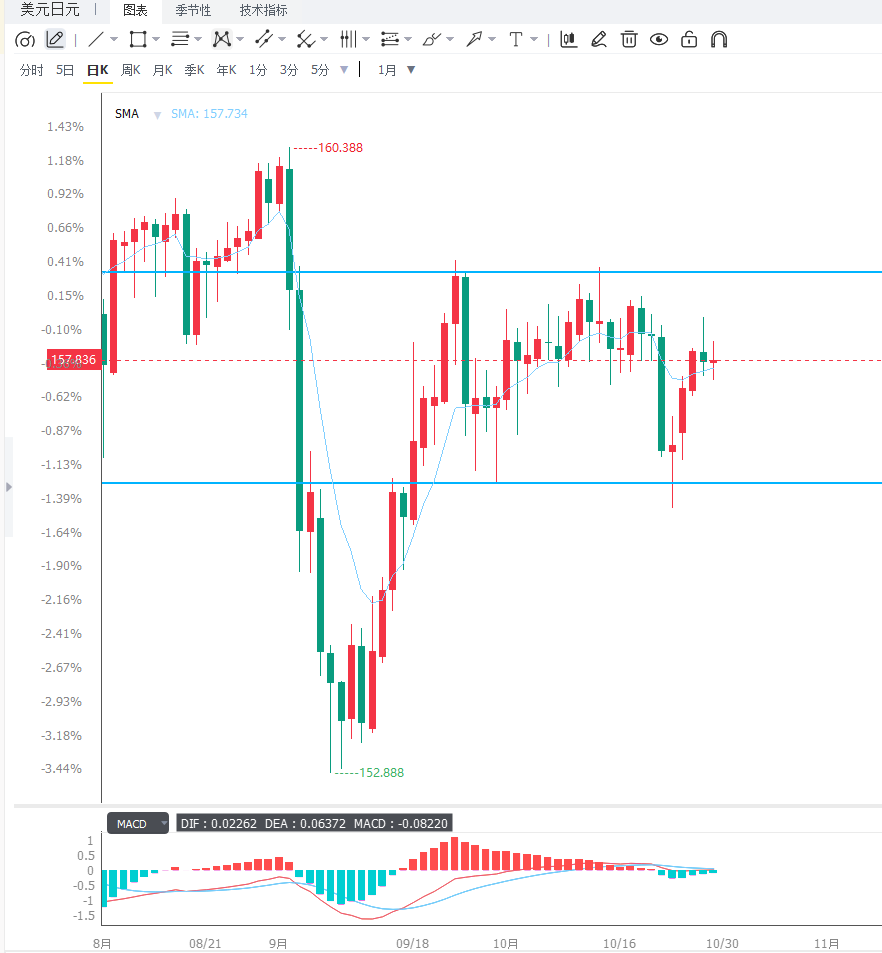 Editor's Summary: The core contradiction for USD/JPY in the short term lies in the support provided by the Fed's hawkish rhetoric and improved risk appetite, while the potential December rate hike signal from the Bank of Japan and expectations of official intervention act as constraints. This two-way dynamic makes the exchange rate more likely to consolidate within the 157.76-158.30 range, awaiting a breakthrough from the decisions of the two major central banks. Three key variables to watch go forward: first, the US September PCE price index to be released later; the strength or weakness of the data will verify the Fed's assertion that "monetary medicine is working" and directly determine the year-end path; second, the Bank of Japan's interest rate decision and statement on Friday, which is the primary policy basis for judging whether the yen can shift from a passive to an active stance; and third, whether the exchange rate can hold above 157.76, which is the primary technical basis for judging whether the bullish momentum continues.
From the perspective of the yen, the core contradiction lies in the gap between "realized appreciation" and "further tightening that has not yet materialized." Data from ABN AMRO shows that the yen's half-year performance is second only to the Norwegian krone, and it ranks fourth year-to-date, seemingly a strong currency. However, the bank also cautions that substantial official intervention this year has been a key factor supporting its resilience. This warning is crucial: if some of the gains come from administrative forces rather than fundamental repricing, then when intervention ends or the market tests its resolve, the yen's retracement slope may be steeper than the data suggests. Furthermore, the current recovery in risk appetite has directly eroded the yen's safe-haven premium. SK Hynix's strong third-quarter results and announcement of increased shareholder returns, along with the realization of profits in the AI industry chain, have driven funds from defensive assets to high-beta assets, with the yen, as a typical funding currency, bearing the brunt. This means that even if the Bank of Japan signals a December rate hike on Friday, its positive impact may be partially offset by the combination of "intervention dependence + safe-haven outflows." However, the yen's downside potential is also somewhat constrained. On the one hand, the Bank of Japan has raised interest rates by a total of 50 basis points this year and is currently in a pause period to assess the impact of previous tightening. If its statement on Friday is hawkish or points out the persistence of inflationary pressures, the expectation of a rate hike at the end of the year will be quickly repriced. On the other hand, the dollar's own upward movement also faces resistance: the Fed's October pause has been fully priced in; the real variable lies in whether the year-end path can be disproven by data, and Thursday's PCE price index will be the first test window. In a horizontal comparison, this situation puts the yen in a relatively passive position: it cannot enjoy the dual benefits of high interest rates and policy certainty like the dollar, nor can it fully enjoy the benefits when risk appetite recovers. Instead, it has to bear the dual test of its funding currency attributes and the phasing out of intervention. This is also the underlying reason why the current USD/JPY rebound has been moderate but has not been effectively suppressed. From a cross-asset perspective, the current fluctuations in USD/JPY are essentially a confluence of four factors: first, valuation support from the sustained high expectations of the USD/JPY interest rate differential; second, safe-haven outflows triggered by the recovery in the AI sector; third, implicit support from the Bank of Japan's (BOJ) pre-decision positioning and intervention expectations; and fourth, data dependence on the Fed's year-end path. It's worth noting that this interconnected structure makes a range-bound trading strategy more suitable for this currency pair than a one-sided bet: when risk appetite and the dollar strengthen in tandem, the exchange rate often enters a tug-of-war; only when their directions diverge (e.g., risk appetite declines while the dollar weakens, or the BOJ unexpectedly turns hawkish) does a trend-driven movement have a basis. Investors should not view single-day rebounds in isolation but rather evaluate them within the transmission chain of "interest rate differential—risk appetite—intervention—central bank pace." On the daily chart, USD/JPY is trading around 158.00, with an overall bullish bias. The price is trading above the 50-period EMA at approximately 157.96 and the 9-period EMA at approximately 157.76, both of which are close to the current price, indicating potential buying interest on dips. The RSI (14) is around 52, in the neutral-to-bullish zone and far from overbought levels, representing a typical "bullish trend, poised for a breakout" pattern. Resistance levels to watch are 158.30, 158.80, and 159.20. Support levels to watch are first the 50-period EMA at approximately 157.96, followed by the 9-period EMA at 157.76. A deeper pullback would test the structural support zone around 157.30. On the 4-hour chart, the exchange rate is moving upwards along the short-term moving average. The MACD histogram is close to the zero line, and the fast and slow lines are approaching a golden cross, indicating bullish momentum but a breakout has not yet been confirmed. Currently, the price is fluctuating narrowly between 157.90 and 158.15. If it retraces to 157.76-157.96 and finds support, there is still a chance for a short-term upward attack on 158.30-158.60. If it breaks below 157.76 with high volume, it may seek support at 157.30 or even 156.80. An upward breakout requires the coordination of the Bank of Japan's decision and PCE data. Until then, it is advisable to treat the market within a range and avoid chasing highs and lows. Editor's Summary: The core contradiction for USD/JPY in the short term lies in the support provided by the Fed's hawkish rhetoric and improved risk appetite, while the potential December rate hike signal from the Bank of Japan and expectations of official intervention act as constraints. This two-way dynamic makes the exchange rate more likely to consolidate within the 157.76-158.30 range, awaiting a breakthrough from the decisions of the two major central banks. Three key variables to watch go forward: first, the US September PCE price index to be released later; the strength or weakness of the data will verify the Fed's assertion that "monetary medicine is working" and directly determine the year-end path; second, the Bank of Japan's interest rate decision and statement on Friday, which is the primary policy basis for judging whether the yen can shift from a passive to an active stance; and third, whether the exchange rate can hold above 157.76, which is the primary technical basis for judging whether the bullish momentum continues.
- Risk Warning and Disclaimer
- The market involves risk, and trading may not be suitable for all investors. This article is for reference only and does not constitute personal investment advice, nor does it take into account certain users’ specific investment objectives, financial situation, or other needs. Any investment decisions made based on this information are at your own risk.