Russia's diesel fuel program collapses, negatively impacting the election; Middle East conflict and potential lower oil price ceilings.
2026-10-29 16:04:23
On Thursday (October 29), WTI crude oil futures fluctuated around $101.20 per barrel during the Asian and European sessions. The market is currently rife with narratives of post-election war, but I believe the conflict will actually decrease. Trump's attempt to use Russian diesel to curb domestic oil inflation has been thwarted, amplifying the negative impact of the midterm elections. Regardless of whether the Republicans ultimately lose the House or both houses, the space for a large-scale US war against Iran will be significantly reduced. At this stage, the US is relying more on military deterrence to force Iran to reach a verifiable agreement on the nuclear issue, limiting the probability of a black swan event leading to escalation. Coupled with the UAE's new bypass pipeline and the potential for easing tensions in diplomatic negotiations, even with pessimistic views from UBS and the World Bank, oil prices still have room to fall. Diesel shortages and the tensions between Russia and Ukraine represent another independent set of factors driving global energy inflation. 
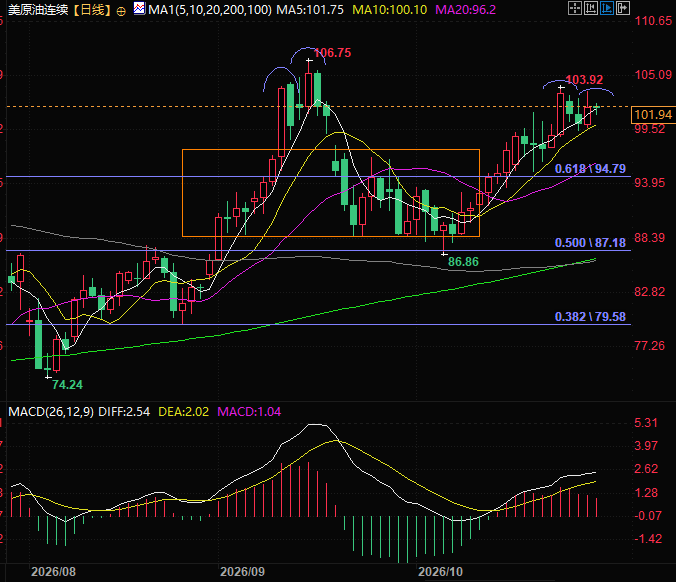 (WTI crude oil futures daily chart, source: EasyTrade) At 15:57 Beijing time, WTI crude oil futures are currently trading at $102.03 per barrel.
Russia's diesel export plan to the US has failed, the US has lost its leverage in controlling inflation, and the risk of the midterm elections has increased.
Trump had hoped to allow Russian diesel to enter the US, using a low-cost source to fill the gap in the East Coast, suppress diesel prices, and alleviate dissatisfaction among agricultural and trucking voters. However, the plan faced strong opposition from Congress: the Treasury Department's General Permit No. 135 supported the transaction, but senators determined that the import violated the law, and ports, banks, and insurance institutions refused to take on the business to avoid legal risks. The first diesel tanker originally scheduled to sail to New York had its destination port canceled and was put on a waiting-for-order voyage, effectively rendering this price control channel ineffective. East Coast PADD1 diesel inventories have been at multi-year lows for a long time. Combined with the autumn harvest, road freight, heating stockpiling in the Northeast, European refining capacity shortages, and soaring shipping insurance premiums in the Strait of Hormuz, the East Coast diesel crack spread has remained strong. After expectations failed to materialize, the pressure of high domestic refined oil prices in the US is difficult to resolve quickly, and energy inflation continues to be a drag on the Republican Party in the midterm elections.Election defeat will limit the president's authority to use force abroad, making a large-scale conflict between the US and Iran less likely.
The market needs to distinguish between "military deterrence statements" and actual large-scale strikes. The baseline scenario is a Republican loss of the House of Representatives, while the pessimistic scenario is a loss of both houses. Both outcomes will bring about the same core change: Trump will be in a lame-legged position. On the one hand, war-related military spending and authorization for overseas military operations will be subject to strict congressional review, and the president's ability to independently launch sustained large-scale strikes will be institutionally limited . On the other hand, the US strategic focus will be more on deterrence and pressure, aiming to push Iran to accept nuclear restrictions, allow continued inspections, and place Iranian nuclear facilities under routine monitoring, prioritizing diplomatic agreements rather than all-out war. Although the US has notified its Middle Eastern allies to prepare contingency plans for strikes and Iranian proxy retaliation against energy facilities after the election, and has deployed more aircraft carriers and amphibious forces to the Persian Gulf, these troop increases and warnings are more of a bargaining chip than a guarantee of a strike. The Houthi attack on Saudi refining facilities is a localized proxy skirmish and does not directly equate to a full-scale US-Iran conflict.Institutions remain pessimistic about the energy shock.
UBS raised its Brent crude oil price forecast for the second time this month, increasing its target price for the end of 2026 to $110 per barrel, while simultaneously raising its forward oil price curve for 2027. UBS's bullish rationale includes: while Gulf crude oil shipments have recovered somewhat, they remain below pre-war levels; the number of attacks on ships in the Strait of Hormuz reached a new high in October; VLCC freight rates from the Middle East to China surged; global commercial inventories continue to decline; and strategic reserve deployments have largely ended, resulting in a tight supply-demand balance supporting oil prices. The World Bank's forecast has also reversed, revising its prediction from last year of an oil surplus and commodity prices falling to a six-year low to a 23% increase in commodity prices for 2026, driven primarily by shipping disruptions caused by the Middle East conflict. However, institutional pricing has not yet fully factored in the hedging variables of the supply chain. Firstly, negotiations between the US and Iran are possible; secondly, Middle Eastern countries are seeking ways to circumvent the Strait of Hormuz. Abu Dhabi National Oil Company (ADNOC) has notified some Asian refineries that the new Hormuz bypass pipeline will be operational in early 2027. A portion of crude oil from the Upper Zakum oil field will be transported via pipeline to the Fujairah terminal for direct loading and delivery to long-term contract customers, eliminating the need for tankers to traverse the highly risky Strait of Hormuz. This alternative route can continuously dilute the risk and shipping premiums associated with strait blockades, and in the long term, weaken the impact of strait disruptions on oil prices and freight rates.Viewpoints and Technical Analysis:
Our core judgment differs from that of institutions: institutional pricing reflects the current static situation of tight supply and demand and high geopolitical premiums, but geopolitical premiums themselves are the most elastic variable. As long as US-Iran diplomacy makes progress, both sides move closer to a nuclear verification agreement, alternative oil transport routes such as the UAE's bypass pipeline gradually materialize, and the Russia-Ukraine conflict eases marginally, international crude oil prices and tanker freight rates have significant room for decline. It's necessary to consider diesel and crude oil separately: diesel shortages are a major driver of this round of global energy shocks, and the repair cycle for refining capacity shortcomings is longer; while as US administrative capacity is constrained by Congress, the approval process for foreign aid becomes more difficult, and support for Ukraine will shrink accordingly. The intensity of the Russia-Ukraine conflict may gradually ease, but it is currently in a phase of repeated back-and-forth, and a rapid ceasefire is unlikely in the short term. Technically: WTI crude oil futures are fluctuating around the 5-day moving average, and a double-top pattern has appeared on the daily chart. If the 5-day moving average can be held during the European and American trading sessions, oil prices will continue their upward trend, but a sharp drop is unlikely to resolve the double-top pattern. (WTI crude oil futures daily chart, source: EasyTrade) At 15:57 Beijing time, WTI crude oil futures are currently trading at $102.03 per barrel.
- Risk Warning and Disclaimer
- The market involves risk, and trading may not be suitable for all investors. This article is for reference only and does not constitute personal investment advice, nor does it take into account certain users’ specific investment objectives, financial situation, or other needs. Any investment decisions made based on this information are at your own risk.