The Bank of Japan's decision to hold rates steady is a foregone conclusion; the real catalyst for the yen's reaction will come after this statement.
2026-10-29 14:56:23
The yen was virtually unchanged against the dollar in Asian trading on Thursday (October 29), trading around 157.80. The dollar/yen pair remained range-bound as investors focused on the Bank of Japan's monetary policy announcement on Friday. 
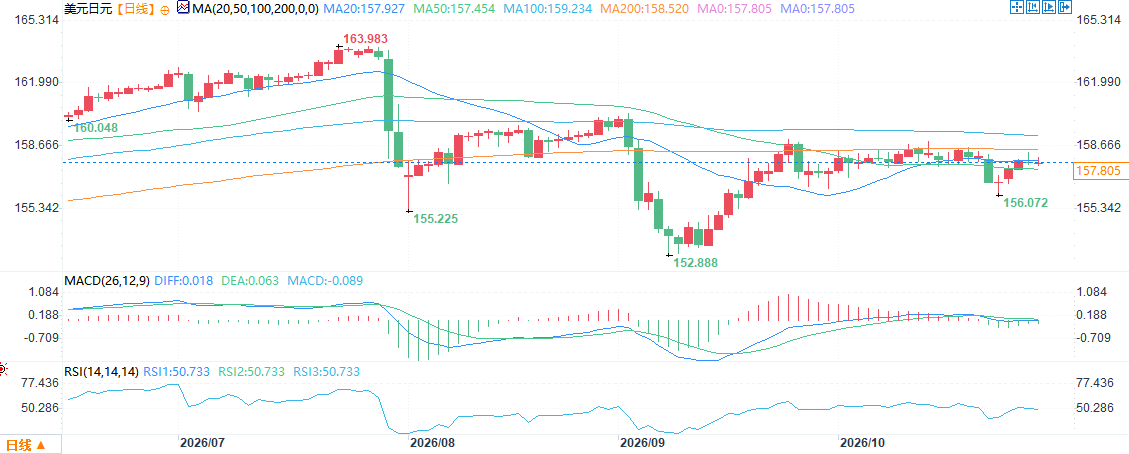 (USD/JPY daily chart, source: FX678) At 14:55 Beijing time, USD/JPY was trading at 157.80/81.
This week's meeting is expected to be a mere formality, with the market focusing on signals for a December rate hike.
Commerzbank analysts noted that the market expects the overnight rate to remain unchanged at 1.25%, and none of the economists surveyed by Bloomberg predict a rate hike this week, thus investors are turning their attention to the policy outlook before the end of the year. Regarding the foreign exchange market, the bank believes that "the more important question will be what signal the Bank of Japan will send in December." They emphasized that "the market is currently pricing in an 80% probability of a rate hike at that time, consistent with our own expectations—that the Bank of Japan will raise the policy rate to 1.5%." In the bank's view, "recent communication from the Bank of Japan and the economic background increasingly indicate that the next step in policy normalization is approaching."The financial system report hints at a message: financial stability does not constitute a constraint.
It's worth noting that Commerzbank points out that "additional support for this view" comes from the Bank of Japan's semi-annual report on risks to the financial system—a report the bank admits is "not the most obvious source of monetary policy signals." Nevertheless, the bank emphasizes that "the report indicates that higher interest rates should remain manageable for the Japanese financial system." Specifically, "in stress tests, the Bank of Japan found that even if the policy rate rises to 2%, it should not pose a significant problem for Japanese banks and companies." It adds that "a rise to 1.25% has been smoothly absorbed, as has the rise in long-term government bond yields." Commerzbank emphasizes that the Bank of Japan is cautious in not presenting this as guidance, noting that "the Bank of Japan emphasizes that the 2% assumption is not a forecast, but only part of the stress test scenario." Even so, the bank judges that "the message to the foreign exchange market is noteworthy: financial stability does not appear to constitute a hard constraint on further policy normalization." Therefore, although "Friday itself may only provide limited new momentum for the yen," Commerzbank concludes that "our structurally bullish view on the yen remains intact."Tokyo's CPI and US data were released on the same day, causing the US dollar index to rise slightly.
On Friday, market participants will also focus on the October Tokyo Consumer Price Index (CPI), which will be released ahead of the Bank of Japan's policy decision. The Tokyo CPI (excluding fresh food) is expected to fall to 2.6% year-on-year from 2.7% in September. Meanwhile, the dollar rose slightly ahead of the US Q3 GDP preliminary reading and the September PCE price index (to be released at 12:30 GMT). As of press time, the dollar index (DXY), which measures the dollar against six major currencies, rose 0.1% to around 102.20. According to TD Securities, the upcoming data should confirm that "Q3 GDP will show solid underlying growth," and that "GDP growth has accelerated to 2.5% from the previous 2.2%, with underlying activity remaining strong." The bank noted that "consumption may remain resilient but slightly slowing," and "fixed investment is also strong, largely thanks to AI." On the downside, they judged that "net exports are likely to be the main drag on GDP growth, but this is partially offset by a rebound in inventories," and the overall growth picture is solid but unbalanced beneath the surface. The US dollar retreated after the Federal Reserve announced its monetary policy, with the Fed maintaining interest rates in the 3.75%-4.00% range as expected.in conclusion
The USD/JPY pair traded in a narrow range ahead of the Bank of Japan's (BOJ) decision. The meeting this week is expected to keep interest rates unchanged, with the real variable being the signal of a December rate hike – the market has already priced in an 80% probability. The BOJ's stress tests of the financial system also suggest that financial stability is not a constraint, and the structurally bullish logic for the yen remains valid. The short-term direction of USD/JPY depends on Tokyo CPI, US GDP and PCE data, and the BOJ's wording regarding its policy path at the end of the year. (USD/JPY daily chart, source: FX678) At 14:55 Beijing time, USD/JPY was trading at 157.80/81.
- Risk Warning and Disclaimer
- The market involves risk, and trading may not be suitable for all investors. This article is for reference only and does not constitute personal investment advice, nor does it take into account certain users’ specific investment objectives, financial situation, or other needs. Any investment decisions made based on this information are at your own risk.