Gold prices surged and then retreated, but there is potential: Easing expectations of interest rate hikes and renewed selling pressure from liquidity are emerging.
2026-10-29 17:46:26
Warsh's dovish remarks lowered expectations for a December rate hike, and lower US Treasury yields boosted gold prices overnight; however, disappointing Google earnings triggered a sharp drop in US tech stocks, and liquidity selling dragged gold prices down during the day. Expectations of easing tensions between the US and Iran offer potential benefits, while rising commodity prices continue to push up inflation and constrain central bank easing measures, thus putting downward pressure on gold prices. Currently, the turning point for gold prices still largely depends on the impact of the Middle East situation on energy inflation expectations. 
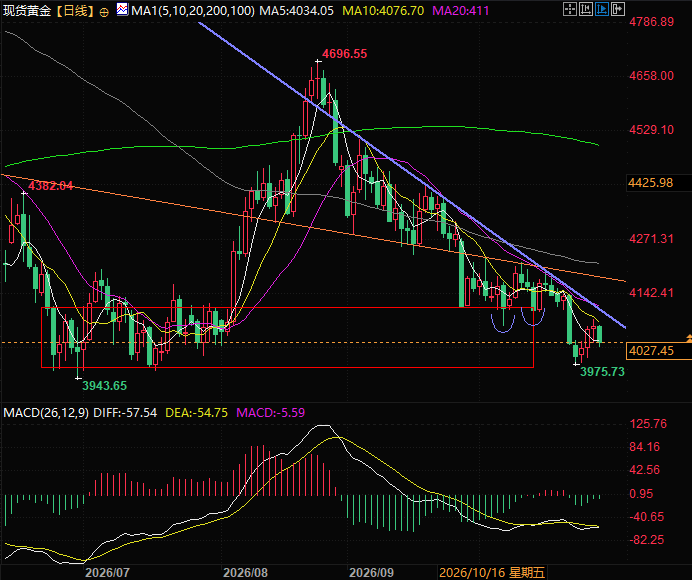 (Spot gold daily chart, source: EasyTrade) At 17:43 Beijing time, spot gold is currently trading at $4026 per ounce.
The Federal Reserve's dovish stance and cooling expectations of interest rate hikes boosted gold prices.
The Federal Reserve kept interest rates unchanged at 3.75%-4.00% as expected. Warsh did not release a hawkish policy outlook, but instead mentioned that financial conditions had tightened. As a result, CME FedWatch data showed that the probability of a December rate hike fell by about 5 percentage points, and yields on 2-year to 10-year US Treasury bonds fell across the board, leading to a decline in real interest rates and driving gold prices sharply higher in late trading yesterday. Deutsche Bank analyst Brett Ryan commented that Warsh acknowledged the marginal tightening of financial conditions, but did not conclude that current conditions were restrictive. This statement was a "hawkish pause," not completely closing the option of a December rate hike, but simply leaving the policy decision entirely to subsequent inflation data. Therefore, the rate hike expectation was only slightly lowered, not indicating a shift to a rate cut narrative. Domestic securities firms added that this communication was "constructive ambiguity." The Fed abandoned traditional forward guidance and no longer made upfront policy commitments, thus widening market expectations. If PCE inflation rebounds more than expected, the probability of a December rate hike will quickly rise again. The market generally interprets this as the Federal Reserve no longer setting a hard rate hike path in advance, and its future policy direction will be highly dependent on the upcoming PCE inflation data.A plunge in tech stocks triggered a liquidity sell-off, putting downward pressure on gold prices during the day.
The overnight bullish rally failed to carry over into the day. Google's earnings fell short of expectations, with weaker search advertising revenue and negative free cash flow, leading to a sharp decline in the US tech sector. The market once again witnessed the familiar logic of liquidity selling. Against the backdrop of sharp fluctuations in equity assets, funds chose to reduce their gold positions in exchange for liquidity, causing gold prices to quickly give back most of the overnight gains. Spot gold fell 1.01% to $4,027 per ounce. Domestic securities firms stated that when risk assets undergo concentrated deleveraging, gold is often seen as a highly liquid asset and sold off, a trading paradigm that has repeatedly appeared recently. This type of selling is not due to a medium- to long-term bearish view on gold, but rather a short-term liquidity shock. The market has strong explosive power, but its sustainability is usually weak. Ajay Kedia, head of Kedia Commodities in Mumbai, mentioned that the current decline in gold prices is essentially due to funds proactively reducing their exposure before the release of key inflation data, coupled with the amplified decline caused by the volatility of tech stocks. The underlying logic of interest rates and geopolitics has not reversed.US-Iran negotiations bring expectations of easing tensions, but commodity inflation constraints remain.
Geopolitically, the US Vice President's letter to Iranian officials, aimed at restarting peace talks, has marginally reduced the probability of a large-scale conflict between the US and Iran. De-escalation itself is beneficial to gold prices, mitigating the inflationary risk from continuously rising energy prices. Meanwhile, the newly built Hormuz Bypass Pipeline in Abu Dhabi is scheduled to begin operation in early 2027, allowing crude oil from the Upper Zakum oil field to be transported directly to the Fujairah terminal for delivery to contract customers, bypassing the high-risk Strait of Hormuz. In the long run, this can dilute the shipping risk premium associated with a strait blockade.Institutions are pessimistic about energy inflation.
Once the risk pricing of a Straits blockade declines, oil prices and commodity inflation expectations will cool simultaneously, easing the tightening pressure on the Federal Reserve and indirectly opening up upward space for gold. However, the pipeline is not yet operational, so the short-term hedging effect on the market cannot be realized. Medium- to long-term inflationary pressures remain significant. The World Bank's latest forecast predicts that global commodity prices will rise by 23% overall in 2026. Disruptions in Middle Eastern shipping, disruptions to Black Sea grain transport, and rising energy prices continue to push up global inflation, forcing major central banks to maintain a tight stance and suppressing gold prices from the interest rate side. The World Bank report points out that rising energy prices, shipping disruptions, and disruptions to food trade are jointly driving commodity inflation, which exhibits cross-regional transmission characteristics, making it difficult for major central banks to quickly shift to easing. It is worth noting that if Trump's administration is lame-faced, the approval process for US aid to Ukraine will become more difficult, and the intensity of the Russia-Ukraine conflict has the potential to gradually ease, but it is currently still in a tug-of-war phase, and the short-term easing effect on commodities is limited.Market Summary: Gold Price Turning Point Anchored to Changes in Middle East Inflation Expectations
Gold prices are currently caught in a tug-of-war between two forces: on the one hand, expectations of Fed policy and geopolitical easing provide support; on the other hand, rising commodity prices are pushing up inflation, and persistent liquidity disturbances are exerting downward pressure. Although many institutions are bullish on commodities and maintain a bullish outlook for oil prices, as long as the risks of conflict in the Middle East subside substantially, energy risk premiums recede, and global inflation expectations decline, both oil prices and tanker freight rates have room to fall, and the real interest rate pressure on gold will also ease accordingly. The World Gold Council suggests that the core catalyst for a gold trend is not a single FOMC statement, but whether the Middle East situation can continue to change the market's long-term pricing of energy inflation; only when energy-driven inflation expectations weaken and the upward pressure on real interest rates is relieved will gold prices have a chance to break out of their trend. Before that, they are likely to maintain a wide range of fluctuations. Whether gold can open an upward trend depends primarily on the Middle East situation. Only when geopolitical events reshape the market's medium- to long-term energy inflation expectations and central bank tightening expectations ease accordingly will gold prices be able to truly reach a trend reversal. Technically: Although gold prices are in a downtrend, the movement is relatively strong; pay attention to the breakout of the downtrend line. (Spot gold daily chart, source: EasyTrade) At 17:43 Beijing time, spot gold is currently trading at $4026 per ounce.
- Risk Warning and Disclaimer
- The market involves risk, and trading may not be suitable for all investors. This article is for reference only and does not constitute personal investment advice, nor does it take into account certain users’ specific investment objectives, financial situation, or other needs. Any investment decisions made based on this information are at your own risk.