Euro/Dollar stalemate: What signals are hidden behind the ECB's pause in interest rate hikes?
2026-10-30 14:56:25
On Friday, October 30th, the European Central Bank (ECB) kept its key interest rates unchanged: the deposit facility rate remained at 2.50%, the main refinancing operations rate at 2.65%, and the marginal lending facility rate at 2.90%. Eurozone inflation in September reached 3.8%, a significant rebound from August's 3.2%, with energy prices rising 18.9% year-on-year, a major driving factor. Excluding energy and fresh food, prices remained relatively stable, with core inflation at around 2.5% and services inflation at 3.2%. The ongoing conflict in the Middle East continues to push up energy costs. The ECB has paused its two rate hikes this year, but the possibility of further increases was discussed internally. Emmanuel Moulin, Governor of the Bank of France and a member of the ECB Governing Council, emphasized that current inflationary pressures are mainly driven by imports, and a cautious approach to policy is being taken. The yield on French 10-year government bonds was around 4.91% on the day, with the fiscal deficit and political uncertainty drawing market attention. 
The Import-Driven Nature of Inflation and the Prudential Policy Stance
Eurozone inflation accelerated primarily in September, driven by energy, which contributed approximately 1.71 percentage points. Excluding energy, price increases remained around 2.3%. Emmanuel Moulin noted that prices were relatively stable excluding energy and fresh agricultural products, with no wage transmission effect observed so far. He explicitly stated that with inflation mainly stemming from external sources, the ECB is taking a cautious approach and will continue to closely monitor data changes, deciding on actions based on information gathered at subsequent meetings. The ECB statement also confirmed that an increased magnitude and duration of energy shocks could push up inflation and drag down growth, but underlying inflation has remained broadly stable so far, and wages have not yet shown a significant response. This assessment distinguishes between the energy price shock and the secondary effects driven by domestic demand, providing a basis for maintaining interest rates unchanged while reserving room for adjustment based on subsequent data.Internal Meeting Discussions and Policy Path Statements
The October 29 meeting decided to maintain interest rates unchanged, but the Governing Council discussed the option of raising rates. European Central Bank President Christine Lagarde stated that the future policy direction is clear, emphasizing a data-dependent, meeting-by-meeting approach without pre-committing to a specific path. She pointed out that the current stance is sufficient to address the backdrop of continued rising energy prices and increased uncertainty, but inflation, growth, and wage data in the coming weeks still need to be observed. The statement also mentioned that financing conditions have tightened since the last meeting, which may restrain inflation and growth. Christine Lagarde also announced her early resignation, with her term ending in February 2027. While acknowledging energy risks, the policy statement did not directly equate short-term price shocks with domestic inflationary pressures requiring immediate further tightening.French fiscal issues and the boundaries of the central bank's responsibilities
Emmanuel Moulin explicitly opposed proposals to cancel or freeze the sovereign debt held by the French central bank, arguing that such a move would create a gap on the balance sheet, causing difficulties for the entire eurozone, without providing substantial help to public finances. He pointed out that France has never defaulted on its debt since 1797, and related discussions have fueled distrust of the country. While French government bonds have recently been sold off, leading to increased borrowing costs, Moulin stressed that fiscal problems should be resolved domestically through a vote to pass a budget that reduces the deficit. This would help demonstrate the country's direction to investors and stabilize markets. The European Central Bank's role is to achieve medium-term inflation stability at its 2% target, not to intervene in member states' fiscal challenges. The yield on French 10-year government bonds fluctuated around 4.9%, reflecting market pricing in the deficit trajectory and political process.Euro/Dollar Market Watch
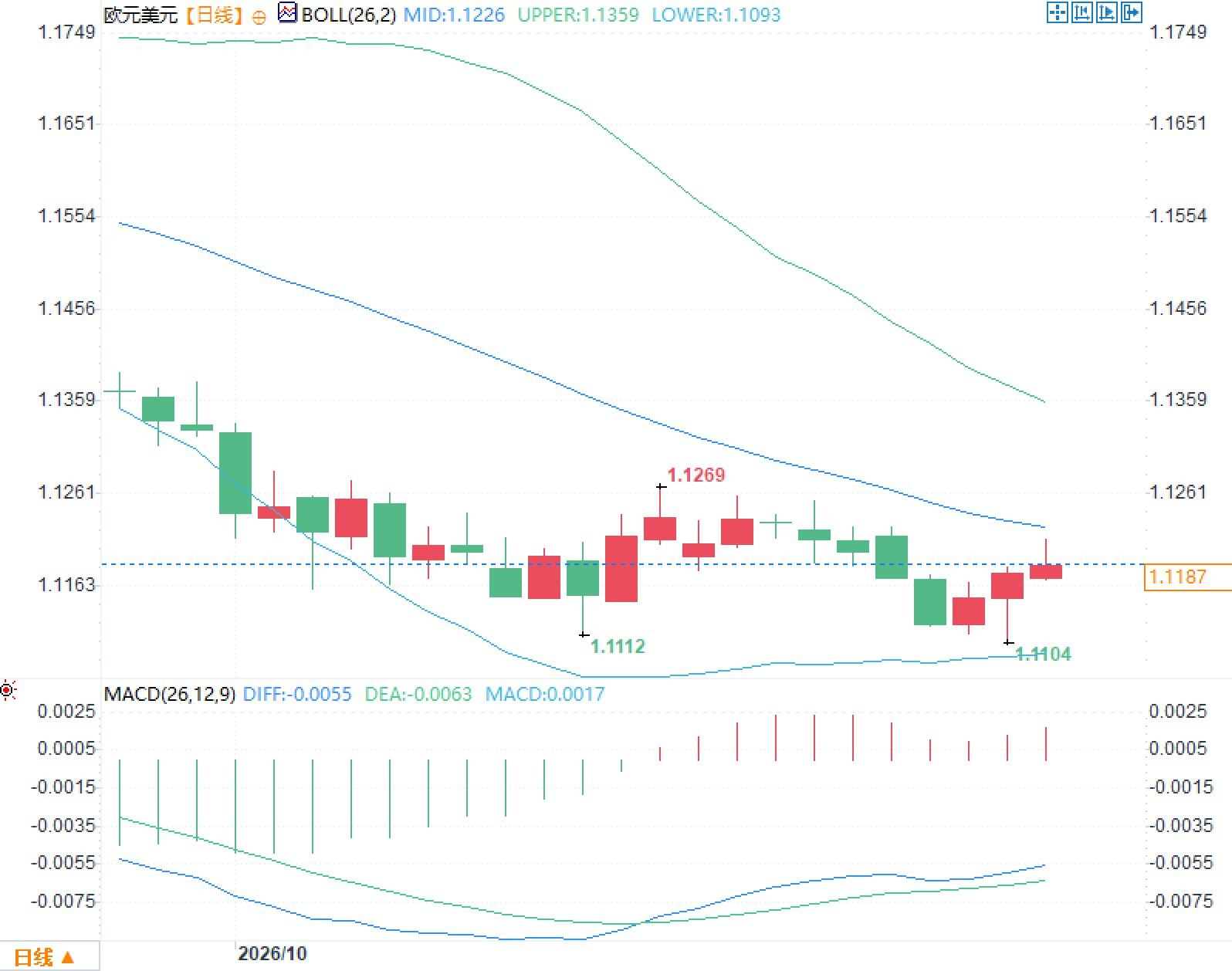
On the daily chart for EUR/USD, the price is trading around 1.118, below the Bollinger Band middle line at 1.1226, with the upper band at 1.1359 and the lower band at 1.1093. The MACD indicator shows a DIFF of -0.0055, a DEA of -0.0063, and a histogram value of +0.0017. Recently, the price has touched a high of 1.1269 and lows of 1.1112 and 1.1104, generally fluctuating around the middle band. The market's reaction to the ECB's decision to keep interest rates unchanged has been relatively limited; the euro's performance reflects more the combined effects of energy prices, French bond yields, and the transatlantic interest rate differential. Technical indicators currently show a neutral to slightly bearish bias, and the price has not broken out of the main Bollinger Band range.Frequently Asked Questions
Question 1: Why did the ECB choose to maintain interest rates when energy inflation was high? Answer: September inflation reached 3.8%, mainly driven by energy. Excluding energy, prices were relatively stable, and there was no significant secondary transmission of wage inflation. Therefore, the policy adopted a cautious approach, waiting for more data to confirm whether the shock had solidified. Question 2: Why did Emmanuel Moulin oppose canceling the sovereign debt held by the Bank of France? Answer: This move would create a balance sheet gap and harm the entire Eurozone, offering no substantial benefit to public finances. It could also exacerbate market distrust of French credit, even though France has not defaulted on its debt since 1797. Question 3: What impact do France's fiscal problems have on ECB policy? Answer: The ECB's mandate is limited to medium-term inflation stability. Fiscal challenges must be addressed by France itself through budget reductions to lower its deficit. Rising bond yields reflect investors' focus on the deficit path but do not directly change the boundaries of monetary policy tools.- Risk Warning and Disclaimer
- The market involves risk, and trading may not be suitable for all investors. This article is for reference only and does not constitute personal investment advice, nor does it take into account certain users’ specific investment objectives, financial situation, or other needs. Any investment decisions made based on this information are at your own risk.