OPEC+ will not add any new supply variables, and oil pricing will return to geopolitics and supply and demand.
2026-11-02 08:22:25
On Monday (November 2nd) during Asian trading hours, US crude oil futures opened slightly lower and are currently down about 1.5%, trading around $102.50 per barrel. Amidst this pressure, policy variables on the supply side have been finalized. The Organization of the Petroleum Exporting Countries (OPEC) and its allies (OPEC+) agreed on Sunday (November 1st) to maintain their December oil production targets. The organization comprises seven key members—Saudi Arabia, Russia, Iraq, Kuwait, Algeria, Kazakhstan, and Oman. According to the official statement, the organization decided to maintain the required production levels for December, with Saudi Arabia's quota at 10.478 million barrels per day, Russia's at 9.949 million barrels per day, and Iraq's at 4.431 million barrels per day. OPEC+ also reaffirmed its collective commitment to full compliance with the Declaration on Cooperation—the basis for coordination between OPEC and participating non-OPEC oil-producing countries. 
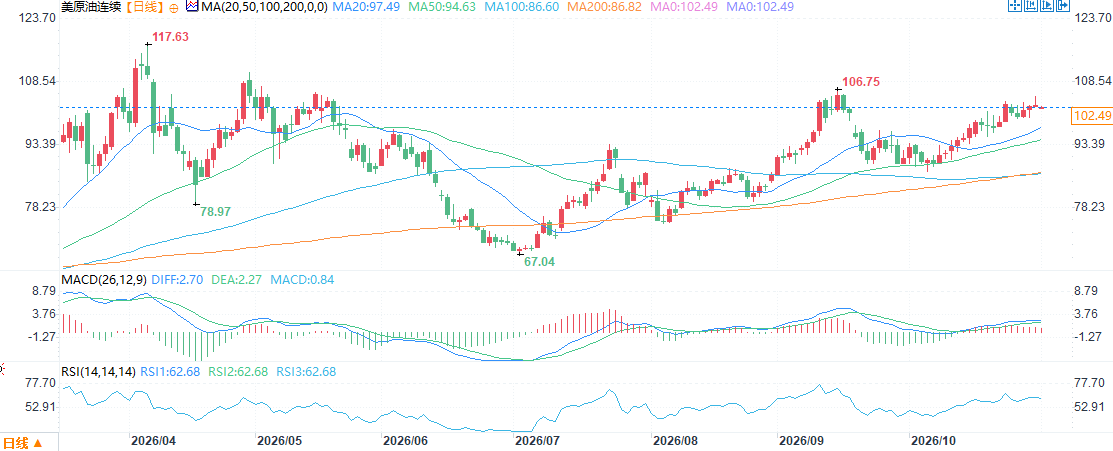 (US crude oil futures daily chart, source: FX678) At 8:18 Beijing time, US crude oil futures were trading at $102.49 per barrel.
Production Arrangements: Based on September figures, quotas for the seven countries are clarified.
The core of this decision is maintenance, not adjustment. The required production levels for December for the seven key member countries—Saudi Arabia, Russia, Iraq, Kuwait, Algeria, Kazakhstan, and Oman—remain at the September baseline. Saudi Arabia's quota is 10.478 million barrels per day, Russia's is 9.949 million barrels per day, and Iraq's is 4.431 million barrels per day, forming the majority of the quotas. Kuwait's quota is approximately 2.676 million barrels per day, Kazakhstan's is approximately 1.628 million barrels per day, Algeria's is approximately 1.007 million barrels per day, and Oman's is approximately 0.841 million barrels per day. The total required production for the seven countries is approximately 31.01 million barrels per day. This arrangement formally continues the existing production cut framework, without signaling new increases in production or redistributing existing quotas; the policy orientation is primarily stability. Previously, the group completed a partial phase-out of voluntary production cuts in September, but still retains an additional production cut arrangement of approximately 2 million barrels per day until the end of 2026. The current decision means that no new policy variables will be introduced on the supply side for the remainder of 2026, and member countries must continue to adhere to their established quotas to avoid disrupting overall coordination due to unilateral adjustments. This move also provides an observation window for subsequent capacity assessments and 2027 quota negotiations, reflecting the organization's strategy of prioritizing stable market expectations in a complex geopolitical environment.Decision Background: The Strait of Hormuz disruption continues, and supply disturbances persist.
Maintaining the December target unchanged was made against the backdrop of the ongoing disruption in the Strait of Hormuz. Earlier reports indicated that Iran claimed two oil tankers struck mines in the Strait of Hormuz and proposed a two-day reopening plan. Shipping risks in the strait directly impact the smooth flow of global crude oil and refined product transportation, and are a significant source of recent oil price risk premiums. Recent attacks on ships have shown a trend towards diversification, including small boats attaching explosive devices and drone attacks on key areas, further expanding the risk range into the heart of the Persian Gulf. Although some shipping traffic has recovered, average daily exports remain significantly below pre-conflict baseline levels. Choosing to remain on hold at this juncture suggests that OPEC+ prefers to observe the actual impact of geopolitical disturbances rather than adding new policy variables to the supply side. Actual production in Gulf member states is generally below quotas, partly due to shipping constraints. By maintaining the target, the organization avoids further signaling increased production when supply is already disrupted, thus preventing excessively loose market expectations. This prudent stance helps allow prices to reflect actual supply and demand and geopolitical risks more accurately than policy expectation fluctuations during periods of high uncertainty.Policy focus: Compliance discipline takes precedence over production adjustments
The statement reaffirmed full compliance with the Declaration on Cooperation, pointing to the organization's current policy focus—member discipline in fulfilling its commitments. Within the framework of maintaining unchanged production targets, the actual effectiveness of the production cut arrangements hinges on whether member countries produce according to their quotas. Strengthening the implementation of existing commitments, rather than adjusting targets, is a more noteworthy signal from this meeting. Some countries previously had overproduction or compensatory production cut arrangements, and their compliance directly impacts the overall effectiveness of the production cuts. The organization's emphasis on collective commitment aims to prevent individual members from deviating from the coordination track due to short-term interests, thereby undermining the credibility of the framework. The monthly meeting mechanism will continue to operate to promptly assess market conditions and actual production. The current focus is on ensuring the implementation of existing production cuts through disciplinary constraints, rather than responding to short-term fluctuations through frequent adjustments to targets. This approach helps improve policy predictability and creates a more stable internal environment for completing the capacity assessment by the end of the year and setting a new benchmark for 2027. Prioritizing compliance means that the market will pay more attention to actual production data rather than simply changes in target figures.Market Implications: Without adding new variables, oil pricing will return to supply and demand and geopolitical factors.
For the market, OPEC+'s decision means no new policy variables have been introduced on the supply side. Given the coexistence of supply disruptions such as the Strait of Hormuz situation, the US-Iran conflict, and the attack on Russian refineries, the risk premium for oil prices is driven more by geopolitical events than by oil-producing countries' policies. Going forward, attention should be paid to the actual compliance of member countries and the impact of the Strait of Hormuz situation on actual supply flows—these two factors will determine whether the existing production cut framework can effectively offset the supply uncertainty caused by geopolitical disturbances. Maintaining the target unchanged reduces policy uncertainty, allowing traders to focus more clearly on actual inventory changes, the extent of shipping disruptions, and demand data. If the Strait of Hormuz risk persists or escalates, the existing production cut arrangements can provide a buffer; if the situation eases, it is necessary to observe whether actual production can recover to the quota level in a timely manner. Overall, the market pricing logic is shifting from "policy expectation-driven" to "dual-driven by geopolitics and fundamentals," and OPEC+'s inaction provides a relatively stable policy backdrop for this shift.in conclusion
OPEC+ decided on Sunday to maintain its December production targets, with the seven key members sticking to their September production levels: Saudi Arabia at 10.478 million barrels per day, Russia at 9.949 million barrels per day, and Iraq at 4.431 million barrels per day. Given the ongoing disruptions in the Strait of Hormuz and unresolved supply-side issues, this decision reflects a wait-and-see approach rather than an increase in production—it neither signals a production surge nor adjusts the production cut framework due to high oil prices. The policy focus is on compliance discipline rather than production adjustments, and market pricing will be more driven by geopolitical events and supply and demand fundamentals. Going forward, attention should be paid to member countries' compliance and the impact of the Strait of Hormuz situation on actual supply flows. (US crude oil futures daily chart, source: FX678) At 8:18 Beijing time, US crude oil futures were trading at $102.49 per barrel.
- Risk Warning and Disclaimer
- The market involves risk, and trading may not be suitable for all investors. This article is for reference only and does not constitute personal investment advice, nor does it take into account certain users’ specific investment objectives, financial situation, or other needs. Any investment decisions made based on this information are at your own risk.