Trump says the US still needs to deal with one or two targets in Iran; Qatar's mediation pushes oil prices down by more than 2%.
2026-11-02 09:48:26
The US-Iran conflict has entered a critical juncture. US President Donald Trump stated on Saturday (October 31st) that the US has destroyed most of Iran's military and nuclear capabilities, but still needs to "deal with" one or two targets, specifically naming the suspected underground nuclear facility "Pickaxe Mountain." Meanwhile, diplomatic negotiations brokered by Qatar continue to advance, and international oil prices saw a technical correction on Monday (November 2nd). With the US midterm elections approaching, military options and a window for negotiation coexist, causing market sentiment to shift between tension and de-escalation. 
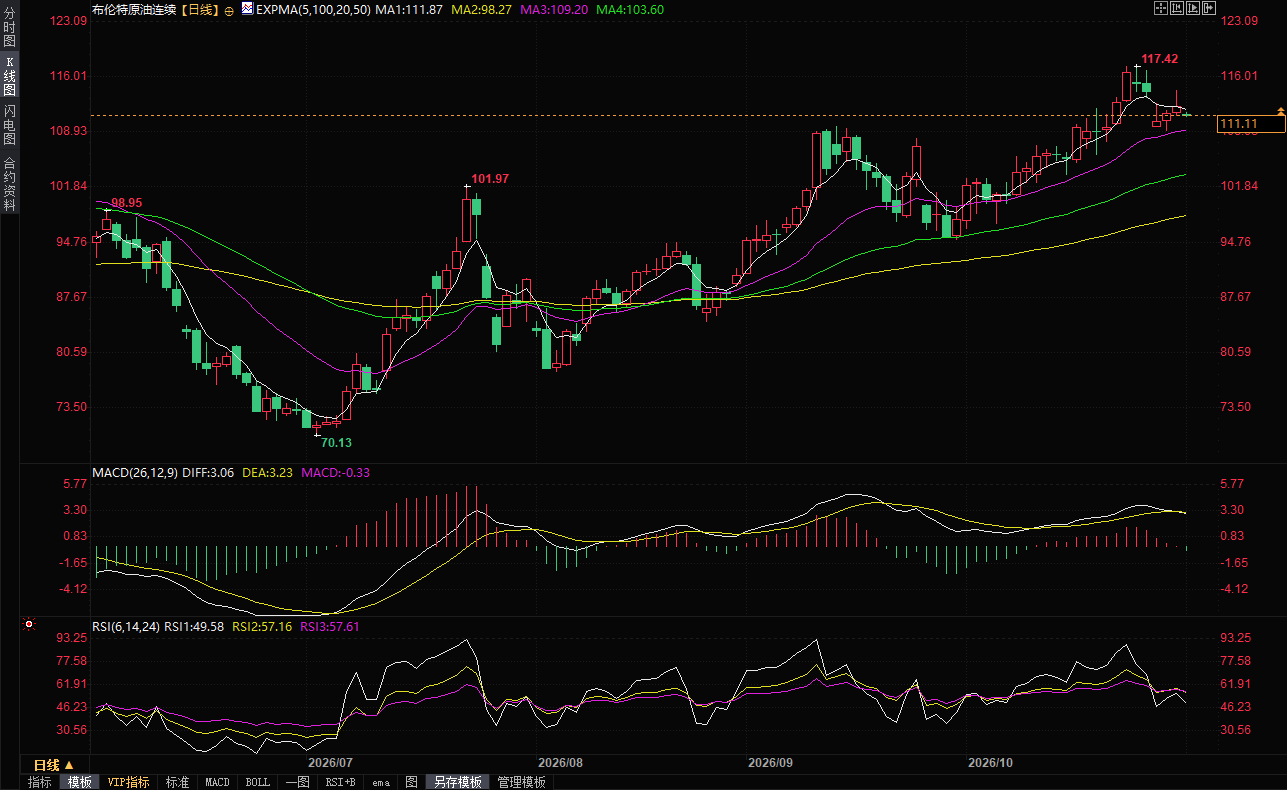 (Brent crude oil futures contract daily chart, source: FX678)
I. Oil prices ease from high levels: War premium meets diplomatic discount
International crude oil futures retreated from six-month highs during Asian trading hours on Monday. Brent crude futures fell as much as 2.2% to $110.86 a barrel, while US WTI crude fell as much as $101.50 a barrel, a drop of about 2.5%. The immediate trigger for the pullback was not a substantial improvement on the supply side, but rather the third consecutive day of talks between Iranian and Qatari mediators in Doha, which briefly fueled market expectations of "some form of diplomatic progress." Coupled with the absence of any substantial military escalation over the weekend, some short-term bulls chose to take profits. However, the price level remains high. Last week, Brent crude closed at a six-month high, while WTI continued to trade above $100 a barrel. Since the outbreak of the conflict, Tehran has restricted shipping in the Strait of Hormuz—a strait that typically carries about one-fifth of global oil consumption—and the reality of supply disruptions has not been resolved. The Iranian Revolutionary Guard previously stated that three oil tankers were stopped after encountering an "unexplained incident," and Iranian state television reported that a ship crossing the strait struck a mine and caught fire. The current "decline" in oil prices is essentially a technical correction within a period of high-level consolidation, rather than a trend reversal. Analysts also warn that the market is still pricing in the risk of escalating verbal clashes following the midterm elections, and the possibility of Brent crude being pushed towards $120 per barrel cannot be ruled out.II. "Gaoshan" and the Red Line: Military Options Have Not Disappeared
Oil prices were able to quickly find support from intraday lows because the risk premium on the supply side lacked the conditions for substantial reduction. On October 31, Trump told reporters in Florida that the US had destroyed "most of Iran's military power," but still needed to "deal with" one or two targets, directly naming the Ghosan underground nuclear facility, saying, "We can do all of that in 10 minutes." Ghosan, located near the Natanz nuclear facility in Isfahan province, is widely considered one of Iran's most heavily fortified underground nuclear facilities. Iran denies any nuclear activity at the facility, calling it "empty." Meanwhile, Tehran's deterrent signals escalated. In a written statement, Iran's Supreme Leader Mojtaba Khamenei met with the Chief of the General Staff of the Armed Forces, the Commander-in-Chief of the Regular Army, and the Commander-in-Chief of the Revolutionary Guard, ordering an "immediate, forceful, and geographically unrestricted response" to any US and Israeli threats, and demanding an updated target list to include "all types of tangible and intangible assets" of the US and Israel within its strike range. This was Mojtaba's first public military directive since assuming the Supreme Leader position in March. The fact that both sides are simultaneously raising their bargaining chips on a rhetorical level means that the existence of a diplomatic window does not equate to the shelving of military options, and therefore the uncertainty on the supply side is difficult to clear up quickly through a few rounds of talks.III. Doha's "Two-Day Plan": Conditions List and Compliance Gap
On the diplomatic track, the most concrete progress came from the "two-day plan" disclosed by Iranian Foreign Minister Araqchi. According to this plan, the US would need to take a series of compliance measures on the first day, and the Strait of Hormuz would reopen on the second day, restoring traffic to its previous state, followed by the resumption of US-Iran negotiations. The conditions for US compliance listed by Iran included: establishing new shipping routes through the Strait of Hormuz, unfreezing Iranian funds, ending regional wars including in Lebanon, lifting the maritime blockade, granting waivers for Iranian oil exports, and lifting new sanctions imposed after the Islamabad Memorandum of Understanding. The sheer size of this list is itself a core obstacle to the negotiations. Tehran placed the reopening of the Strait after the US had fulfilled its obligations, while the US's policy space regarding sanctions lifting and fund unfreezing was constrained by multiple factors, including domestic politics and alliance relations. Araqchi also stated that there were currently no plans for direct meetings with US officials, and consultations would be conducted indirectly through mediators in Qatar and Pakistan. Tehran described the letter from US Vice President Vance to Iranian Security Chief Rezaei as having a "completely changed tone," with Rezaei calling it "a good sign," but no formal response has yet been given. The change in tone was not enough to constitute a commitment to fulfill the agreement, and the oil price's reaction to this signal was limited to intraday pullbacks rather than a trend of decline.IV. The Time Window Following the Midterm Elections and the Silence of OPEC+
The key variable truly determining the next direction of oil prices is the time window following the US midterm elections on November 3rd. Multiple media outlets reported that the US has informed its Gulf allies that a new round of strikes against Iran could be launched as early as November 4th—the day after the election. Trump's previous self-restraint of "not taking action before the election" naturally expired after the vote. Disagreements within the decision-making ranks, revealed by US media, further amplified the uncertainty: Defense Secretary Hergsays and Secretary of State Rubio are highly skeptical of the nuclear agreement and tend to maintain pressure; Vice President Vance, Special Envoy Witkov, and Kushner advocate resuming negotiations. The variables from Israel are equally significant: Netanyahu's camp failed to secure a majority in the parliamentary elections, and the deadlock in forming a government could itself provide a political motivation to reactivate the military agenda. Another anchor on the supply side comes from OPEC+. On November 1st, Saudi Arabia, Russia, Iraq, Kuwait, Kazakhstan, Algeria, and Oman—seven major OPEC+ oil-producing countries—held a video conference and decided to maintain current crude oil production levels in December, the same as in September. This decision confirms market expectations that the organization will not make further policy adjustments before next year. With Middle Eastern exports facing disruption due to conflict, OPEC+'s decision to remain on hold means it will neither fuel the war premium nor increase production to offset the supply gap in the Strait of Hormuz. The bottom support and top constraint for oil prices are thus simultaneously locked within a narrow range based on the intensity of the conflict and the credibility of the negotiations.Editor's Summary
The current pricing logic in the crude oil market can be summarized as "walking on two legs": one leg rests on the physical supply risks in the Strait of Hormuz, and the other leg rests on the progress of the Doha talks. A drop of over 2% intraday indicates that diplomatic signals have short-term pricing power, but the price center remains anchored at Brent crude at $110-113 per barrel, suggesting the market has not incorporated the lifting of the blockade into its baseline scenario. Iran's "two-day plan" strictly links the opening of the Strait to the lifting of US sanctions and the unfreezing of funds, while the US faces two paths after the election: "reaching an agreement" and "fighting first, then talking," with mismatched time scales. OPEC+ maintaining its production level further compresses the buffer space on the supply side to absorb shocks through increased production. For energy consumers and macroeconomic policymakers, the core risk is not whether oil prices have peaked, but that the switch between war premiums and diplomatic discounts may be completed with sharp gaps—either upwards or downwards. (Brent crude oil futures contract daily chart, source: FX678)Frequently Asked Questions
Q: What are the specific contents of Iran's proposed "two-day plan," and how does it differ from earlier proposals? The "two-day plan" is a negotiation framework disclosed by Iranian Foreign Minister Araqchi on November 1st. Its core is to directly link the opening of the Strait of Hormuz with the US's prior compliance with its agreements: On the first day, the US would take a series of measures, including unfreezing Iranian funds, lifting the maritime blockade, granting oil export waivers, and lifting new sanctions following the memorandum; on the second day, the strait would reopen, and negotiations between Iran and the US would then begin. It is essentially a compressed version of the previous "seven-day plan." The Qatari mediator suggested shortening the seven days to five days or even less, and Iran accepted the "two-day" proposal. However, the feasibility of the plan depends on whether the US accepts the size of the conditions list; there is currently no public record of a formal US response. Q: How significant is the actual impact of the Strait of Hormuz blockade on oil prices? The strait typically carries about one-fifth of global oil consumption. Since the outbreak of the conflict, Iran has restricted shipping, resulting in incidents of ships hitting mines and catching fire, and oil tankers being stopped. This physical disruption is a key driver of Brent crude rising from pre-conflict levels to over $110 per barrel. OPEC+ maintaining its production levels means there is no additional spare capacity being proactively released to fill the gap, resulting in extremely low supply elasticity. Even if diplomatic progress leads to a short-term decline, as long as traffic in the Strait of Hormuz does not return to normal levels, the price center is unlikely to return to the pre-conflict range. Q: Why is the US midterm election considered a key time point for oil prices? Trump previously stated that he would not launch a new attack on Iran before the election, essentially setting a self-imposed deadline. This constraint will naturally be lifted after the election. The US has informed its Gulf allies of possible action as early as November 4th, while there is a clear division within the decision-making body between "fighting" and "talking." The election results themselves will also affect Trump's political maneuvering space: if the Republicans lose, some analysts believe his inclination to take major military action may increase rather than decrease. Therefore, the market views the days following the election as a concentrated window for repricing the war premium. Q: What does Iran's Supreme Leader's "unrestricted" retaliation order mean? During a meeting with the three commanders of the armed forces, Mojtaba Khamenei ordered an "immediate, forceful, and unrestricted response" to any threats from the US and Israel, and demanded that "all US and Israeli assets" be included on the strike list. This was his first publicly issued military directive since taking office, and its signaling significance outweighed its tactical details. The wording "unrestricted" means that Iran is not committed to limiting its retaliation to a specific geographical area, which theoretically includes US military bases and Israeli targets within the Gulf states. This increases the probability that the conflict, once restarted, will spill over outwards, and is one of the direct motivations for the Gulf states to urge Washington to allow more time for negotiations. Question: Is OPEC+ maintaining its production level bullish or bearish for oil prices? Against the backdrop of supply disruptions in the Middle East, maintaining production levels means that OPEC+ will not increase production to lower prices, thus providing a floor for oil prices rather than a bearish factor. However, this decision also excludes the option for the organization to actively tighten supply to push up prices. Currently, OPEC+ is still implementing its existing production cut agreement of approximately 2 million barrels per day until the end of 2026. Maintaining the September level in December effectively "freezes" the policy until quota negotiations begin next year. The net effect is to make oil prices more fully exposed to geopolitical events, increasing volatility, but the direction is determined by the US-Iran rivalry rather than the policies of oil-producing countries. At 09:46 Beijing time, Brent crude oil is currently trading at $111.21 per barrel.- Risk Warning and Disclaimer
- The market involves risk, and trading may not be suitable for all investors. This article is for reference only and does not constitute personal investment advice, nor does it take into account certain users’ specific investment objectives, financial situation, or other needs. Any investment decisions made based on this information are at your own risk.