Crude oil trading alert: OPEC+ maintains December production levels; US crude oil prices surged and then retreated, maintaining a high-level consolidation.
2026-11-02 09:40:26
WTI crude oil opened lower and continued to decline in Asian trading on Monday, last trading around $101.78 per barrel, down about 2.2% from Friday's close of $104.12 per barrel; Brent crude oil traded around $111.6 per barrel, down about 0.1% from Friday's close of $111.75 per barrel. Both benchmark oil prices saw profit-taking after three consecutive days of gains, primarily driven by a cooling of both supply and geopolitical risk premiums.  On the supply side, core OPEC+ members confirmed at an online meeting on Sunday that their December production targets would remain unchanged, with Saudi Arabia's quota at 10.478 million barrels per day, Russia's at 9.949 million barrels per day, and Iraq's at 4.431 million barrels per day. This decision was in line with market expectations—OPEC+ had already completed a phased replenishment of its voluntary production cuts of 1.65 million barrels per day, and the focus has now shifted to negotiations on 2027 quotas. In terms of actual implementation, export disruptions caused by the conflict with Iran in Gulf member states are still recovering, and most members' actual production is far below their quota levels. Therefore, maintaining the unchanged target has a limited impact on marginal supply, but it eliminates the downside risk of further production increases in the short term. Geopolitically, diplomatic contacts between the US and Iran continue to advance. Iranian Foreign Minister Araghchi disclosed a "two-day plan"—the US will first fulfill its commitments, followed by the reopening and resumption of navigation in the Strait of Hormuz. Trump also stated that negotiations are progressing and that no new attacks will be launched before the election. The reopening of diplomatic channels has significantly reduced market concerns about immediate post-election military escalation, and geopolitical risk premiums have marginally declined. However, the tight situation in the physical market has not fundamentally eased. EIA data shows that VLCC freight rates from the Middle East to Asia reached their highest level since records began at least in 2005 in March 2026; at least 30 ship attacks were reported in and around the Strait of Hormuz in October, a monthly record. Rabobank points out that "delivering crude oil to the market has become exceptionally expensive and fragile"—although the "Hormuz Shuttle" mechanism maintains basic liquidity, record tanker freight, insurance, and logistics costs have made physical crude oil trading prices significantly higher than those in the futures market. This divergence between "paper easing and physical tightness" implies structural support for futures prices. Regarding inventories, global crude oil inventories have declined significantly, with US commercial crude oil inventories reduced to a low of 411 million barrels, and the release of strategic petroleum reserves essentially complete, significantly thinning the buffer. Goldman Sachs raised its December 2026 Brent crude oil price forecast from $90 to $105 per barrel, while UBS expects it to remain around $110 per barrel by the end of the year, both pointing to a still tight supply and demand fundamentals. On the daily chart, WTI crude oil has been rising continuously since late October, reaching a high of around $104.50 per barrel before falling back, and is currently consolidating in the $101-$104 per barrel range. The RSI (14) has fallen from its high to about 58, which is in the neutral to strong range; the MACD histogram is close to the zero axis, and the momentum has slowed down but has not weakened. The original chart analysis shows that the upper resistance levels to watch are $102.50 per barrel, $104.12 per barrel and $104.50 per barrel; the lower support levels are first at the $101.00 per barrel level, followed by the $100.50 per barrel and $99.00 per barrel areas. On the 4-hour chart, oil prices have retreated from their highs and broken below short-term moving average support, currently fluctuating between $101.00 and $102.50 per barrel. If a rebound to $102.50 per barrel is met with resistance, the bearish trend may continue; if a decisive break below $101.00 per barrel occurs, the risk of accelerated decline should be noted, potentially testing $100.50 per barrel.
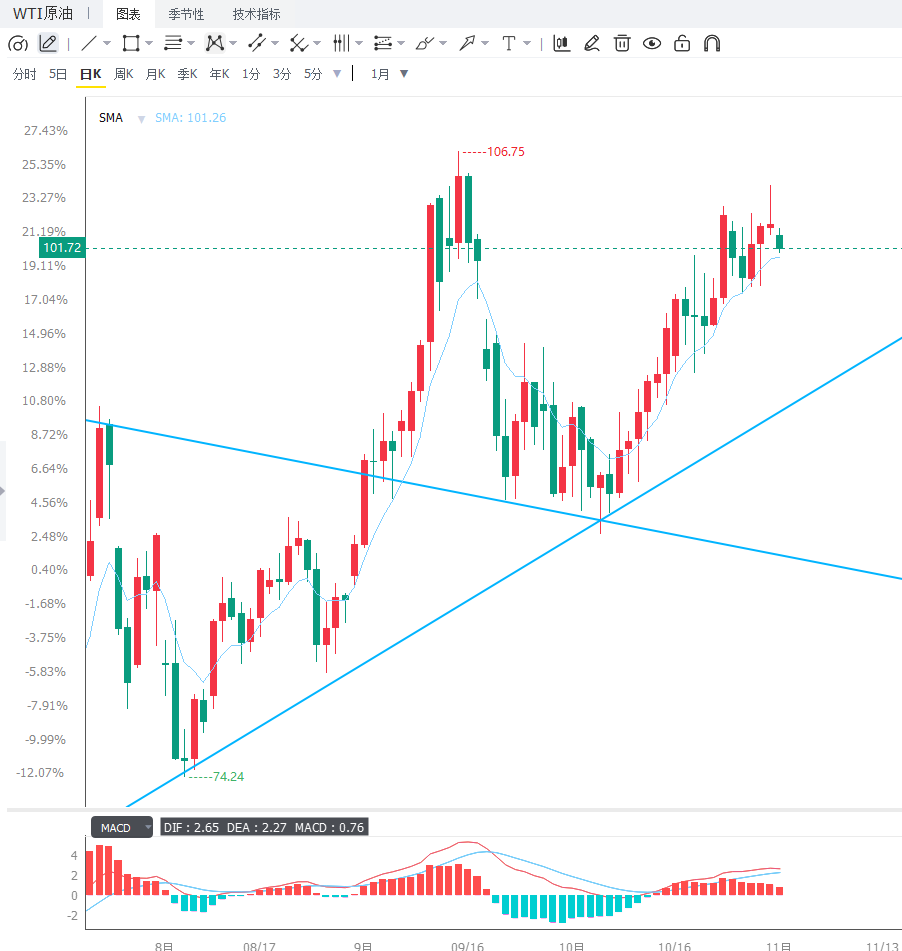 The core contradiction in WTI crude oil's current situation lies in the tug-of-war between "diplomatic easing weakening risk premiums" and "structural tensions in the physical market." In the short term, OPEC+ maintaining its production levels has eliminated downside risks on the supply side, but the progress of US-Iran diplomacy has reduced geopolitical premiums, making oil prices more likely to fluctuate and consolidate within the $100.50-$104.50/barrel range. Three key variables need to be monitored: first, the outcome of the US midterm elections on November 3rd and the subsequent US policy towards Iran; if the risk of military action escalates again, oil prices may rebound rapidly; second, the actual progress of the resumption of shipping in the Strait of Hormuz; if the "two-day plan" is implemented and shipping normalizes, the risk premium will further diminish; and third, whether WTI can find effective support at the $101.00/barrel level, which is the primary technical basis for judging whether the short-term pullback will deepen.
On the supply side, core OPEC+ members confirmed at an online meeting on Sunday that their December production targets would remain unchanged, with Saudi Arabia's quota at 10.478 million barrels per day, Russia's at 9.949 million barrels per day, and Iraq's at 4.431 million barrels per day. This decision was in line with market expectations—OPEC+ had already completed a phased replenishment of its voluntary production cuts of 1.65 million barrels per day, and the focus has now shifted to negotiations on 2027 quotas. In terms of actual implementation, export disruptions caused by the conflict with Iran in Gulf member states are still recovering, and most members' actual production is far below their quota levels. Therefore, maintaining the unchanged target has a limited impact on marginal supply, but it eliminates the downside risk of further production increases in the short term. Geopolitically, diplomatic contacts between the US and Iran continue to advance. Iranian Foreign Minister Araghchi disclosed a "two-day plan"—the US will first fulfill its commitments, followed by the reopening and resumption of navigation in the Strait of Hormuz. Trump also stated that negotiations are progressing and that no new attacks will be launched before the election. The reopening of diplomatic channels has significantly reduced market concerns about immediate post-election military escalation, and geopolitical risk premiums have marginally declined. However, the tight situation in the physical market has not fundamentally eased. EIA data shows that VLCC freight rates from the Middle East to Asia reached their highest level since records began at least in 2005 in March 2026; at least 30 ship attacks were reported in and around the Strait of Hormuz in October, a monthly record. Rabobank points out that "delivering crude oil to the market has become exceptionally expensive and fragile"—although the "Hormuz Shuttle" mechanism maintains basic liquidity, record tanker freight, insurance, and logistics costs have made physical crude oil trading prices significantly higher than those in the futures market. This divergence between "paper easing and physical tightness" implies structural support for futures prices. Regarding inventories, global crude oil inventories have declined significantly, with US commercial crude oil inventories reduced to a low of 411 million barrels, and the release of strategic petroleum reserves essentially complete, significantly thinning the buffer. Goldman Sachs raised its December 2026 Brent crude oil price forecast from $90 to $105 per barrel, while UBS expects it to remain around $110 per barrel by the end of the year, both pointing to a still tight supply and demand fundamentals. On the daily chart, WTI crude oil has been rising continuously since late October, reaching a high of around $104.50 per barrel before falling back, and is currently consolidating in the $101-$104 per barrel range. The RSI (14) has fallen from its high to about 58, which is in the neutral to strong range; the MACD histogram is close to the zero axis, and the momentum has slowed down but has not weakened. The original chart analysis shows that the upper resistance levels to watch are $102.50 per barrel, $104.12 per barrel and $104.50 per barrel; the lower support levels are first at the $101.00 per barrel level, followed by the $100.50 per barrel and $99.00 per barrel areas. On the 4-hour chart, oil prices have retreated from their highs and broken below short-term moving average support, currently fluctuating between $101.00 and $102.50 per barrel. If a rebound to $102.50 per barrel is met with resistance, the bearish trend may continue; if a decisive break below $101.00 per barrel occurs, the risk of accelerated decline should be noted, potentially testing $100.50 per barrel. The core contradiction in WTI crude oil's current situation lies in the tug-of-war between "diplomatic easing weakening risk premiums" and "structural tensions in the physical market." In the short term, OPEC+ maintaining its production levels has eliminated downside risks on the supply side, but the progress of US-Iran diplomacy has reduced geopolitical premiums, making oil prices more likely to fluctuate and consolidate within the $100.50-$104.50/barrel range. Three key variables need to be monitored: first, the outcome of the US midterm elections on November 3rd and the subsequent US policy towards Iran; if the risk of military action escalates again, oil prices may rebound rapidly; second, the actual progress of the resumption of shipping in the Strait of Hormuz; if the "two-day plan" is implemented and shipping normalizes, the risk premium will further diminish; and third, whether WTI can find effective support at the $101.00/barrel level, which is the primary technical basis for judging whether the short-term pullback will deepen.
- Risk Warning and Disclaimer
- The market involves risk, and trading may not be suitable for all investors. This article is for reference only and does not constitute personal investment advice, nor does it take into account certain users’ specific investment objectives, financial situation, or other needs. Any investment decisions made based on this information are at your own risk.