With the Democrats controlling both houses of Congress, has the medium-term direction of the US dollar really changed?
2026-11-05 08:24:26
The US dollar index fluctuated slightly lower during Asian trading hours on Thursday (November 5), currently trading around 101.45. The dollar retreated on Wednesday but has recovered from its intraday lows. The overwhelming victory of the Democrats in the US midterm elections eliminated a source of market uncertainty, while investors simultaneously assessed the possibility of regulatory changes. Democrats won control of both the Senate and the House of Representatives on Tuesday, achieving their first overwhelming victory in generations in some Republican strongholds, with tens of millions of voters sharply rejecting President Trump. This unexpected victory eased concerns about a potentially contested election result, but also raised the prospect of a divided government and legislative gridlock—Republicans controlling the White House and Democrats controlling Congress, while the US grapples with the Iran conflict and the AI boom that is both driving economic growth and inflation. 
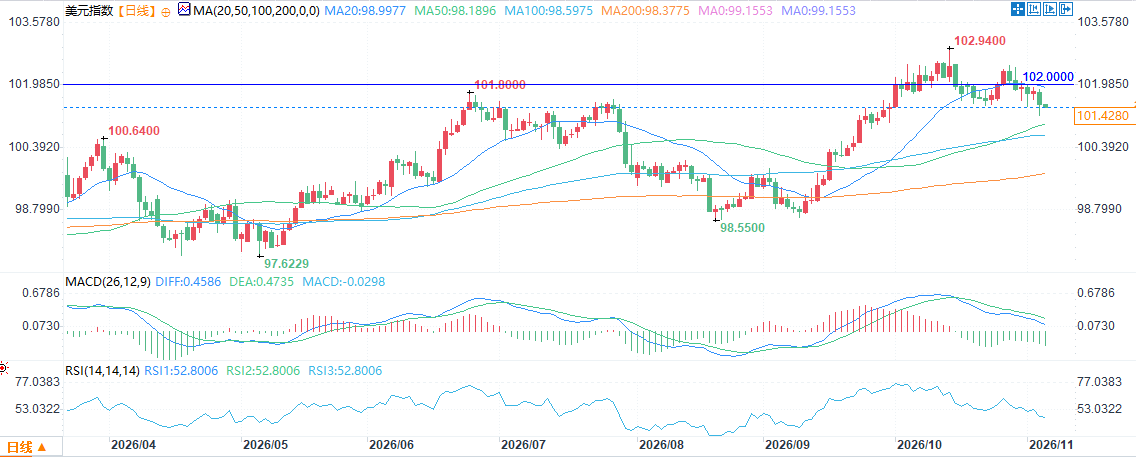 (US Dollar Index Daily Chart, Source: EasyForex) At 8:21 Beijing time, the US Dollar Index was at 101.42.
Market reaction: Risk appetite rebounded, the dollar came under pressure but recovered from its lows.
U.S. stocks rose, with the S&P 500 gaining about 2%; oil prices plummeted as investors awaited Washington's next move in the U.S.-Iran conflict. A forex and precious metals risk manager stated, "It's a feeling of risk appetite. Perhaps what we're seeing is just a 'sell the rumor, buy the fact' combination, and the relief of not getting bogged down in the election results controversy." "Fundamentally, given the Democrats' stance on issues like data centers, you might still see more AI concerns. But for now, the market is relieved that Trump won't fight back, and when we see overall risk appetite, it's generally bad for the dollar." The dollar index fell to 101.21 on Wednesday, its lowest level since September 30. The euro rose 0.21% to 1.1217, after reaching 1.1272, its highest level since October 6. This movement implies that the "de-uncertainty" effect of the election results outweighed the "increased regulatory risk" effect, with a rebound in risk appetite dominating the short-term direction of the dollar. However, the dollar did not fall unilaterally but found support at lower levels.The Federal Reserve expects the probability of a December rate hike to rise to 81.2%, with political changes not altering the interest rate path.
Despite the changing political landscape in the United States, expectations for the Federal Reserve's interest rate path have remained largely unchanged. According to CME FedWatch, the market is pricing in an 81.2% probability of a rate hike of at least 25 basis points at the Fed's December meeting, up from 77.4% the previous day. This data suggests that the election has altered political risk premiums and regulatory expectations, rather than the core of monetary policy pricing—the Fed's path remains driven by inflation and employment data, not by congressional affiliation.Economic data: ADP exceeded expectations, while ISM non-manufacturing slightly missed expectations.
The election results largely overshadowed a series of US economic data released that day. The ADP National Employment Report showed that private sector jobs increased by 86,000 in October, exceeding economists' expectations of 69,000. This was the latest in a series of labor market data releases this week, concluding with the government's non-farm payrolls report on Friday. Another report from the Institute for Supply Management (ISM) showed that the non-manufacturing PMI fell to 54.5 in October, down from 54.9 in September and slightly below economists' expectations of 54.8, but still above the 50-point expansion threshold. The combination of the better-than-expected ADP report and the slightly lower-than-expected ISM report suggests that the labor market remains resilient, and while the service sector expansion has slowed, it remains within expansion territory, supporting expectations of interest rate hikes.Institutional Views
Chris Turner, Global Head of Markets at ING, pointed out that the Democratic Party's landslide victory in the midterm elections initially put pressure on the dollar and short-term US Treasury yields, but most of the decline has been reversed as investors refocus on the strong US economy and the prospect of continued tightening by the Federal Reserve. He believes the dollar will continue to trade from a macroeconomic and monetary policy perspective in the short term, with an overall supportive bias. OCBC strategists Sim Moh Siong and Christopher Wong believe the dollar remains supported after the Fed held rates steady in October, but there is limited room for further significant gains. They expect a final 25-basis-point rate hike in December. Unless core inflation continues to rise more than expected, the dollar is unlikely to show a sustained upward trend. High oil prices, firm US Treasury yields, and European fiscal and energy risks (suppressing the euro) provide support, but the overall bias is towards range-bound trading.in conclusion
The dollar retreated after the Democrats swept both houses of Congress but recovered from its intraday lows. The core logic was that "reduced uncertainty" outweighed "rising regulatory risks"—concerns about a contested election result eased, risk appetite rebounded, the S&P 500 rose about 2%, crude oil fell sharply, and the dollar index touched its lowest level since September 30 overnight. However, the dollar did not fall unilaterally. The probability of a December rate hike rose to 81.2%, and ADP employment increased by 86,000, exceeding expectations, indicating that the political changes have not altered the core pricing of monetary policy. The euro rose to its highest level since October 6, and the pound rose to its highest level in more than seven weeks, awaiting the Bank of England's decision. Short-term trends depend on the sustainability of risk appetite, how the Democrats' regulatory stance on AI and data centers is implemented, and the repricing of Friday's non-farm payroll data on interest rate hike expectations. (US Dollar Index Daily Chart, Source: EasyForex) At 8:21 Beijing time, the US Dollar Index was at 101.42.
- Risk Warning and Disclaimer
- The market involves risk, and trading may not be suitable for all investors. This article is for reference only and does not constitute personal investment advice, nor does it take into account certain users’ specific investment objectives, financial situation, or other needs. Any investment decisions made based on this information are at your own risk.