The Democratic sweep of both houses of Congress boosted expectations of a de-escalation, but physical market volatility remains; caution is advised as gold prices may see a pullback after a surge.
2026-11-05 17:58:26
On Wednesday (November 5th) during the Asian and European sessions, international oil prices plummeted 9% overnight with no significant rebound, while spot gold continued to rise 1.5%, currently trading at 88.35%. Preliminary vote counts in the US midterm elections show that the Democrats have won a majority of seats in both the House and Senate. Of the 435 seats in the House, Democrats have secured 224, Republicans 133, with 78 seats remaining undecided; in the Senate, Democrats have won 54 (including independent caucuses), Republicans 44, with only 2 seats undecided. While different media outlets may have varying statistical methods, the unexpectedly large "blue tsunami" victory is a reality. Market expectations have shifted from trading on the Democrats winning the House to constrain the Pentagon to a more aggressive Democratic sweep of both houses, impeaching the Secretary of Defense, and even negotiating a presidency. After the new Congress takes office in January 2027, Trump's domestic and foreign policy agenda will continue to be subject to congressional scrutiny and checks and balances. This dramatic shift in the power structure has already triggered a chain reaction in assets such as the US dollar, US Treasury bonds, crude oil, and gold. However, Maersk's CEO commented that there is a clear disconnect between the current economic fundamentals and market performance at the political level, indicating that shipping costs and the energy crisis have not yet been resolved. 
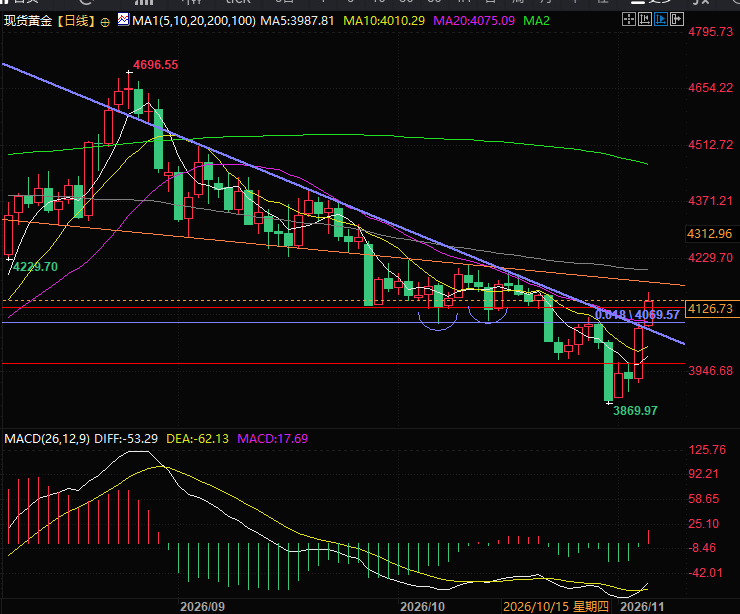 (Spot gold daily chart, source: EasyTrade) At 17:53 Beijing time, spot gold is currently trading at $4124 per ounce.
Elections Reshape Crude Oil Pricing Logic: Geopolitical Premiums Fall Rapidly, But Risks Remain Clear.
The election results first rewrote the geopolitical premium logic of the oil market. Democratic leaders in both the House and Senate stated their intention to push for an end to the war against Iran. Senate Majority Leader Schumer explicitly stated that Congress, with its power to allocate funds, could use this to restrain the president from launching wars without popular authorization, and that the war against Iran must end. House Majority Leader Jeffries also pointed out that the ongoing conflict with Iran continues to push up oil prices across the US, and that Trump's tariffs cost ordinary Americans thousands of dollars more each year, which he would simultaneously push for tariff removal. The market quickly priced in expectations of a de-escalation in the Middle East, and oil prices fell for four consecutive days, with the risk premium clearing rapidly. However, tail risks have not been eliminated: On November 5th local time, the UK's Office for Maritime Trade Operations reported that an oil tanker in the northern waters of Qatar was hit by two unidentified projectiles, resulting in damage to the vessel and uncertainty about the crew's condition. Physical disturbances in the Persian Gulf could still recur at any time. Goldman Sachs also warned that although the risk premium for oil prices has declined, there is still a possibility of a further tightening of Middle Eastern oil supply, and the premium could rebound at any time.The inflation narrative is being reassessed: the dual constraints of energy and tariffs are being eased.
Falling oil prices coupled with expectations of tariff reductions are reshaping the market's inflation narrative. Several key drivers of this round of inflation—energy premiums from the Iran conflict, increased import costs due to tariffs, and electricity demand driven by the expansion of AI computing power—are all experiencing marginal changes. While the Democrats cannot directly order the removal of tariffs or interfere in executive branch diplomacy, they hold leverage over funding and the debt ceiling. They can use a government shutdown and refusal to raise the debt ceiling as negotiating tools to force the White House to make concessions on tariffs and the Middle East conflict. The market is beginning to price in: the two major inflation drivers, energy and tariffs, are cooling marginally, the inflation inflection point is expected to arrive sooner, the necessity for the Federal Reserve to maintain high interest rates is decreasing, and expectations for easing are rising earlier. Meanwhile, the Democratic victories at the state and local levels are also introducing regulatory variables to AI and data center construction. Goldman Sachs analysts believe that the Democratic victories at the local level will significantly tighten regulations on AI and data centers, putting pressure on some utilities and independent power producers; however, institutions judge that the suspension of data center development will only be a short-term phenomenon and will not suppress computing power capital expenditure in the long term. This will also indirectly affect the inflation path: some market views previously held that AI would bring sustained deflationary benefits, and the Democratic Party's cautious attitude toward AI expansion will make the market more cautious about the judgment that "AI will quickly suppress inflation".The US dollar and US Treasury bonds weakened in tandem, leading to a strong rebound in gold prices.
This chain of macroeconomic expectations directly drove a strong rebound in gold prices. During Thursday's European session, spot gold surged to a two-week high, reaching a peak of $4146.63 per ounce, while spot gold rose 1.6% to $4124.89. December gold futures rose 1.5% to $4135.4 per ounce. The previous trading day saw gold prices jump 3.4%, the largest single-day gain since mid-August. One of the core drivers of the price increase was the weakening dollar and declining US Treasury yields: the dollar fell to a one-month low, and the 10-year US Treasury yield retreated to its lowest level since September 10th, significantly restoring the attractiveness of non-interest-bearing gold. Silver, platinum, and palladium also strengthened, with palladium rising by 2.2%.Institutional opinions are divided: there is considerable upside potential, but the constraints are clear.
Institutions have already provided their outlook on the future trend of gold prices. Analysts believe that gold prices stabilizing above the $4,000 mark is key to this rebound. If yields and capital flows continue to provide support, gold prices are expected to advance towards $4,200 and $4,400. Citi is even more optimistic, giving a target price of $4,500 within 0-3 months, provided that navigation in the Strait of Hormuz resumes and the conflict between Saudi Arabia and the Houthis de-escalates. However, ING warns that there are still obstacles to the short-term upward movement of gold prices. Inflation stickiness will continue to support expectations of tight monetary policy, and the market is highly tied to the situation in the Middle East and the direction of the energy market. Easing expectations do not equate to a complete resolution of the conflict, and geopolitical black swan events can disrupt the market at any time.Follow-up tracking: The game continues, and the non-farm payrolls report is the key short-term verification point.
The current market theme has shifted to "expectations first, awaiting verification." On one hand, the market is betting that Democratic checks and balances in Congress will end the Iran conflict, lower tariffs, and suppress energy inflation, thereby opening up room for the Federal Reserve to cut interest rates, which is beneficial to gold. On the other hand, the White House still retains veto power, and foreign policy and trade executive power remain concentrated in Trump's hands, so the tug-of-war between the two parties will continue. The most important verification point next is Friday's US non-farm payroll data, which will directly revise expectations for the Federal Reserve's monetary policy and determine whether this round of gold rebound can continue. Overall, the midterm elections have opened up a new trading logic for gold: it is no longer simply a safe-haven asset for Middle East conflicts, but has begun to trade the macro narrative of "the inflation inflection point arriving earlier and the interest rate decline cycle starting." However, continued vigilance is needed, as sudden attacks in the Middle East, a deadlock in the debt ceiling negotiations between the two parties, and a rebound in inflation data could all disrupt this pricing rhythm, and fluctuations in gold prices, such as impulsive pullbacks and rebounds, will continue. Technical Analysis: Spot gold broke through two key levels in one go: the 0.618 Fibonacci retracement level at 4070 and 4100, as well as the upper edge of the trading range. It also broke through the downtrend line. Currently, there is a significant need for a pullback to test the strength of the breakout and the degree of market acceptance. The immediate resistance level is the neckline of a head and shoulders pattern, while support is around 4070. If gold can hold above 4070, a bottom reversal pattern may emerge, potentially leading to an upward move towards 4250 or higher. (Spot gold daily chart, source: EasyTrade) At 17:53 Beijing time, spot gold is currently trading at $4124 per ounce.
- Risk Warning and Disclaimer
- The market involves risk, and trading may not be suitable for all investors. This article is for reference only and does not constitute personal investment advice, nor does it take into account certain users’ specific investment objectives, financial situation, or other needs. Any investment decisions made based on this information are at your own risk.