Waller signals hawkish interest rate hikes; gold prices surge then retreat.
2026-11-10 17:42:30
On Tuesday (November 10), during the Asian and European sessions, international gold prices experienced a volatile trading pattern, rising and then falling back. The market was driven by two main factors: on the one hand, the weakening of the White House's control over Congress and the easing of geopolitical tensions in the Middle East lowered the inflation ceiling, leading to a temporary rebound in gold prices; on the other hand, hawkish statements from Federal Reserve officials raised expectations of interest rate hikes again, limiting the upside potential of gold prices and intensifying the battle between bulls and bears. 
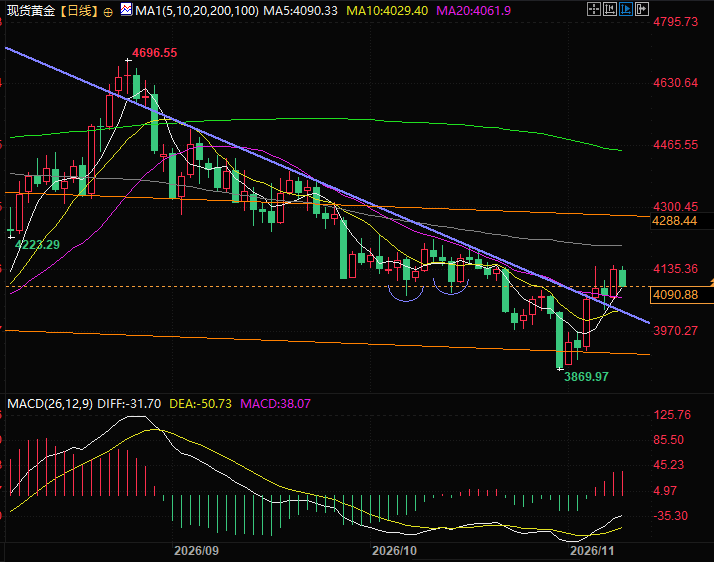 (Spot gold daily chart, source: EasyTrade) At 17:32 Beijing time, spot gold is currently trading at $4089 per ounce.
Easing geopolitical tensions boosted gold prices, but hawkish comments from the Federal Reserve caused prices to fall back.
Gold prices recently rebounded, primarily driven by the White House losing control of both houses of Congress. This weakened the Trump administration's foreign policy, reducing market expectations for a full-blown escalation of the US-Iran conflict and large-scale tariffs. The geopolitical tensions in the Middle East lowered the global inflation ceiling, attracting safe-haven funds and pushing up gold prices. However, the rebound failed to sustain. Federal Reserve Governor Waller released a clear hawkish signal, directly dampening bullish sentiment and causing gold prices to fall. In his speech in London, Waller stated that even though October's inflation data was slightly lower than September's, he still supported a 25 basis point rate hike in December. He also emphasized that if core CPI rose to 0.3% or higher, increasing the risk of inflation contagion, a 50 basis point rate hike should be considered to avoid damaging the Fed's credibility in combating inflation. This stance contrasts sharply with Fed Chairman Warsh's style of not providing interest rate guidance. Current interest rate futures pricing indicates an approximately 85% probability of a December rate hike to the 4.00%-4.25% range, and a more than 50% probability of another rate hike in March next year. As a non-interest-bearing asset, gold is directly suppressed by rising interest rate expectations and increasing real interest rates in the short term. The ongoing tensions between the US and Iran continue: rumors of Qatar mediating negotiations are frequently circulated, while Iran has repeatedly and strongly denied these claims; Trump is simultaneously signaling a de-escalation of the conflict while stating that US troops are on standby. Houthi attacks on Saudi facilities continue, and although shipping in the Strait of Hormuz has somewhat recovered, the safety risks to the waterway remain, resulting in a geopolitical situation of "long-term unresolved issues, with a decreased probability of short-term escalation."Lower oil prices ease pressure on global central banks to continue raising interest rates.
Expectations of easing tensions between the US and Iran dominated the downward trend in crude oil prices, leading to a rapid price correction. This directly alleviated inflationary pressures from energy consumption to consumer goods and reduced the necessity for continued interest rate hikes by global central banks. Although Goldman Sachs warned that shipping through the Strait of Hormuz remains fragile before a formal agreement is reached, maintaining its medium- to long-term high oil price target, the short-term geopolitical premium has quickly receded, temporarily easing the inflationary threat from the energy sector. In terms of shipping, Saudi tankers have resumed normal passage under US coordination, and October saw the highest LNG shipments through the Strait of Hormuz since the start of the conflict. This supply-side recovery further suppressed upward pressure on oil prices.Warning: Falling inflation amid high energy prices could be a precursor to recession.
The drag on the global real economy from energy shocks is gradually becoming apparent. A key dialectical risk exists here: if inflation levels in various countries continue to decline despite the previous surge in energy prices, it doesn't necessarily indicate victory in the fight against inflation; it could be a harbinger of rapidly shrinking end-user demand and an economic recession. RBC Capital previously warned of the potential risk of inflation spillover from rising commodity costs and high energy prices, but the current trading theme has shifted from "energy price increases forcing interest rate hikes" to "high energy costs eroding demand and fueling recession expectations." Waller also noted that while US GDP momentum weakened and household consumption slowed this quarter, and the labor market remained largely robust, high inflation remains a core policy focus.With the inflation cycle coming to an end, expectations of further easing have opened up room for gold to rise.
Once this round of anti-inflationary measures nears its end, stabilizing growth and introducing economic stimulus packages will likely become the policy priorities for many countries. If recessionary signals continue to materialize, monetary policy will shift, and expectations for looser liquidity will rise. As a non-interest-bearing safe-haven asset, gold will enjoy a more favorable pricing environment, and its rebound potential is expected to further expand.Summary and Technical Analysis
Waller actually began turning hawkish in May, sticking to his stance without much surprise to the market. The recent pullback in gold prices is largely due to profit-taking. Secondly, the US October CPI is about to be released. Deutsche Bank predicts a significant month-on-month decline in inflation, with the market consensus expecting a core CPI increase of 0.2%. This is the last key inflation reference before the Fed's next rate meeting. Due to last year's US government shutdown, this year's CPI will not release year-on-year data, making interpretation more difficult. This is also a core basis for Waller's assessment of the December rate hike. Additionally, the previous sharp correction in US stocks and the issues of stricter approval processes and excessive capital expenditures for AI companies will also lead to a decline in US GDP, limiting the Fed's aggressive rate hike plans. KBC also noted that lower energy prices and a recovery in risk appetite have led to a slight weakening of the dollar, while US Treasury yields remain volatile, awaiting CPI guidance. However, Waller has clearly turned hawkish since the beginning of the year. Finally, in the Middle East, US-Iran diplomatic statements, the opening of the Strait of Hormuz, and news of Houthi attacks could disrupt oil prices and inflation expectations, causing significant fluctuations in gold prices. Technical Analysis: Although gold prices have recently broken out and are facing a pullback, they remain in a bullish pattern. Pay attention to the support of the 5-day moving average and the key level of 4060, which is an important support level for this round of gold price movement. (Spot gold daily chart, source: EasyTrade) At 17:32 Beijing time, spot gold is currently trading at $4089 per ounce.
- Risk Warning and Disclaimer
- The market involves risk, and trading may not be suitable for all investors. This article is for reference only and does not constitute personal investment advice, nor does it take into account certain users’ specific investment objectives, financial situation, or other needs. Any investment decisions made based on this information are at your own risk.