Burnham's potential snap election and Brexit reversal speculation: ING releases its major forecast, providing a full analysis of the two major risks and opportunities for the pound.
2026-11-10 20:30:28
ING's latest report indicates that the Bank of England is expected to raise interest rates again in February next year, but will begin cutting rates before the end of 2027; inflation may rise to nearly 4.5%, mainly due to soaring energy bills. Meanwhile, Prime Minister Burnham may call an early election, or even a bold scenario of rejoining the EU customs union, all of which will significantly impact the GBP/USD interest rate spread and risk premium. Coupled with tonight's US October CPI data, the direction of the US dollar has become the biggest short-term variable. Forex traders need to closely monitor policy paths and political risks, and capitalize on the pound's volatility window. 
 Forex traders may consider interest rate differential trading: during the BoE's hawkish window, GBP still presents opportunities for swing trading against low-interest-rate currencies (such as the Japanese yen) or a relatively weak US dollar. However, caution is advised as the expectation of a rate cut in 2027 may be priced in prematurely, putting pressure on the pound in the medium to long term.
The Bank of England's path is clear: first increase, then decrease; interest rate differentials support the pound in the short term.
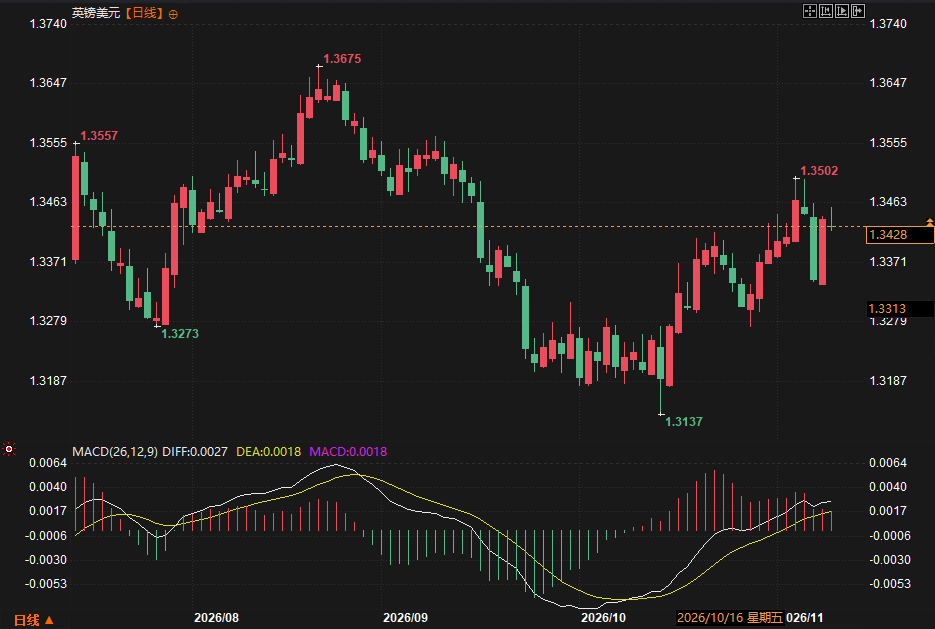
ING's baseline scenario clearly states that UK inflation will rise to nearly 4.5% in early 2027 and remain around 4% throughout the summer. Rising gas prices will increase household utility bills by about 30% by April, with energy alone contributing over 1 percentage point to inflation; food inflation is expected to reach 4-5%. The good news is that the labor market and wage growth remain moderate, with limited second-round effects, which allows the Bank of England to potentially ease restrictions in the summer and begin cutting interest rates in November. For GBPUSD traders, this means that short-term interest rate differentials remain favorable for the pound. The Bank of England raised interest rates to 4% last week, and the market expects another 25 basis point increase to 4.25% in February. Compared to the Fed's current range, the pound remains attractive. Currently, GBPUSD is fluctuating between 1.34 and 1.3450. Technically, it has held above the 100-day moving average, indicating further upside potential in the short term, with key resistance at 1.3500. If the US CPI is weak tonight and the dollar weakens, the pound may test this level; if the CPI is stronger than expected, it may retrace to the support level of 1.3400 or even 1.3370. Forex traders may consider interest rate differential trading: during the BoE's hawkish window, GBP still presents opportunities for swing trading against low-interest-rate currencies (such as the Japanese yen) or a relatively weak US dollar. However, caution is advised as the expectation of a rate cut in 2027 may be priced in prematurely, putting pressure on the pound in the medium to long term.Growth and fiscal pressures: Weak domestic demand limits the pound's upside potential
ING points out that UK growth faces a "tug-of-war between two forces." Data center investment and AI-related professional services continue to benefit from global demand, a positive factor; however, restrictive monetary policy, negative real wage growth, and tighter fiscal policy will drag down domestic demand, leading to a slowdown in growth in 2027. This means for the foreign exchange market that a significant one-sided rise in the pound is unlikely. Even with short-term interest rate hikes providing support, weak economic fundamentals will limit capital inflows. Attention should be paid to UK GDP and retail sales data; further deterioration in domestic demand could accelerate market pricing in interest rate cuts, putting downward pressure on the pound.Political risks escalate: snap elections and the "return to the EU" scenario
ING's risk scenarios warrant close attention from forex traders. Prime Minister Burnham's promise of a "10-year plan for the UK" seems contradictory to the 2029 general election deadline. Many major reforms (social care, nationalization) require a new five-year term to proceed, increasing the likelihood of an early election: spending reviews have been postponed until next year, while Burnham's push for closer ties with the EU is interpreted as an attempt to win over center-left voters. Right-wing divisions coupled with rising Labour poll numbers offer a narrow window of opportunity, but it's a huge gamble. The market is most likely to dislike this scenario—it would bring the issue of long-term borrowing needs to the forefront, while UK public finances currently only "look okay." Early elections typically lead to increased volatility, and GBPUSD could experience a rapid gap or widen intraday fluctuations. A bolder scenario is that the UK agrees to rejoin the EU customs union. While Brexit is unpopular, a full rejoining remains a distant prospect. If an early election becomes a de facto referendum on European relations, a landslide victory for Labour followed by Burnham's swift action, coupled with populism and geopolitical instability providing an opportunity for EU leaders, could trigger customs union negotiations. This would significantly reduce trade barriers and, coupled with regulatory alignment, allow the UK to be economically closer to the EU by the end of 2027 than it is now. ING believes that if this happens, it will almost certainly be welcomed by a stronger pound. For traders, political risk is a double-edged sword: short-term uncertainty weighs on the pound, but a closer EU relationship in the medium to long term would benefit the GBP. It is recommended to pay attention to relevant polls, government statements, and EU responses, and use options or narrowed stop-loss orders to manage tail risk if necessary.Tonight's CPI and Overall Strategy: The direction of the US dollar will determine the short-term fate of the British pound.
Tonight's US October CPI is the main focus. The market expects a month-on-month slowdown, but the core data remains a key concern. If the data is weak, the dollar will be under pressure, benefiting non-US currencies such as GBPUSD and EURUSD; if it is strong, it will strengthen expectations of a Fed rate hike in December, putting downward pressure on the pound. Combined with the sharp drop in oil prices due to progress in US-Iran negotiations, overall inflation expectations are cooling, and risk appetite is rising, which is beneficial for high-yield currencies in the short term.- Risk Warning and Disclaimer
- The market involves risk, and trading may not be suitable for all investors. This article is for reference only and does not constitute personal investment advice, nor does it take into account certain users’ specific investment objectives, financial situation, or other needs. Any investment decisions made based on this information are at your own risk.