Production exceeded expectations; have the UK's Q3 data been fully reflected in the GBP/USD exchange rate?
2026-11-12 16:40:28
On Thursday, November 12th, the UK Office for National Statistics released monthly GDP figures for September and preliminary data for the third quarter. Month-on-month growth was 0.2%, higher than the market expectation of 0.0%, while August's figure was revised down from 0.1% to flat. Third-quarter growth was 0.7% quarter-on-quarter, in line with expectations, accelerating from 0.5% in the second quarter, with a year-on-year increase of 1.9%. The pound traded in a narrow range against the dollar around 1.3260 that day, down slightly by about 0.1% from the previous trading day. Market pricing for a December rate hike by the Bank of England remained in the 71% to 74% range. The ongoing conflict in the Middle East continues to push up energy prices, and after the Bank of England raised its benchmark interest rate by 25 basis points to 4.00% on November 5th, the inflation outlook remains a core constraint on policy. 
Third-quarter growth resilience and better-than-expected monthly performance
The UK's real GDP expanded by 0.7% quarter-on-quarter in the third quarter, marking the ninth consecutive three-month period of positive growth, indicating that economic activity remained relatively resilient despite rising energy costs. Data from the Office for National Statistics showed that the service sector was the main driver, contributing approximately 0.77 percentage points month-on-month, while the production sector contributed 0.01 percentage points, and the construction sector dragged down the growth by 0.04 percentage points. On a monthly basis, overall output increased by 0.2% in September, with growth in the service, production, and construction sectors. The construction sector saw a 0.8% month-on-month increase, partially offsetting the negative contribution from the quarter. The August data was revised down to flat, reflecting routine revisions in the statistical process, but did not change the overall trend of the third quarter meeting expectations. This result is broadly consistent with the Bank of England's previous assessment of the growth path, providing policymakers with a relatively stable economic backdrop, allowing them to focus more on the return to the inflation target.Service sector-led growth and production recovery
The UK services sector grew 0.2% month-on-month in September, exceeding expectations. Nine out of 14 sub-sectors recorded positive growth, with real estate activity contributing the most, rising 0.4% month-on-month, followed by transport and warehousing, which rose 1.4%. Information and communication technology (ICT) and professional scientific and technical services continued to expand, with AI-related activities such as computer programming repeatedly contributing significantly to the sector's growth throughout the year. The production sector grew 0.3% month-on-month in September, with manufacturing showing a significant increase of 0.7%, significantly better than the expected negative growth. Sub-sectors such as computer, electronic, and optical products, and machinery and equipment performed particularly well. On a quarterly basis, the services sector expanded 0.9% month-on-month, the production sector saw a slight increase of 0.1%, while construction declined by 0.7% due to new construction projects. The overall structure shows that demand was led by the services sector, while supply-side production activity saw a temporary rebound in September. However, the quarterly weakness in the construction sector still highlights the uneven distribution of investment across related sectors.Bank of England's policy space and inflation constraints
The Bank of England raised its benchmark interest rate by 25 basis points to 4.00% on November 5th by a vote of 8 to 1, with committee member Catherine Mann advocating for a 50 basis point hike. Governor Andrew Bailey stated in the policy statement that this increase is unlikely to be the last in this round if the Middle East conflict fails to ease, while emphasizing that it should not be seen as the beginning of an inevitable long-term rate hike sequence. The latest Monetary Policy Report raised its Consumer Price Index (CPI) inflation forecast to around 4.9% by mid-2027, primarily driven by the direct effects of energy prices; the CPI rose to 3.5% year-on-year in September. Market pricing through overnight index swaps indicates a 71% to 74% probability of a 25 basis point rate hike at the December 17th meeting. The resilience of growth data has reduced pressure on policymakers to postpone tightening due to economic downturns, but the energy-driven inflation path still requires policy to remain restrained until there is evidence that secondary effects are under control. Bailey previously stated that if the conflict continues to push up energy prices, the necessity for further rate hikes will increase, a statement consistent with current market pricing.GBP/USD Market Overview
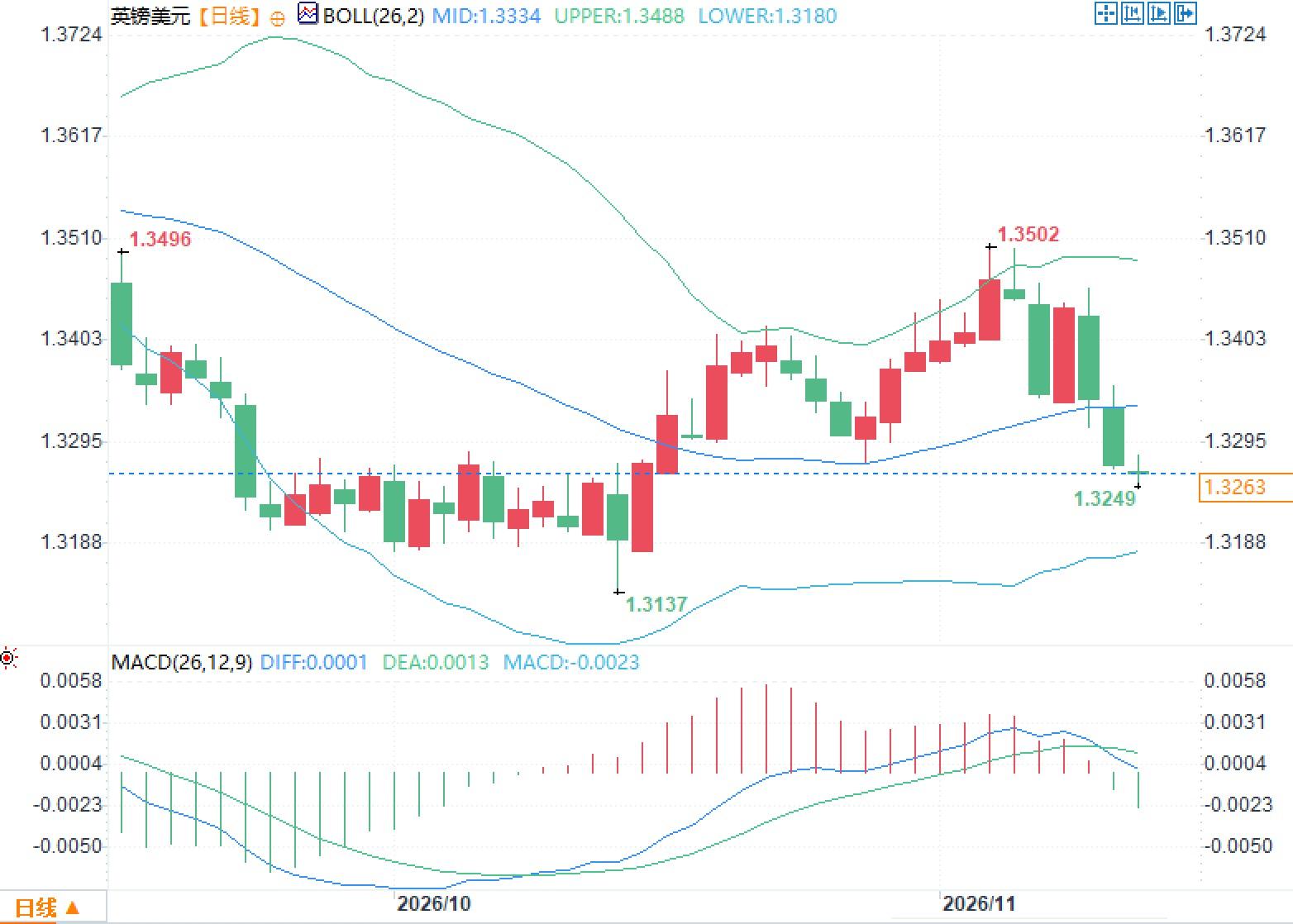
The daily chart shows that the GBP/USD price is below the Bollinger Band middle line at 1.3334, with the upper band at 1.3488 and the lower band at 1.3180. The current level is around 1.3260, in the area between the middle and lower bands. The price recently retreated after reaching a high near 1.3502, touching a low of 1.3137 near the marked low. Regarding the MACD indicator, the DIFF value is 0.0001, the DEA value is 0.0013, and the histogram is negative 0.0023. The fast and slow lines converged near the zero line and then slightly crossed downwards. The price did not deviate significantly after the data release, reflecting that the market has already priced in the third-quarter growth meeting expectations.Frequently Asked Questions
Question 1: Does the better-than-expected September GDP growth change the Bank of England's policy path in December? Answer: The 0.2% month-on-month growth was better than expected, with contributions from both the service and production sectors. However, the overall third-quarter figures remained in line with expectations, and the Bank of England had already taken growth resilience into account. The current policy focus remains on inflation; the prospect of rising energy prices keeps interest rate hike pricing high. Growth data is more about reducing than increasing the room for policy shift. Question 2: What is the significance of the contribution of AI-related activities to service sector growth? Answer: Sub-sectors such as information and communication technology and computer programming continued to expand, becoming an important part of the 0.9% month-on-month growth in the service sector over three months. This type of activity supports overall output, but its share is relatively limited and has not changed the policy framework centered on energy-driven inflation. The Bank of England still emphasizes the need to observe whether secondary effects spread.- Risk Warning and Disclaimer
- The market involves risk, and trading may not be suitable for all investors. This article is for reference only and does not constitute personal investment advice, nor does it take into account certain users’ specific investment objectives, financial situation, or other needs. Any investment decisions made based on this information are at your own risk.